

6. Wave Run-up and Overtopping
187
from shore. Hence, the run-up estimation is uncertain with such variations
in the beach slope. Steeper beaches are wave-reflecting, while, shallowersloping beaches are wave-dissipating.
According to Stockdon et al. [2006], wave run-up involves two parts,
viz., wave setup which is a mean water surface élévation averaged over time
and swash. Hence, wave run-up équation incorporating swash, S, which is
the change of water-land boundary about the MSL is shown below.
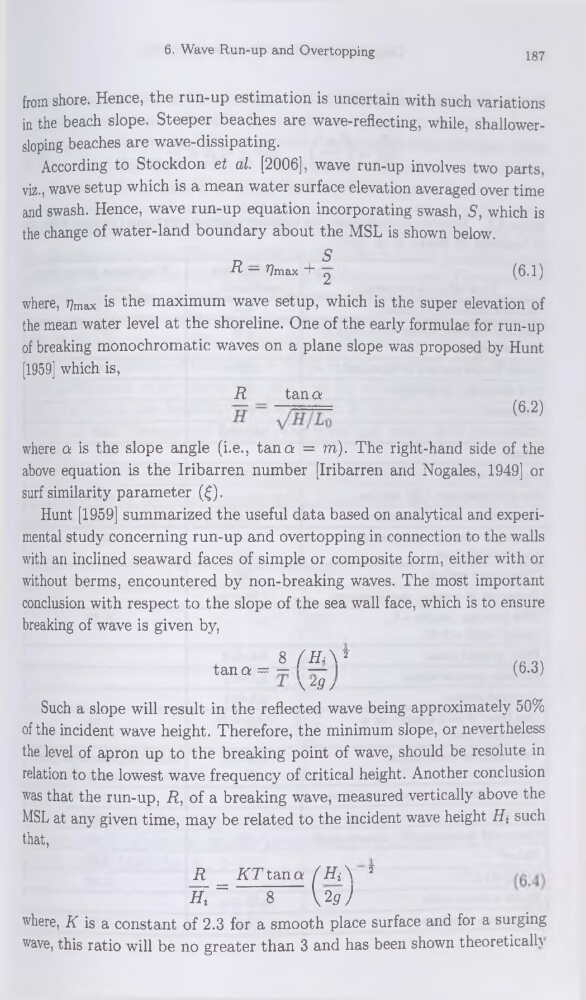
n
S
R — î?max + 2
(6.1)
where, r/max is the maximum wave setup, which is the super élévation of
the mean water level at the shoreline. One of the early formulae for run-up
of breaking monochromatic waves on a plane slope was proposed by Hunt
[1959] which is,
R
tan a
(6-2)
where a is the slope angle (i.e., tan a = m). The right-hand side of the
above équation is the Iribarren number [Iribarren and Nogales, 1949] or
surf similarity parameter (£).
Hunt [1959] summarized the useful data based on analytical and experimental study concerning run-up and overtopping in connection to the walls
with an inclined seaward faces of simple or composite form, either with or
without berms, encountered by non-breaking waves. The most important
conclusion with respect to the slope of the sea wall face, which is to ensure
breaking of wave is given by,
8 f HA 2
tana= — —
(6.3)
\ z9 /
Such a slope will resuit in the reflected wave being approximately 50%
ofthe incident wave height. Therefore, the minimum slope, or nevertheless
the level of apron up to the breaking point of wave, should be resolute in
relation to the lowest wave frequency of critical height. Another conclusion
was that the run-up, R^ of a breaking wave, measured vertically above the
MSL at any given time, may be related to the incident wave height Hi such
that,
R
KTtàna ( Hi\ 2
Hi =
8
V 2g)
where, K is a constant of 2.3 for a smooth place surface and for a surging
wave, this ratio will be no greater than 3 and has been shown theoreticalh
187
from shore. Hence, the run-up estimation is uncertain with such variations
in the beach slope. Steeper beaches are wave-reflecting, while, shallowersloping beaches are wave-dissipating.
According to Stockdon et al. [2006], wave run-up involves two parts,
viz., wave setup which is a mean water surface élévation averaged over time
and swash. Hence, wave run-up équation incorporating swash, S, which is
the change of water-land boundary about the MSL is shown below.
n
S
R — î?max + 2
(6.1)
where, r/max is the maximum wave setup, which is the super élévation of
the mean water level at the shoreline. One of the early formulae for run-up
of breaking monochromatic waves on a plane slope was proposed by Hunt
[1959] which is,
R
tan a
(6-2)
where a is the slope angle (i.e., tan a = m). The right-hand side of the
above équation is the Iribarren number [Iribarren and Nogales, 1949] or
surf similarity parameter (£).
Hunt [1959] summarized the useful data based on analytical and experimental study concerning run-up and overtopping in connection to the walls
with an inclined seaward faces of simple or composite form, either with or
without berms, encountered by non-breaking waves. The most important
conclusion with respect to the slope of the sea wall face, which is to ensure
breaking of wave is given by,
8 f HA 2
tana= — —
(6.3)
\ z9 /
Such a slope will resuit in the reflected wave being approximately 50%
ofthe incident wave height. Therefore, the minimum slope, or nevertheless
the level of apron up to the breaking point of wave, should be resolute in
relation to the lowest wave frequency of critical height. Another conclusion
was that the run-up, R^ of a breaking wave, measured vertically above the
MSL at any given time, may be related to the incident wave height Hi such
that,
R
KTtàna ( Hi\ 2
Hi =
8
V 2g)
where, K is a constant of 2.3 for a smooth place surface and for a surging
wave, this ratio will be no greater than 3 and has been shown theoreticalh