

186
Coastal Engineering: Theory and Practice
océan waves are stochastic in nature, a mathematical expression for these
two factors are not possible. Hence, the wave run-up and overtopping for
Coastal structures are established based on the experimental investigations.
6.2 Wave Run-up
6.2.1 General
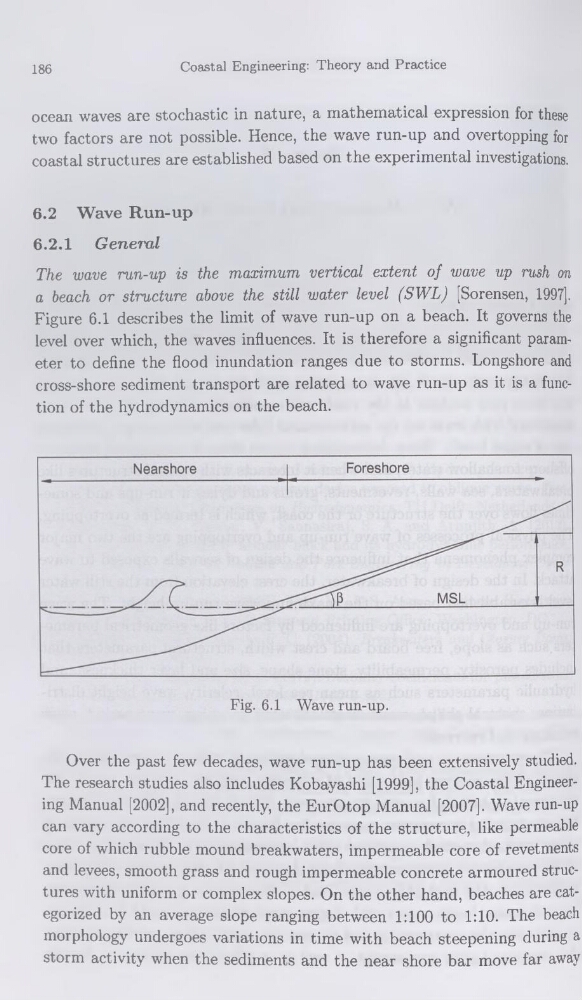
The wave run-up is the maximum vertical extent of wave up rush on
a beach or structure above the still water level (SWL) [Sorensen, 1997].
Figure 6.1 describes the lirait of wave run-up on a beach. It governs the
level over which, the waves influences. It is therefore a significant parameter to define the flood inundation ranges due to storms. Longshore and
cross-shore sédiment transport are related to wave run-up as it is a fonction of the hydrodynamics on the beach.
Over the past few décades, wave run-up has been extensively studied.
The research studies also includes Kobayashi [1999], the Coastal Engineering Manual [2002], and recently, the EurOtop Manual [2007]. Wave run-up
can vary according to the characteristics of the structure, like permeable
core of which rubble mound breakwaters, imperméable core of revetments
and levees, smooth grass and rough imperméable concrète armoured structures with uniform or complex slopes. On the other hand, beaches are categorized by an average slope ranging between 1:100 to 1:10. The beach
morphology undergoes variations in time with beach steepening during a
storm activity when the sédiments and the near shore bar move far away
Coastal Engineering: Theory and Practice
océan waves are stochastic in nature, a mathematical expression for these
two factors are not possible. Hence, the wave run-up and overtopping for
Coastal structures are established based on the experimental investigations.
6.2 Wave Run-up
6.2.1 General
The wave run-up is the maximum vertical extent of wave up rush on
a beach or structure above the still water level (SWL) [Sorensen, 1997].
Figure 6.1 describes the lirait of wave run-up on a beach. It governs the
level over which, the waves influences. It is therefore a significant parameter to define the flood inundation ranges due to storms. Longshore and
cross-shore sédiment transport are related to wave run-up as it is a fonction of the hydrodynamics on the beach.
Over the past few décades, wave run-up has been extensively studied.
The research studies also includes Kobayashi [1999], the Coastal Engineering Manual [2002], and recently, the EurOtop Manual [2007]. Wave run-up
can vary according to the characteristics of the structure, like permeable
core of which rubble mound breakwaters, imperméable core of revetments
and levees, smooth grass and rough imperméable concrète armoured structures with uniform or complex slopes. On the other hand, beaches are categorized by an average slope ranging between 1:100 to 1:10. The beach
morphology undergoes variations in time with beach steepening during a
storm activity when the sédiments and the near shore bar move far away