

5. Rubble Mound Structures
175
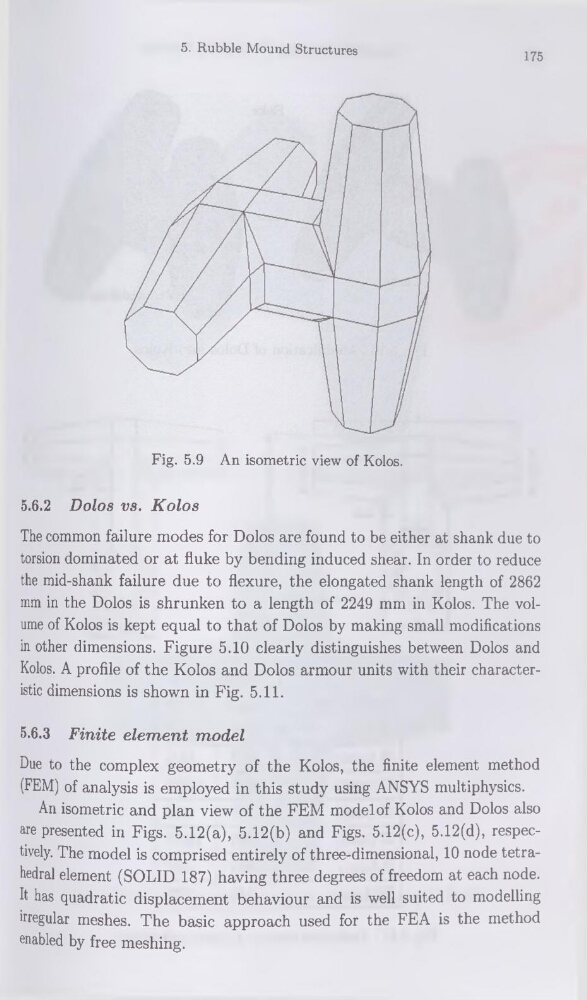
Fig. 5.9 An isométrie view of Kolos.
5.6.2
Dolos vs. Kolos
The common failure modes for Dolos are found to be either at shank due to
torsion dominated or at fluke by bending induced shear. In order to reduce
the mid-shank failure due to flexure, the elongated shank length of 2862
mm in the Dolos is shrunken to a length of 2249 mm in Kolos. The volume of Kolos is kept equal to that of Dolos by making small modifications
in other dimensions. Figure 5.10 clearly distinguishes between Dolos and
Kolos. A profile of the Kolos and Dolos armour units with their characteristic dimensions is shown in Fig. 5.11.
5.6.3
Finite element model
Due to the complex geometry of the Kolos, the finite element method
(FEM) of analysis is employed in this study using ANSYS multiphysics.
An isométrie and plan view of the FEM modelof Kolos and Dolos also
are presented in Figs. 5.12(a), 5.12(b) and Figs. 5.12(c), 5.12(d), respectively. The model is comprised entirely of three-dimensional, 10 node tetrahedral element (SOLID 187) having three degrees of freedom at each node.
It has quadratic displacement behaviour and is well suited to modelling
hregular meshes. The basic approach used for the FEA is the method
enabled by free meshing.
175
Fig. 5.9 An isométrie view of Kolos.
5.6.2
Dolos vs. Kolos
The common failure modes for Dolos are found to be either at shank due to
torsion dominated or at fluke by bending induced shear. In order to reduce
the mid-shank failure due to flexure, the elongated shank length of 2862
mm in the Dolos is shrunken to a length of 2249 mm in Kolos. The volume of Kolos is kept equal to that of Dolos by making small modifications
in other dimensions. Figure 5.10 clearly distinguishes between Dolos and
Kolos. A profile of the Kolos and Dolos armour units with their characteristic dimensions is shown in Fig. 5.11.
5.6.3
Finite element model
Due to the complex geometry of the Kolos, the finite element method
(FEM) of analysis is employed in this study using ANSYS multiphysics.
An isométrie and plan view of the FEM modelof Kolos and Dolos also
are presented in Figs. 5.12(a), 5.12(b) and Figs. 5.12(c), 5.12(d), respectively. The model is comprised entirely of three-dimensional, 10 node tetrahedral element (SOLID 187) having three degrees of freedom at each node.
It has quadratic displacement behaviour and is well suited to modelling
hregular meshes. The basic approach used for the FEA is the method
enabled by free meshing.