

1. Introduction
3
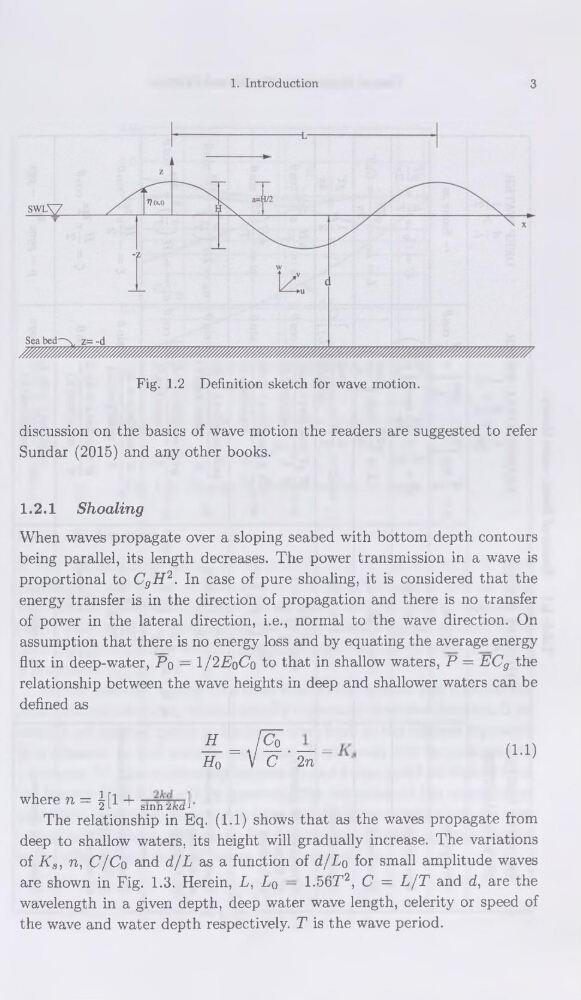
Fig. 1.2 Définition sketch for wave motion.
discussion on the basics of wave motion the readers are suggested to refer
Sundar (2015) and any other books.
1.2.1 Shoaling
When waves propagate over a sloping seabed with bottom depth contours
being parallel, its length decreases. The power transmission in a wave is
proportional to CgH2. In case of pure shoaling, it is considered that the
energy transfer is in the direction of propagation and there is no transfer
of power in the latéral direction, i.e., normal to the wave direction. On
assumption that there is no energy loss and by equating the average energy
flux in deep-water, Pq — 1/2EqCq to that in shallow waters, P = ECg the
relationship between the wave heights in deep and shallower waters can be
defined as
Æ= M — =
Ho
V C ’ 2n
(1-1)
where n = |[1 +
2 l
sinn ZKaJ
The relationship in Eq. (1.1) shows that as the waves propagate from
deep to shallow waters, its height will gradually increase. The variations
of Ka, n, C/Co and d/L as a function of d/L0 for small amplitude waves
are shown in Fig. 1.3. Herein, L, Lq — 1.56T2, C = L/T and d, are the
wavelength in a given depth, deep water wave length, celerity or speed of
the wave and water depth respectively. T is the wave period.
3
Fig. 1.2 Définition sketch for wave motion.
discussion on the basics of wave motion the readers are suggested to refer
Sundar (2015) and any other books.
1.2.1 Shoaling
When waves propagate over a sloping seabed with bottom depth contours
being parallel, its length decreases. The power transmission in a wave is
proportional to CgH2. In case of pure shoaling, it is considered that the
energy transfer is in the direction of propagation and there is no transfer
of power in the latéral direction, i.e., normal to the wave direction. On
assumption that there is no energy loss and by equating the average energy
flux in deep-water, Pq — 1/2EqCq to that in shallow waters, P = ECg the
relationship between the wave heights in deep and shallower waters can be
defined as
Æ= M — =
Ho
V C ’ 2n
(1-1)
where n = |[1 +
2 l
sinn ZKaJ
The relationship in Eq. (1.1) shows that as the waves propagate from
deep to shallow waters, its height will gradually increase. The variations
of Ka, n, C/Co and d/L as a function of d/L0 for small amplitude waves
are shown in Fig. 1.3. Herein, L, Lq — 1.56T2, C = L/T and d, are the
wavelength in a given depth, deep water wave length, celerity or speed of
the wave and water depth respectively. T is the wave period.