

2
Coastal Engineering: Theory and Practice
Coastal Area
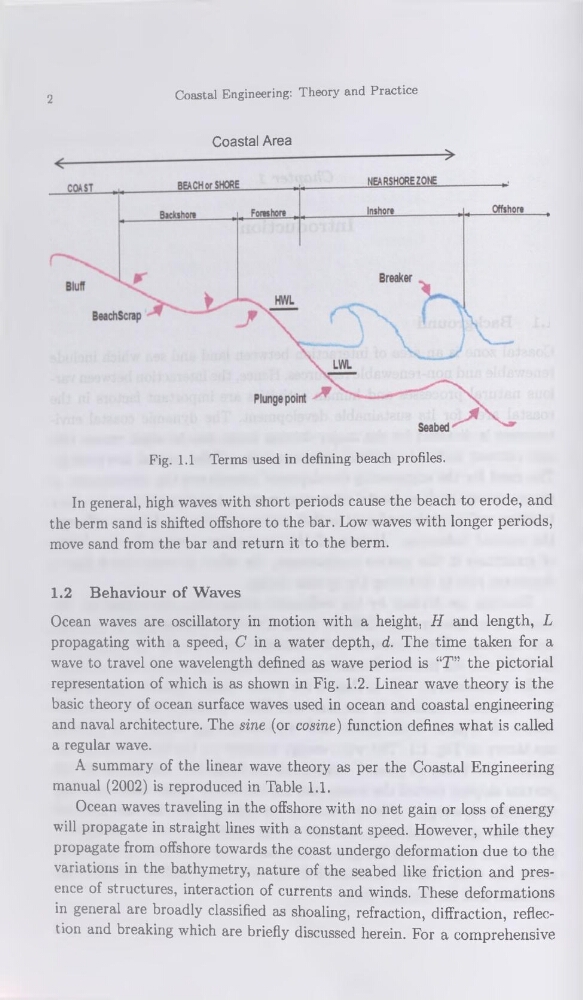
Fig. 1.1 Terms used in defining beach profiles.
In general, high waves with short periods cause the beach to erode, and
the berm sand is shifted offshore to the bar. Low waves with longer periods,
move sand from the bar and return it to the berm.
1.2 Behaviour of Waves
Océan waves are oscillatory in motion with a height, H and length, L
propagating with a speed, C in a water depth, d. The time taken for a
wave to travel one wavelength defined as wave period is “T” the pictorial
représentation of which is as shown in Fig. 1.2. Linear wave theory is the
basic theory of océan surface waves used in océan and Coastal engineering
and naval architecture. The sine (or cosine) function defines what is called
a régulât wave.
A summary of the linear wave theory as per the Coastal Engineering
manual (2002) is reproduced in Table 1.1.
Océan waves traveling in the offshore with no net gain or loss of energy
will propagate in straight lines with a constant speed. However, while they
propagate from offshore towards the coast undergo deformation due to the
variations in the bathymetry, nature of the seabed like friction and présence of structures, interaction of currents and winds. These deformations
in general are broadly classified as shoaling, refraction, diffraction, reflection and breaking which are briefly discussed herein. For a comprehensive
Coastal Engineering: Theory and Practice
Coastal Area
Fig. 1.1 Terms used in defining beach profiles.
In general, high waves with short periods cause the beach to erode, and
the berm sand is shifted offshore to the bar. Low waves with longer periods,
move sand from the bar and return it to the berm.
1.2 Behaviour of Waves
Océan waves are oscillatory in motion with a height, H and length, L
propagating with a speed, C in a water depth, d. The time taken for a
wave to travel one wavelength defined as wave period is “T” the pictorial
représentation of which is as shown in Fig. 1.2. Linear wave theory is the
basic theory of océan surface waves used in océan and Coastal engineering
and naval architecture. The sine (or cosine) function defines what is called
a régulât wave.
A summary of the linear wave theory as per the Coastal Engineering
manual (2002) is reproduced in Table 1.1.
Océan waves traveling in the offshore with no net gain or loss of energy
will propagate in straight lines with a constant speed. However, while they
propagate from offshore towards the coast undergo deformation due to the
variations in the bathymetry, nature of the seabed like friction and présence of structures, interaction of currents and winds. These deformations
in general are broadly classified as shoaling, refraction, diffraction, reflection and breaking which are briefly discussed herein. For a comprehensive