

5. Rubble Mound Structures
161
• Type C called composite breakwater consisting of a vertical breakwater,
placed on a foundation with slopes on both sides, in which case, the waves
are reflected at high water, but break at low water.
The large majority of sloping breakwaters consists of rock and/or concrète blocks, the widely used name is rubble-mound breakwater. In deeper
waters, they usually hâve a concrète superstructure (limits the overtopping
at minimum cost, access for traffic, other needs), in shallow water they
rarely hâve a real superstructure.
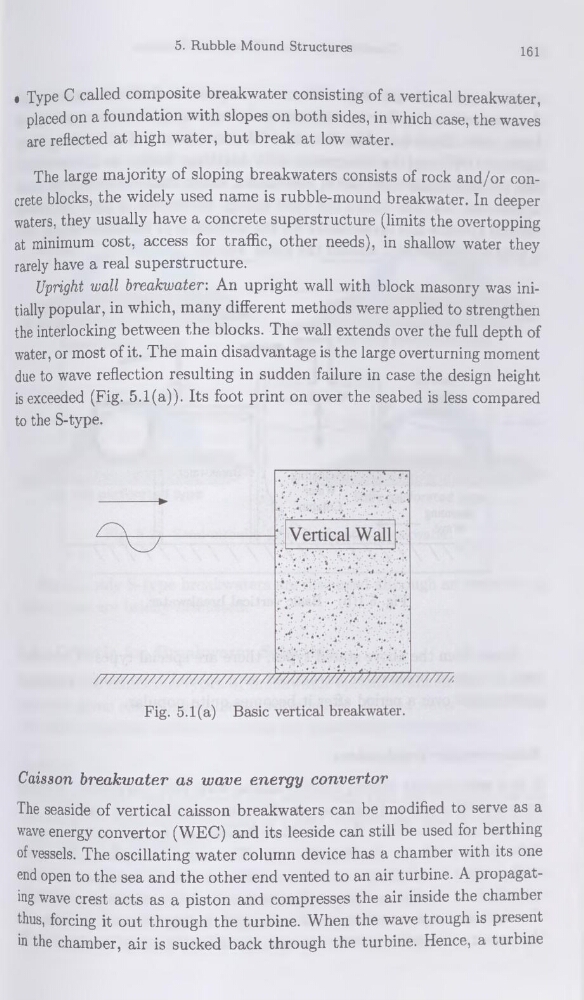
Upright wall breakwater: An upright wall with block masonry was initially popular, in which, many different methods were applied to strengthen
the interlocking between the blocks. The wall extends over the full depth of
water, or most of it. The main disadvantage is the large overturning moment
due to wave reflection resulting in sudden failure in case the design height
is exceeded (Fig. 5.1 (a)). Its foot print on over the seabed is less compared
to the S-type.
Caisson breakwater as wave energy convertor
The seaside of vertical caisson breakwaters can be modified to serve as a
wave energy convertor (WEC) and its leeside can still be used for berthing
of vessels. The oscillating water column device has a chamber with its one
end open to the sea and the other end vented to an air turbine. A propagating wave crest acts as a piston and compresses the air inside the chamber
thus, forcing it out through the turbine. When the wave trough is présent
in the chamber, air is sucked back through the turbine. Hence, a turbine
161
• Type C called composite breakwater consisting of a vertical breakwater,
placed on a foundation with slopes on both sides, in which case, the waves
are reflected at high water, but break at low water.
The large majority of sloping breakwaters consists of rock and/or concrète blocks, the widely used name is rubble-mound breakwater. In deeper
waters, they usually hâve a concrète superstructure (limits the overtopping
at minimum cost, access for traffic, other needs), in shallow water they
rarely hâve a real superstructure.
Upright wall breakwater: An upright wall with block masonry was initially popular, in which, many different methods were applied to strengthen
the interlocking between the blocks. The wall extends over the full depth of
water, or most of it. The main disadvantage is the large overturning moment
due to wave reflection resulting in sudden failure in case the design height
is exceeded (Fig. 5.1 (a)). Its foot print on over the seabed is less compared
to the S-type.
Caisson breakwater as wave energy convertor
The seaside of vertical caisson breakwaters can be modified to serve as a
wave energy convertor (WEC) and its leeside can still be used for berthing
of vessels. The oscillating water column device has a chamber with its one
end open to the sea and the other end vented to an air turbine. A propagating wave crest acts as a piston and compresses the air inside the chamber
thus, forcing it out through the turbine. When the wave trough is présent
in the chamber, air is sucked back through the turbine. Hence, a turbine