

146
Coastal Engineering: Theory and Practice
On the other hand, if the ratio of M/Q is less than 7, the discharge
from the inlet flushes away the bar.
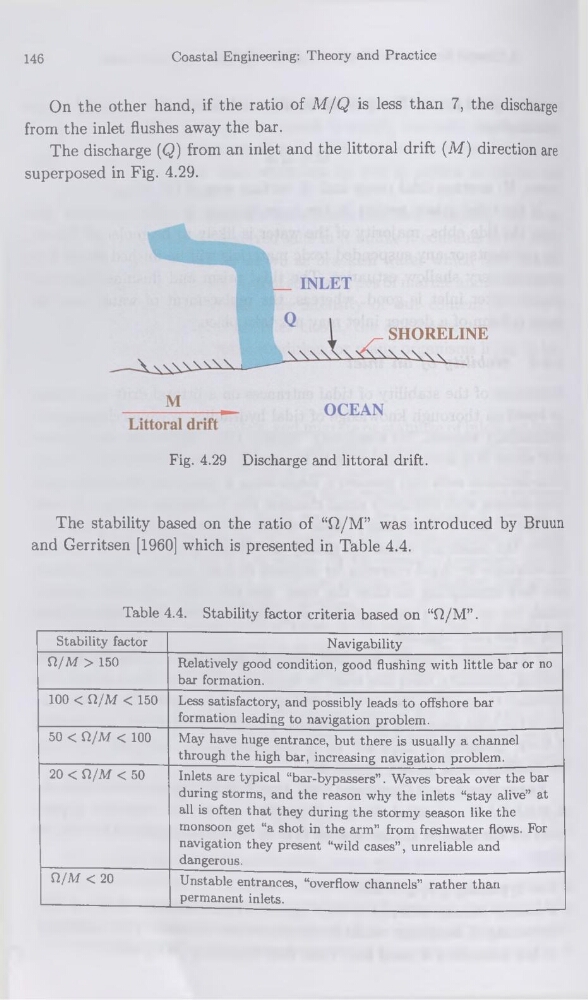
The discharge (Q) from an inlet and the littoral drift (M) direction are
superposed in Fig. 4.29.
Fig. 4.29 Discharge and littoral drift.
The stability based on the ratio of “Q/M” was introduced by Bruun
and Gerritsen [1960] which is presented in Table 4.4.
Table 4.4. Stability factor criteria based on “Q/M”.
Stability factor
Navigability
Q/M > 150
Relatively good condition, good flushing with little bar or no
bar formation.
100 < Q/M < 150 Less satisfactory, and possibly leads to offshore bar
formation leading to navigation problem.
50 < Q/M < 100
May hâve huge entrance, but there is usually a channel
through the high bar, increasing navigation problem.
20 < Q/M < 50
Inlets are typical “bar-bypassers”. Waves break over the bar
during storms, and the reason why the inlets “stay alive” at
ail is often that they during the stormy season like the
monsoon get “a shot in the arm” from freshwater flows. For
navigation they présent “wild cases”, unreliable and
dangerous.
Q/M < 20
Unstable entrances, “overflow channels” rather than
permanent inlets.
Coastal Engineering: Theory and Practice
On the other hand, if the ratio of M/Q is less than 7, the discharge
from the inlet flushes away the bar.
The discharge (Q) from an inlet and the littoral drift (M) direction are
superposed in Fig. 4.29.
Fig. 4.29 Discharge and littoral drift.
The stability based on the ratio of “Q/M” was introduced by Bruun
and Gerritsen [1960] which is presented in Table 4.4.
Table 4.4. Stability factor criteria based on “Q/M”.
Stability factor
Navigability
Q/M > 150
Relatively good condition, good flushing with little bar or no
bar formation.
100 < Q/M < 150 Less satisfactory, and possibly leads to offshore bar
formation leading to navigation problem.
50 < Q/M < 100
May hâve huge entrance, but there is usually a channel
through the high bar, increasing navigation problem.
20 < Q/M < 50
Inlets are typical “bar-bypassers”. Waves break over the bar
during storms, and the reason why the inlets “stay alive” at
ail is often that they during the stormy season like the
monsoon get “a shot in the arm” from freshwater flows. For
navigation they présent “wild cases”, unreliable and
dangerous.
Q/M < 20
Unstable entrances, “overflow channels” rather than
permanent inlets.