

144
Coastal Engineering: Theory and Practice
helps the inlet to be open. During a storm surge, it causes a huge amount
of water into a bay than what it is used to supply normally during a tidal
cycle. When this huge amount of water falls back to the océan it spills over
the barrier island as the risen water has no way of means to retreat and
thus it results to an inlet.
For several reasons inlets are quite important but complex. The water
inside a bay contains less dissolved salts in it unlike it contains in the océan
water. This kind of water is known as brackish water which falls between
fresh and sait water. The survival of several types of marine animais dépends
on such brackish water inlets. The intensity of sait content in a bay is
controlled by the inlets. If an inlet closes, the sait content in the water
decreases resulting inhabitable condition for many organisms living in bay.
4.8.2 Tidal flushing
The opening and closing of inlets, and migrate or stabilize of inlets are based
on the rate of changes in littoral drift, sédiment transport through the inlet,
tidal range and flushing, wave climate and also dredging. Variations in an
inlet can be seen at different time scales, short term changes can be observed
in hours during severe storm events and long term changes in décades or
even centuries. As the velocity of current is low at the entrance of inlets,
sand particle tend to deposit as shoals. At the seaward boundary outside
the inlet, the ebb-tidal deltas occur and deform or withdraw due to the
interaction of incoming waves and ebb tides.
The systematic replacement of water in an inlet or bay or estuary as
a resuit of tidal flow is referred to as tidal flushing. The flushing time is
defined as the time needed to drain a volume V of water through an outlet
A with current velocity U. The flushing time, tp of an inlet can be defined
as the time taken to replace its freshwater volume Vp at the rate of the
net flow through the inlet, which is given by the river discharge rate Q.
Maximum flushing occurs at spring tides and sometimes during spécial
“monsoon”-periods like in India.
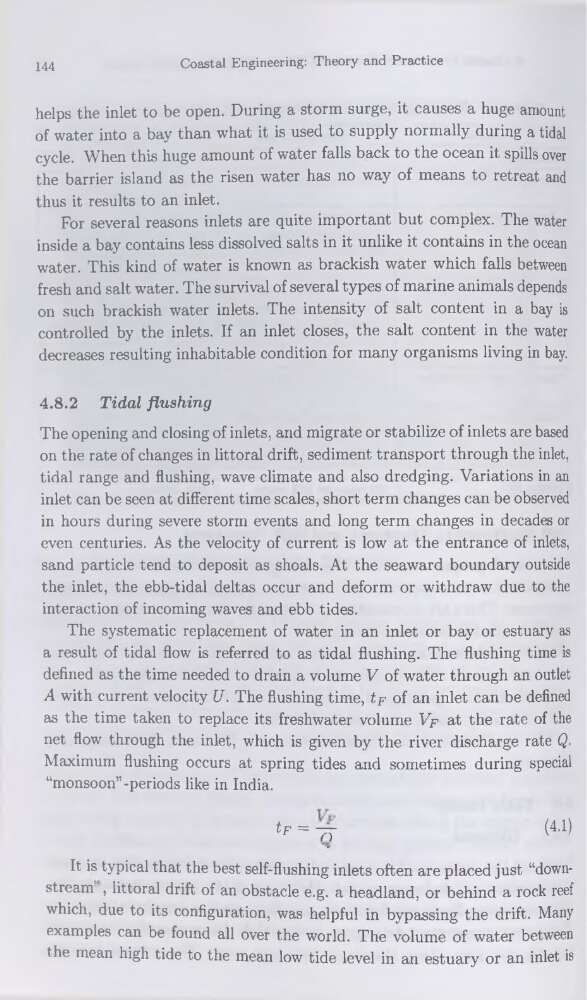
iF = 77
(4-1)
It is typical that the best self-flushing inlets often are placed just “downstream , littoral drift of an obstacle e.g. a headland, or behind a rock reef
which, due to its configuration, was helpful in bypassing the drift. Many
examples can be found ail over the world. The volume of water between
the mean high tide to the mean low tide level in an estuary or an inlet is
Coastal Engineering: Theory and Practice
helps the inlet to be open. During a storm surge, it causes a huge amount
of water into a bay than what it is used to supply normally during a tidal
cycle. When this huge amount of water falls back to the océan it spills over
the barrier island as the risen water has no way of means to retreat and
thus it results to an inlet.
For several reasons inlets are quite important but complex. The water
inside a bay contains less dissolved salts in it unlike it contains in the océan
water. This kind of water is known as brackish water which falls between
fresh and sait water. The survival of several types of marine animais dépends
on such brackish water inlets. The intensity of sait content in a bay is
controlled by the inlets. If an inlet closes, the sait content in the water
decreases resulting inhabitable condition for many organisms living in bay.
4.8.2 Tidal flushing
The opening and closing of inlets, and migrate or stabilize of inlets are based
on the rate of changes in littoral drift, sédiment transport through the inlet,
tidal range and flushing, wave climate and also dredging. Variations in an
inlet can be seen at different time scales, short term changes can be observed
in hours during severe storm events and long term changes in décades or
even centuries. As the velocity of current is low at the entrance of inlets,
sand particle tend to deposit as shoals. At the seaward boundary outside
the inlet, the ebb-tidal deltas occur and deform or withdraw due to the
interaction of incoming waves and ebb tides.
The systematic replacement of water in an inlet or bay or estuary as
a resuit of tidal flow is referred to as tidal flushing. The flushing time is
defined as the time needed to drain a volume V of water through an outlet
A with current velocity U. The flushing time, tp of an inlet can be defined
as the time taken to replace its freshwater volume Vp at the rate of the
net flow through the inlet, which is given by the river discharge rate Q.
Maximum flushing occurs at spring tides and sometimes during spécial
“monsoon”-periods like in India.
iF = 77
(4-1)
It is typical that the best self-flushing inlets often are placed just “downstream , littoral drift of an obstacle e.g. a headland, or behind a rock reef
which, due to its configuration, was helpful in bypassing the drift. Many
examples can be found ail over the world. The volume of water between
the mean high tide to the mean low tide level in an estuary or an inlet is