

4. Coastal Erosion and Protection Measures Including Case Studies
143
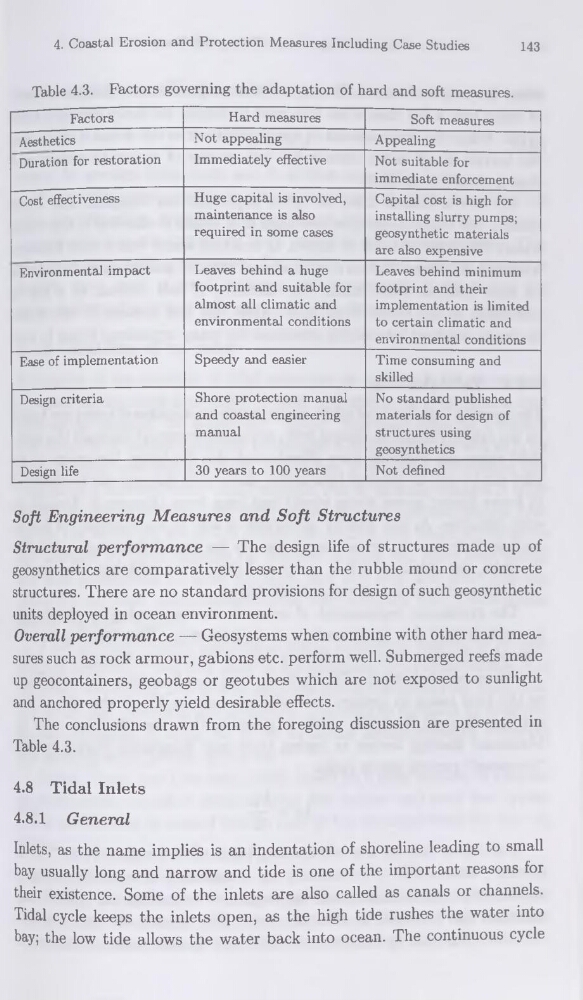
Table 4.3. Factors governing the adaptation of hard and soft measures.
Factors
Hard measures
Soft measures
Aesthetics
Not appealing
Appealing
""Duration for restoration
Immediately effective
Not suitable for
immédiate enforcement
Cost effectiveness
Huge capital is involved,
maintenance is also
required in some cases
Capital cost is high for
installing slurry pumps;
geosynthetic materials
are also expensive
Environmental impact
Leaves behind a huge
footprint and suitable for
almost ail climatic and
environmental conditions
Leaves behind minimum
footprint and their
implémentation is limited
to certain climatic and
environmental conditions
Ease of implémentation
Speedy and easier
Time consuming and
skilled
Design criteria
Shore protection manual
and Coastal engineering
manual
No standard published
materials for design of
structures using
geosynthetics
Design life
30 years to 100 years
Not defined
Soft Engineering Measures and Soft Structures
Structural performance — The design life of structures made up of
geosynthetics are comparatively lesser than the rubble mound or concrète
structures. There are no standard provisions for design of such geosynthetic
units deployed in océan environment.
Overall performance — Geosystems when combine with other hard measures such as rock armour, gabions etc. perform well. Submerged reefs made
up geocontainers, geobags or geotubes which are not exposed to sunlight
and anchored properly yield désirable effects.
The conclusions drawn from the foregoing discussion are presented in
Table 4.3.
4.8
Tidal Inlets
4.8.1 General
Inlets, as the name implies is an indentation of shoreline leading to small
bay usually long and narrow and tide is one of the important reasons for
their existence. Some of the inlets are also called as canals or channels.
Tidal cycle keeps the inlets open, as the high tide rushes the water into
bay; the low tide allows the water back into océan. The continuous cycle
143
Table 4.3. Factors governing the adaptation of hard and soft measures.
Factors
Hard measures
Soft measures
Aesthetics
Not appealing
Appealing
""Duration for restoration
Immediately effective
Not suitable for
immédiate enforcement
Cost effectiveness
Huge capital is involved,
maintenance is also
required in some cases
Capital cost is high for
installing slurry pumps;
geosynthetic materials
are also expensive
Environmental impact
Leaves behind a huge
footprint and suitable for
almost ail climatic and
environmental conditions
Leaves behind minimum
footprint and their
implémentation is limited
to certain climatic and
environmental conditions
Ease of implémentation
Speedy and easier
Time consuming and
skilled
Design criteria
Shore protection manual
and Coastal engineering
manual
No standard published
materials for design of
structures using
geosynthetics
Design life
30 years to 100 years
Not defined
Soft Engineering Measures and Soft Structures
Structural performance — The design life of structures made up of
geosynthetics are comparatively lesser than the rubble mound or concrète
structures. There are no standard provisions for design of such geosynthetic
units deployed in océan environment.
Overall performance — Geosystems when combine with other hard measures such as rock armour, gabions etc. perform well. Submerged reefs made
up geocontainers, geobags or geotubes which are not exposed to sunlight
and anchored properly yield désirable effects.
The conclusions drawn from the foregoing discussion are presented in
Table 4.3.
4.8
Tidal Inlets
4.8.1 General
Inlets, as the name implies is an indentation of shoreline leading to small
bay usually long and narrow and tide is one of the important reasons for
their existence. Some of the inlets are also called as canals or channels.
Tidal cycle keeps the inlets open, as the high tide rushes the water into
bay; the low tide allows the water back into océan. The continuous cycle