

Altimeter Data Analysis of the Antarctic Circumpolar Current
63
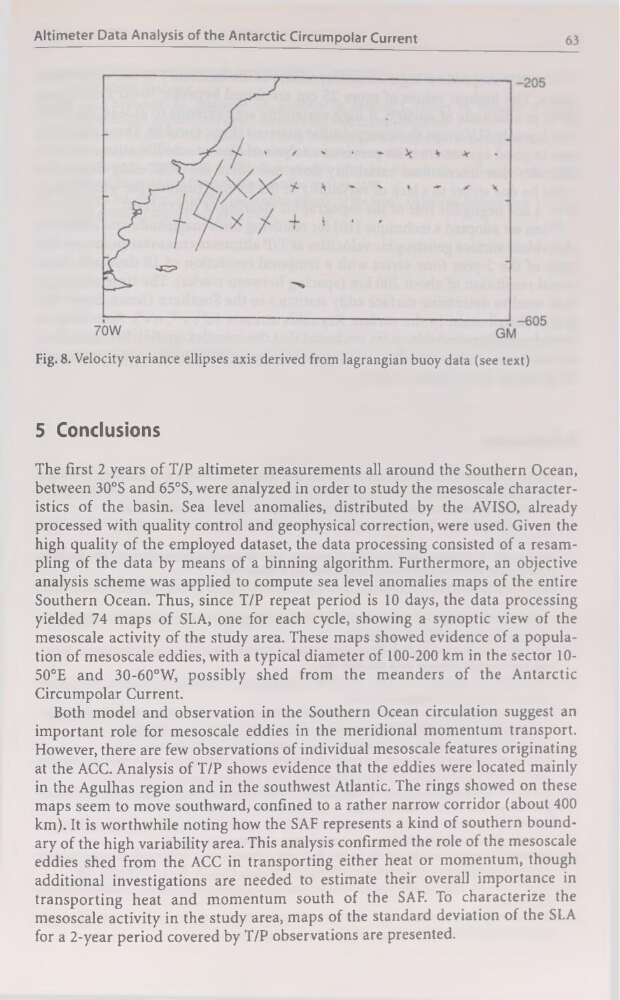
Fig. 8. Velocity variance ellipses axis derived from lagrangian buoy data (see text)
5 Conclusions
The first 2 years of T/P altimeter measurements ail around the Southern Océan,
between 30°S and 65°S, were analyzed in order to study the mesoscale characteristics of the basin. Sea level anomalies, distributed by the AVISO, already
processed with quality control and geophysical correction, were used. Given the
high quality of the employed dataset, the data processing consisted of a resampling of the data by means of a binning algorithm. Furthermore, an objective
analysis scheme was applied to compute sea level anomalies maps of the entire
Southern Océan. Thus, since T/P repeat period is 10 days, the data processing
yielded 74 maps of SLA, one for each cycle, showing a synoptic view of the
mesoscale activity of the study area. These maps showed evidence of a population of mesoscale eddies, with a typical diameter of 100-200 km in the sector 1050°E and 30-60°W, possibly shed from the meanders of the Antarctic
Circumpolar Current.
Both model and observation in the Southern Océan circulation suggest an
important rôle for mesoscale eddies in the méridional momentum transport.
However, there are few observations of individual mesoscale features originating
at the ACC. Analysis of T/P shows evidence that the eddies were located mainly
in the Agulhas région and in the Southwest Atlantic. The rings showed on these
maps seem to move southward, confined to a rather narrow corridor (about 400
km). It is worthwhile noting how the SAF represents a kind of Southern boundary of the high variability area. This analysis confirmed the rôle of the mesoscale
eddies shed from the ACC in transporting either heat or momentum, though
additional investigations are needed to estimate their overall importance in
transporting heat and momentum south of the SAF. To characterize the
mesoscale activity in the study area, maps of the standard déviation of the SLA
for a 2-year period covered by T/P observations are presented.
63
Fig. 8. Velocity variance ellipses axis derived from lagrangian buoy data (see text)
5 Conclusions
The first 2 years of T/P altimeter measurements ail around the Southern Océan,
between 30°S and 65°S, were analyzed in order to study the mesoscale characteristics of the basin. Sea level anomalies, distributed by the AVISO, already
processed with quality control and geophysical correction, were used. Given the
high quality of the employed dataset, the data processing consisted of a resampling of the data by means of a binning algorithm. Furthermore, an objective
analysis scheme was applied to compute sea level anomalies maps of the entire
Southern Océan. Thus, since T/P repeat period is 10 days, the data processing
yielded 74 maps of SLA, one for each cycle, showing a synoptic view of the
mesoscale activity of the study area. These maps showed evidence of a population of mesoscale eddies, with a typical diameter of 100-200 km in the sector 1050°E and 30-60°W, possibly shed from the meanders of the Antarctic
Circumpolar Current.
Both model and observation in the Southern Océan circulation suggest an
important rôle for mesoscale eddies in the méridional momentum transport.
However, there are few observations of individual mesoscale features originating
at the ACC. Analysis of T/P shows evidence that the eddies were located mainly
in the Agulhas région and in the Southwest Atlantic. The rings showed on these
maps seem to move southward, confined to a rather narrow corridor (about 400
km). It is worthwhile noting how the SAF represents a kind of Southern boundary of the high variability area. This analysis confirmed the rôle of the mesoscale
eddies shed from the ACC in transporting either heat or momentum, though
additional investigations are needed to estimate their overall importance in
transporting heat and momentum south of the SAF. To characterize the
mesoscale activity in the study area, maps of the standard déviation of the SLA
for a 2-year period covered by T/P observations are presented.