

56
A. Simone et al.
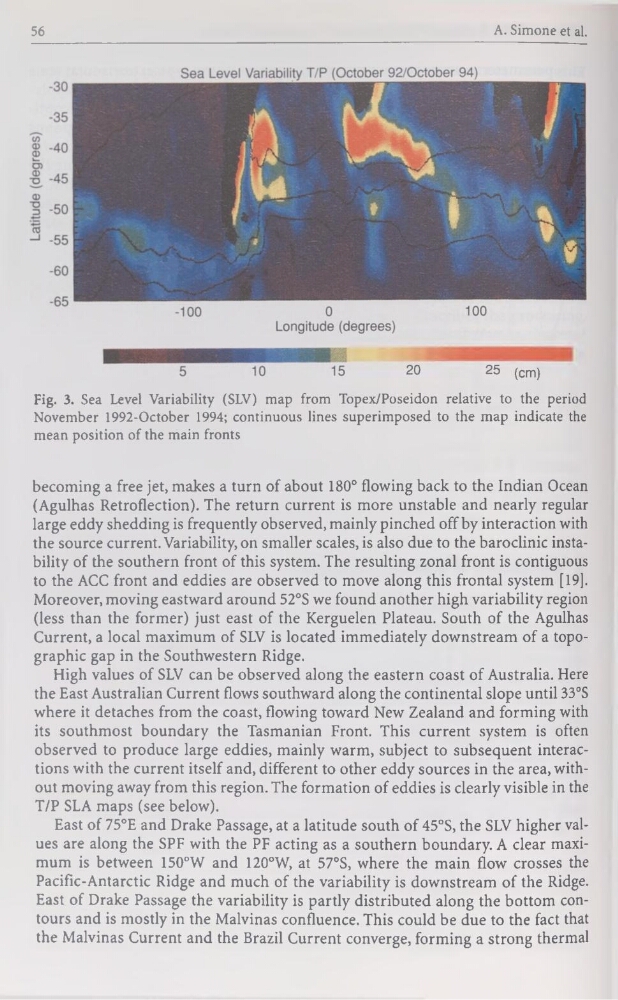
Fig. 3. Sea Level Variability (SLV) map from Topex/Poseidon relative to the period
November 1992-October 1994; continuons lines superimposed to the map indicate the
mean position of the main fronts
20
25 (Cm)
becoming a free jet, makes a turn of about 180° flowing back to the Indian Océan
(Agulhas Retroflection). The return current is more unstable and nearly regular
large eddy shedding is frequently observed, mainly pinched off by interaction with
the source current. Variability, on smaller scales, is also due to the baroclinie instability of the Southern front of this System. The resulting zonal front is contiguous
to the ACC front and eddies are observed to move along this frontal System [19].
Moreover, moving eastward around 52°S we found another high variability région
(less than the former) just east of the Kerguelen Plateau. South of the Agulhas
Current, a local maximum of SLV is located immediately downstream of a topographie gap in the Southwestern Ridge.
High values of SLV can be observed along the eastern coast of Australia. Here
the East Australian Current flows southward along the continental slope until 33°S
where it détachés from the coast, flowing toward New Zealand and forming with
its southmost boundary the Tasmanian Front. This current System is often
observed to produce large eddies, mainly warm, subject to subséquent interactions with the current itself and, different to other eddy sources in the area, without moving away from this région. The formation of eddies is clearly visible in the
T/P SLA maps (see below).
East of 75°E and Drake Passage, at a latitude south of 45°S, the SLV higher values are along the SPF with the PF acting as a Southern boundary. A clear maximum is between 150°W and 120°W, at 57°S, where the main flow crosses the
Pacific-Antarctic Ridge and much of the variability is downstream of the Ridge.
East of Drake Passage the variability is partly distributed along the bottom contours and is mostly in the Malvinas confluence. This could be due to the fact that
the Malvinas Current and the Brazil Current converge, forming a strong thermal
A. Simone et al.
Fig. 3. Sea Level Variability (SLV) map from Topex/Poseidon relative to the period
November 1992-October 1994; continuons lines superimposed to the map indicate the
mean position of the main fronts
20
25 (Cm)
becoming a free jet, makes a turn of about 180° flowing back to the Indian Océan
(Agulhas Retroflection). The return current is more unstable and nearly regular
large eddy shedding is frequently observed, mainly pinched off by interaction with
the source current. Variability, on smaller scales, is also due to the baroclinie instability of the Southern front of this System. The resulting zonal front is contiguous
to the ACC front and eddies are observed to move along this frontal System [19].
Moreover, moving eastward around 52°S we found another high variability région
(less than the former) just east of the Kerguelen Plateau. South of the Agulhas
Current, a local maximum of SLV is located immediately downstream of a topographie gap in the Southwestern Ridge.
High values of SLV can be observed along the eastern coast of Australia. Here
the East Australian Current flows southward along the continental slope until 33°S
where it détachés from the coast, flowing toward New Zealand and forming with
its southmost boundary the Tasmanian Front. This current System is often
observed to produce large eddies, mainly warm, subject to subséquent interactions with the current itself and, different to other eddy sources in the area, without moving away from this région. The formation of eddies is clearly visible in the
T/P SLA maps (see below).
East of 75°E and Drake Passage, at a latitude south of 45°S, the SLV higher values are along the SPF with the PF acting as a Southern boundary. A clear maximum is between 150°W and 120°W, at 57°S, where the main flow crosses the
Pacific-Antarctic Ridge and much of the variability is downstream of the Ridge.
East of Drake Passage the variability is partly distributed along the bottom contours and is mostly in the Malvinas confluence. This could be due to the fact that
the Malvinas Current and the Brazil Current converge, forming a strong thermal