

Altimeter Data Analysis of the Antarctic Circumpolar Current
55
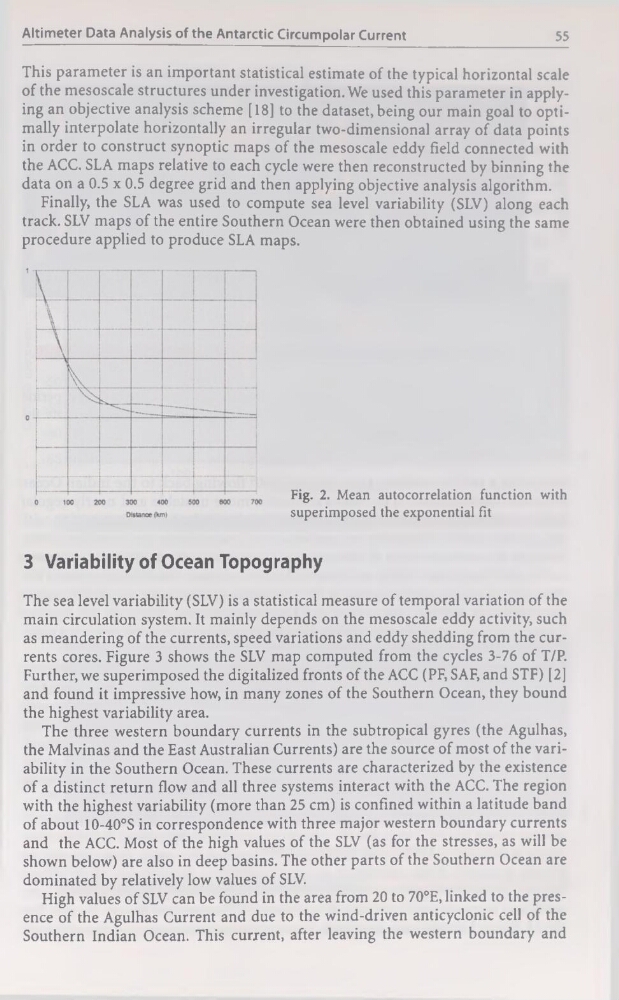
This parameter is an important statistical estimate of the typical horizontal scale
of the mesoscale structures under investigation. We used this parameter in applying an objective analysis scheme [18] to the dataset, being our main goal to optimally interpolate horizontally an irregular two-dimensional array of data points
in order to construct synoptic maps of the mesoscale eddy field connected with
the ACC. SLA maps relative to each cycle were then reconstructed by binning the
data on a 0.5 x 0.5 degree grid and then applying objective analysis algorithm.
Finally, the SLA was used to compute sea level variability (SLV) along each
track. SLV maps of the entire Southern Océan were then obtained using the same
procedure applied to produce SLA maps.
Fig. 2. Mean autocorrélation function with
superimposed the exponential fit
3 Variability of Océan Topography
The sea level variability (SLV) is a statistical measure of temporal variation of the
main circulation System. It mainly dépends on the mesoscale eddy activity, such
as meandering of the currents, speed variations and eddy shedding from the currents cores. Figure 3 shows the SLV map computed from the cycles 3-76 of T/P.
Further, we superimposed the digitalized fronts of the ACC (PF, SAF, and STF) [2]
and found it impressive how, in many zones of the Southern Océan, they bound
the highest variability area.
The three western boundary currents in the subtropical gyres (the Agulhas,
the Malvinas and the East Australian Currents) are the source of most of the variability in the Southern Océan. These currents are characterized by the existence
of a distinct return flow and ail three Systems interact with the ACC. The région
with the highest variability (more than 25 cm) is confined within a latitude band
of about 10-40°S in correspondence with three major western boundary currents
and the ACC. Most of the high values of the SLV (as for the stresses, as will be
shown below) are also in deep basins. The other parts of the Southern Océan are
dominated by relatively low values of SLV.
High values of SLV can be found in the area from 20 to 70°E, linked to the présence of the Agulhas Current and due to the wind-driven anticyclonic cell of the
Southern Indian Océan. This current, after leaving the western boundary and
55
This parameter is an important statistical estimate of the typical horizontal scale
of the mesoscale structures under investigation. We used this parameter in applying an objective analysis scheme [18] to the dataset, being our main goal to optimally interpolate horizontally an irregular two-dimensional array of data points
in order to construct synoptic maps of the mesoscale eddy field connected with
the ACC. SLA maps relative to each cycle were then reconstructed by binning the
data on a 0.5 x 0.5 degree grid and then applying objective analysis algorithm.
Finally, the SLA was used to compute sea level variability (SLV) along each
track. SLV maps of the entire Southern Océan were then obtained using the same
procedure applied to produce SLA maps.
Fig. 2. Mean autocorrélation function with
superimposed the exponential fit
3 Variability of Océan Topography
The sea level variability (SLV) is a statistical measure of temporal variation of the
main circulation System. It mainly dépends on the mesoscale eddy activity, such
as meandering of the currents, speed variations and eddy shedding from the currents cores. Figure 3 shows the SLV map computed from the cycles 3-76 of T/P.
Further, we superimposed the digitalized fronts of the ACC (PF, SAF, and STF) [2]
and found it impressive how, in many zones of the Southern Océan, they bound
the highest variability area.
The three western boundary currents in the subtropical gyres (the Agulhas,
the Malvinas and the East Australian Currents) are the source of most of the variability in the Southern Océan. These currents are characterized by the existence
of a distinct return flow and ail three Systems interact with the ACC. The région
with the highest variability (more than 25 cm) is confined within a latitude band
of about 10-40°S in correspondence with three major western boundary currents
and the ACC. Most of the high values of the SLV (as for the stresses, as will be
shown below) are also in deep basins. The other parts of the Southern Océan are
dominated by relatively low values of SLV.
High values of SLV can be found in the area from 20 to 70°E, linked to the présence of the Agulhas Current and due to the wind-driven anticyclonic cell of the
Southern Indian Océan. This current, after leaving the western boundary and