

Mapping the Thickness of Pancake Ice Using Océan Wave Dispersion...
23
F”+1(Jc) = a"F’(£)+AF’(k),
(14)
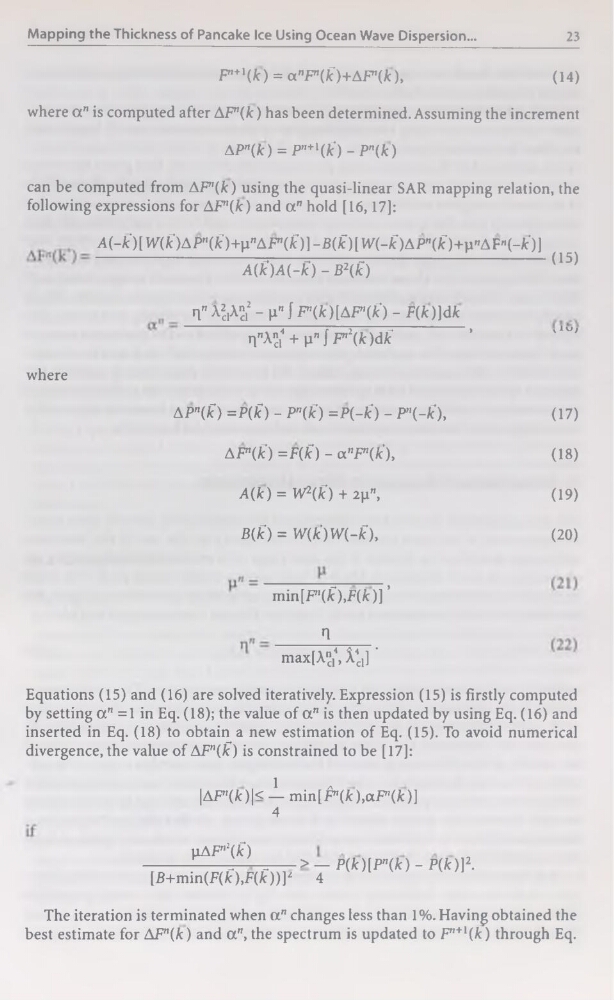
where a” is computed after AF’(k ) has been determined. Assuming the incrément
AP"(k) = P"+1(£) - Pn(k)
can be computed from AF'(k) using the quasi-linear SAR mapping relation, the
following expressions for AF'(fc) and a” hold [16,17]:
A(-/c')[IV(£)AP"(A)+p"AFJ(X)]-B(£)[W(-r)APn(A)+p"AF'’(-X)]
A(£)A(-£)-B2(£)
( 15)
H" X2 clAn cl2 - p" J FW[AF”(£) - F(k)]dk
»
4
r
7
~*
>
\ A V /
rpXÿ + p" J F”’(k)dk
where
AP”(£) =P(£) - P"(£) =P(-£) - P"(-£),
(17)
AF"(£) =F(£) - a''F,(fc’),
(18)
A(k) = W2(A) + 2pn,
(19)
b(£) = wW(-£),
(20)
min[F'(£),F(k)] ’
H
max[Xÿ, Â4 cl] ‘
Equations (15) and (16) are solved iteratively. Expression (15) is fïrstly computed
by setting a" =1 in Eq. (18); the value of a” is then updated by using Eq. (16) and
inserted in Eq. (18) to obtain a new estimation of Eq. (15). To avoid numerical
divergence, the value of AF"(£) is constrained to be [17]:
1
A
|AF'(/c)|< — min[F"(/c),aF'(k)]
4
pAF”2(£)
[B+min(F(£),F(£))]
->-P(fc)[PW-P(k)]2.
2
4
The itération is terminated when a" changes less than 1%. Having obtained the
best estimate for AF(A:) and a”, the spectrum is updated to F”+1(Zc) through Eq.
23
F”+1(Jc) = a"F’(£)+AF’(k),
(14)
where a” is computed after AF’(k ) has been determined. Assuming the incrément
AP"(k) = P"+1(£) - Pn(k)
can be computed from AF'(k) using the quasi-linear SAR mapping relation, the
following expressions for AF'(fc) and a” hold [16,17]:
A(-/c')[IV(£)AP"(A)+p"AFJ(X)]-B(£)[W(-r)APn(A)+p"AF'’(-X)]
A(£)A(-£)-B2(£)
( 15)
H" X2 clAn cl2 - p" J FW[AF”(£) - F(k)]dk
»
4
r
7
~*
>
\ A V /
rpXÿ + p" J F”’(k)dk
where
AP”(£) =P(£) - P"(£) =P(-£) - P"(-£),
(17)
AF"(£) =F(£) - a''F,(fc’),
(18)
A(k) = W2(A) + 2pn,
(19)
b(£) = wW(-£),
(20)
min[F'(£),F(k)] ’
H
max[Xÿ, Â4 cl] ‘
Equations (15) and (16) are solved iteratively. Expression (15) is fïrstly computed
by setting a" =1 in Eq. (18); the value of a” is then updated by using Eq. (16) and
inserted in Eq. (18) to obtain a new estimation of Eq. (15). To avoid numerical
divergence, the value of AF"(£) is constrained to be [17]:
1
A
|AF'(/c)|< — min[F"(/c),aF'(k)]
4
pAF”2(£)
[B+min(F(£),F(£))]
->-P(fc)[PW-P(k)]2.
2
4
The itération is terminated when a" changes less than 1%. Having obtained the
best estimate for AF(A:) and a”, the spectrum is updated to F”+1(Zc) through Eq.