

P. Wadhams et al.
22
modulation processes of the real cross section as linear through their modulation
transfer fonctions (tilt and hydrodynamic), Hasselmann and Hasselmann [16]
derived a closed, non-linear intégral mapping transformation relating the SAR
spectrum P(k) to the the two-dimensional directional wave spectrum F(/c)which
can be computed by fast fourier transform using the following expression:
p<0 = tAj
■ 2 2 (^)” ?„,„(£).
(12)
(2tc)
n=1
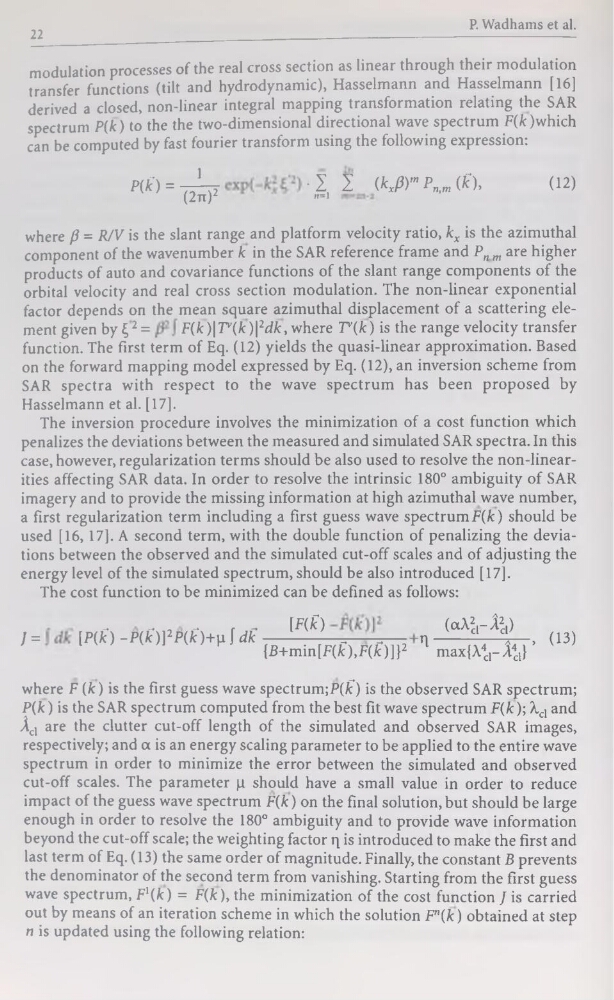
where (1 = R/V is the slant range and platform velocity ratio, kx is the azimuthal
component of the wavenumber k in the SAR reference frame and Pn m are higher
products of auto and covariance fonctions of the slant range components of the
orbital velocity and real cross section modulation. The non-linear exponential
factor dépends on the mean square azimuthal displacement of a scattering élément given by §2 =
F(k)|Tv(k)|2dk, where T(k) is the range velocity transfer
fonction. The first term of Eq. (12) yields the quasi-linear approximation. Based
on the forward mapping model expressed by Eq. (12), an inversion scheme from
SAR spectra with respect to the wave spectrum has been proposed by
Hasselmann et al. [17].
The inversion procedure involves the minimization of a cost fonction which
penalizes the déviations between the measured and simulated SAR spectra. In this
case, however, regularization terms should be also used to résolve the non-linearities affecting SAR data. In order to résolve the intrinsic 180° ambiguity of SAR
imagery and to provide the missing information at high azimuthal wave number,
a First regularization term including a First guess wave spectrumF(k) should be
used [16, 17]. A second term, with the double fonction of penalizing the déviations between the observed and the simulated cut-off scales and of adjusting the
energy level of the simulated spectrum, should be also introduced [17].
The cost fonction to be minimized can be defined as follows:
J =
[Ptf) -P(£)]2Ptf)+pl d£
[f(C
{B+min[F(£),F(£)]}2 U
(otX2 cl-Â2 cl)
max{X4cl-Â4cl} ’
(13)
where F (k) is the First guess wave spectrum;P(£) is the observed SAR spectrum;
P(k ) is the SAR spectrum computed from the best Fit wave spectrum F(k ); X.cl and
Àcl are the clutter cut-off length of the simulated and observed SAR images,
respectively; and a is an energy scaling parameter to be applied to the entire wave
spectrum in order to minimize the error between the simulated and observed
cut-off scales. The parameter p should hâve a small value in order to reduce
impact of the guess wave spectrum F(k) on the final solution,but should be large
enough in order to résolve the 180° ambiguity and to provide wave information
beyond the cut-off scale; the weighting factor q is introduced to make the first and
last term of Eq. (13) the same order of magnitude. Finally, the constant B prevents
the denominator of the second term from vanishing. Starting from the first guess
wave spectrum, F'(k) = F(k), the minimization of the cost fonction J is carried
out by means of an itération scheme in which the solution F"(k) obtained at step
n is updated using the following relation:
22
modulation processes of the real cross section as linear through their modulation
transfer fonctions (tilt and hydrodynamic), Hasselmann and Hasselmann [16]
derived a closed, non-linear intégral mapping transformation relating the SAR
spectrum P(k) to the the two-dimensional directional wave spectrum F(/c)which
can be computed by fast fourier transform using the following expression:
p<0 = tAj
■ 2 2 (^)” ?„,„(£).
(12)
(2tc)
n=1
where (1 = R/V is the slant range and platform velocity ratio, kx is the azimuthal
component of the wavenumber k in the SAR reference frame and Pn m are higher
products of auto and covariance fonctions of the slant range components of the
orbital velocity and real cross section modulation. The non-linear exponential
factor dépends on the mean square azimuthal displacement of a scattering élément given by §2 =
F(k)|Tv(k)|2dk, where T(k) is the range velocity transfer
fonction. The first term of Eq. (12) yields the quasi-linear approximation. Based
on the forward mapping model expressed by Eq. (12), an inversion scheme from
SAR spectra with respect to the wave spectrum has been proposed by
Hasselmann et al. [17].
The inversion procedure involves the minimization of a cost fonction which
penalizes the déviations between the measured and simulated SAR spectra. In this
case, however, regularization terms should be also used to résolve the non-linearities affecting SAR data. In order to résolve the intrinsic 180° ambiguity of SAR
imagery and to provide the missing information at high azimuthal wave number,
a First regularization term including a First guess wave spectrumF(k) should be
used [16, 17]. A second term, with the double fonction of penalizing the déviations between the observed and the simulated cut-off scales and of adjusting the
energy level of the simulated spectrum, should be also introduced [17].
The cost fonction to be minimized can be defined as follows:
J =
[Ptf) -P(£)]2Ptf)+pl d£
[f(C
{B+min[F(£),F(£)]}2 U
(otX2 cl-Â2 cl)
max{X4cl-Â4cl} ’
(13)
where F (k) is the First guess wave spectrum;P(£) is the observed SAR spectrum;
P(k ) is the SAR spectrum computed from the best Fit wave spectrum F(k ); X.cl and
Àcl are the clutter cut-off length of the simulated and observed SAR images,
respectively; and a is an energy scaling parameter to be applied to the entire wave
spectrum in order to minimize the error between the simulated and observed
cut-off scales. The parameter p should hâve a small value in order to reduce
impact of the guess wave spectrum F(k) on the final solution,but should be large
enough in order to résolve the 180° ambiguity and to provide wave information
beyond the cut-off scale; the weighting factor q is introduced to make the first and
last term of Eq. (13) the same order of magnitude. Finally, the constant B prevents
the denominator of the second term from vanishing. Starting from the first guess
wave spectrum, F'(k) = F(k), the minimization of the cost fonction J is carried
out by means of an itération scheme in which the solution F"(k) obtained at step
n is updated using the following relation: