

226
S. Gremes Cordero, E. Salusti
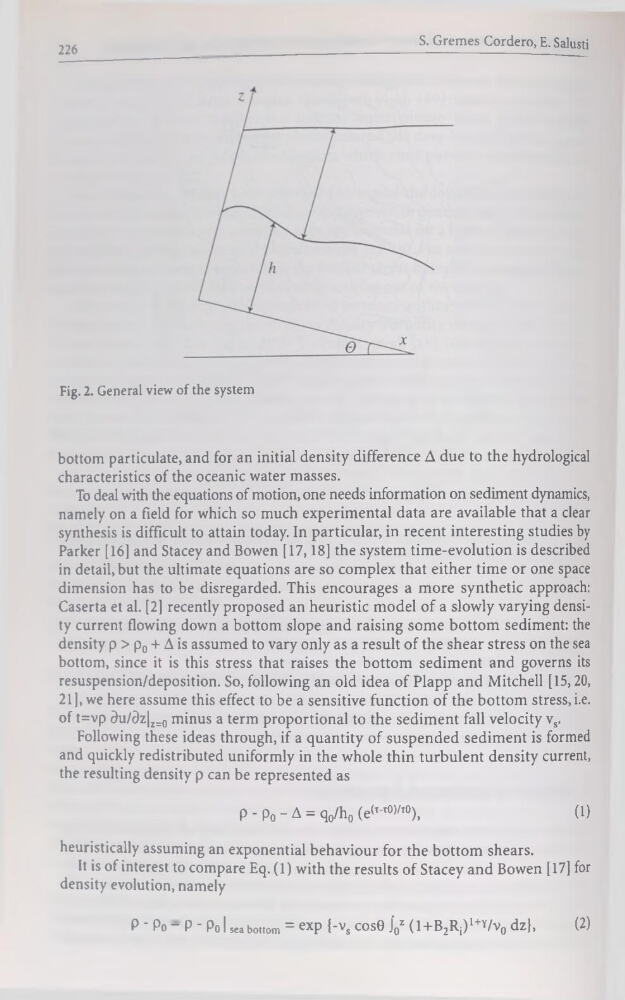
Fig. 2. General view of the System
bottom particulate, and for an initial density différence A due to the hydrological
characteristics of the oceanic water masses.
To deal with the équations of motion, one needs information on sédiment dynamics,
namely on a field for which so much experimental data are available that a clear
synthesis is difficult to attain today. In particular, in recent interesting studies by
Parker [16] and Stacey and Bowen [17,18] the System time-evolution is described
in detail, but the ultimate équations are so complex that either time or one space
dimension has to be disregarded. This encourages a more synthetic approach:
Caserta et al. [2] recently proposed an heuristic model of a slowly varying density current flowing down a bottom slope and raising some bottom sédiment: the
density p > p0 + A is assumed to vary only as a resuit of the shear stress on the sea
bottom, since it is this stress that raises the bottom sédiment and governs its
resuspension/deposition. So, following an old idea of Plapp and Mitchell [15,20,
21 ], we here assume this effect to be a sensitive function of the bottom stress, i.e.
of t=vp du/dz|z=0 minus a term proportional to the sédiment fall velocity vs.
Following these ideas through, if a quantity of suspended sédiment is formed
and quickly redistributed uniformly in the whole thin turbulent density current,
the resulting density p can be represented as
p - p0 - A = q0/h0 (e
heuristically assuming an exponential behaviour for the bottom shears.
It is of interest to compare Eq. (1) with the results of Stacey and Bowen [17] for
density évolution, namely
P - Po - P - Po I sea bottom = exP {-Vs COS0 Joz (l + B2Rj)1+Y/v0 dz],
(2)
S. Gremes Cordero, E. Salusti
Fig. 2. General view of the System
bottom particulate, and for an initial density différence A due to the hydrological
characteristics of the oceanic water masses.
To deal with the équations of motion, one needs information on sédiment dynamics,
namely on a field for which so much experimental data are available that a clear
synthesis is difficult to attain today. In particular, in recent interesting studies by
Parker [16] and Stacey and Bowen [17,18] the System time-evolution is described
in detail, but the ultimate équations are so complex that either time or one space
dimension has to be disregarded. This encourages a more synthetic approach:
Caserta et al. [2] recently proposed an heuristic model of a slowly varying density current flowing down a bottom slope and raising some bottom sédiment: the
density p > p0 + A is assumed to vary only as a resuit of the shear stress on the sea
bottom, since it is this stress that raises the bottom sédiment and governs its
resuspension/deposition. So, following an old idea of Plapp and Mitchell [15,20,
21 ], we here assume this effect to be a sensitive function of the bottom stress, i.e.
of t=vp du/dz|z=0 minus a term proportional to the sédiment fall velocity vs.
Following these ideas through, if a quantity of suspended sédiment is formed
and quickly redistributed uniformly in the whole thin turbulent density current,
the resulting density p can be represented as
p - p0 - A = q0/h0 (e
heuristically assuming an exponential behaviour for the bottom shears.
It is of interest to compare Eq. (1) with the results of Stacey and Bowen [17] for
density évolution, namely
P - Po - P - Po I sea bottom = exP {-Vs COS0 Joz (l + B2Rj)1+Y/v0 dz],
(2)