

General Characteristics of Density-Turbidity Currents in the Ross Sea (Antarctica)
225
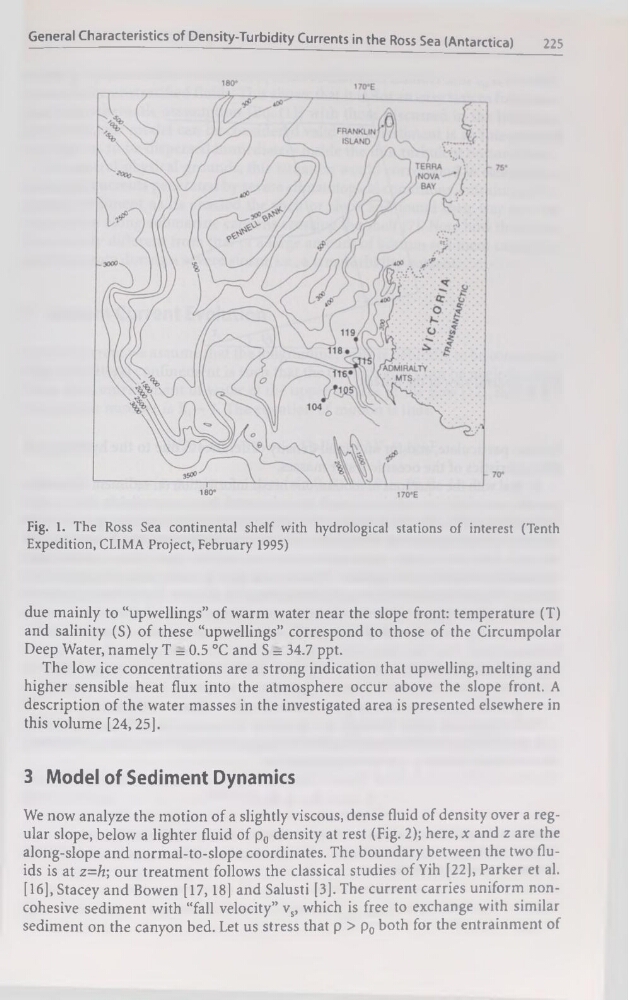
Fig. 1. The Ross Sea continental shelf with hydrological stations of interest (Tenth
Expédition, CLIMA Project, February 1995)
due mainly to “upwellings” of warm water near the slope front: température (T)
and salinity (S) of these “upwellings” correspond to those of the Circumpolar
Deep Water, namely T = 0.5 °C and S = 34.7 ppt.
The low ice concentrations are a strong indication that upwelling, melting and
higher sensible heat flux into the atmosphère occur above the slope front. A
description of the water masses in the investigated area is presented elsewhere in
this volume [24,25].
3 Model of Sédiment Dynamics
We now analyze the motion of a slightly viscous, dense fluid of density over a regular slope, below a lighter fluid of p0 density at rest (Fig. 2); here, x and z are the
along-slope and normal-to-slope coordinates. The boundary between the two fluids is at z=h; our treatment follows the classical studies of Yih [22], Parker et al.
[16], Stacey and Bowen [17,18] and Salusti [3]. The current carries uniform noncohesive sédiment with “fall velocity” vs, which is free to exchange with similar
sédiment on the canyon bed. Let us stress that p > p0 both for the entrainment of
225
Fig. 1. The Ross Sea continental shelf with hydrological stations of interest (Tenth
Expédition, CLIMA Project, February 1995)
due mainly to “upwellings” of warm water near the slope front: température (T)
and salinity (S) of these “upwellings” correspond to those of the Circumpolar
Deep Water, namely T = 0.5 °C and S = 34.7 ppt.
The low ice concentrations are a strong indication that upwelling, melting and
higher sensible heat flux into the atmosphère occur above the slope front. A
description of the water masses in the investigated area is presented elsewhere in
this volume [24,25].
3 Model of Sédiment Dynamics
We now analyze the motion of a slightly viscous, dense fluid of density over a regular slope, below a lighter fluid of p0 density at rest (Fig. 2); here, x and z are the
along-slope and normal-to-slope coordinates. The boundary between the two fluids is at z=h; our treatment follows the classical studies of Yih [22], Parker et al.
[16], Stacey and Bowen [17,18] and Salusti [3]. The current carries uniform noncohesive sédiment with “fall velocity” vs, which is free to exchange with similar
sédiment on the canyon bed. Let us stress that p > p0 both for the entrainment of