

Thermohaline Data and Océan Circulation on the Ross Sea Continental Shelf
7
3 Data Products and Areal Variability
Large portions of the Antarctic continental shelf serve as production sites and
temporary storage réservoirs for dense shelf waters. Formed mainly by winter
cooling and freezing at the sea surface, shelf waters supply much of the sait that
drives thermohaline circulation beneath the large ice shelves, and the properties
by which new bottom water is identified [6, 21]. At the cold températures that
characterize the Ross Sea continental shelf, salinity variations exert a greater control over the density field. Océan general circulation models often “restore” salinity near Antarctica to observed conditions, e.g., as represented by the NODC
Salinity
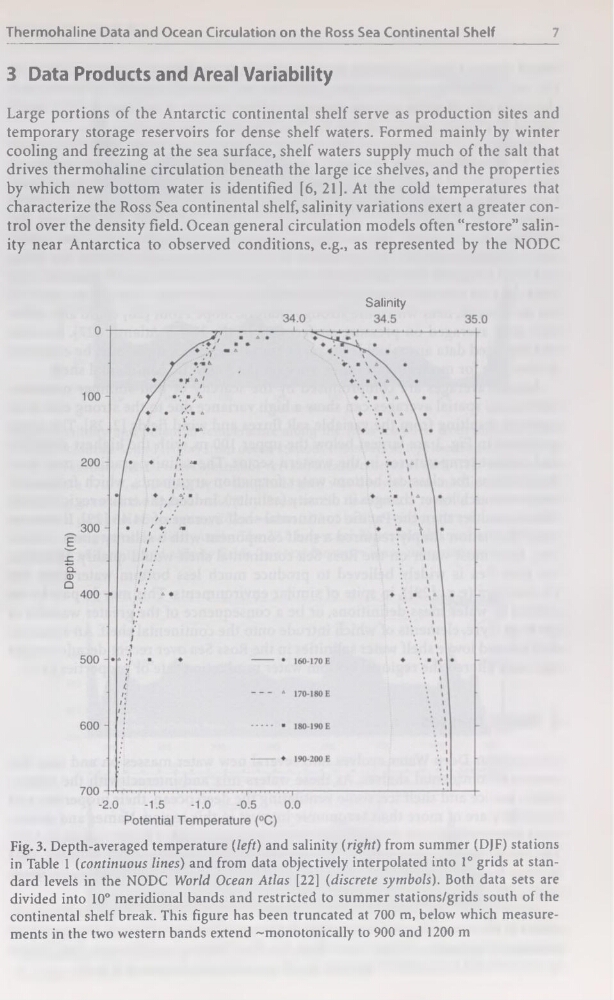
Fig. 3. Depth-averaged température (left) and salinity (right) from summer (DJF) stations
in Table 1 (continuons Unes) and from data objectively interpolated into 1° grids at standard levels in the NODC World Océan Atlas [22] (discrète symbols). Both data sets are
divided into 10° méridional bands and restricted to summer stations/grids south of the
continental shelf break. This figure has been truncated at 700 m, below which measurements in the two western bands extend -monotonically to 900 and 1200 m
7
3 Data Products and Areal Variability
Large portions of the Antarctic continental shelf serve as production sites and
temporary storage réservoirs for dense shelf waters. Formed mainly by winter
cooling and freezing at the sea surface, shelf waters supply much of the sait that
drives thermohaline circulation beneath the large ice shelves, and the properties
by which new bottom water is identified [6, 21]. At the cold températures that
characterize the Ross Sea continental shelf, salinity variations exert a greater control over the density field. Océan general circulation models often “restore” salinity near Antarctica to observed conditions, e.g., as represented by the NODC
Salinity
Fig. 3. Depth-averaged température (left) and salinity (right) from summer (DJF) stations
in Table 1 (continuons Unes) and from data objectively interpolated into 1° grids at standard levels in the NODC World Océan Atlas [22] (discrète symbols). Both data sets are
divided into 10° méridional bands and restricted to summer stations/grids south of the
continental shelf break. This figure has been truncated at 700 m, below which measurements in the two western bands extend -monotonically to 900 and 1200 m