

G.M.R. Manzella et al.
170
402 m
March
May
July
Sept.
November
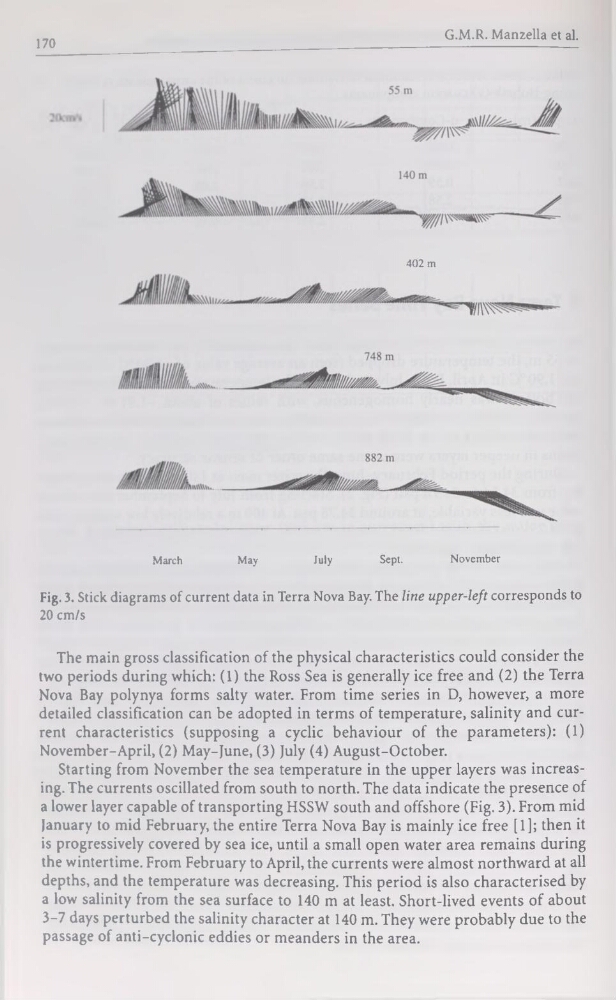
Fig. 3. Stick diagrams of current data in Terra Nova Bay. The line upper-left corresponds to
20 cm/s
The main gross classification of the physical characteristics could consider the
two periods during which: (1) the Ross Sea is generally ice free and (2) the Terra
Nova Bay polynya forms salty water. From time sériés in D, however, a more
detailed classification can be adopted in terms of température, salinity and current characteristics (supposing a cyclic behaviour of the parameters): (1)
November-April, (2) May-June, (3) July (4) August-October.
Starting from November the sea température in the upper layers was increasing. The currents oscillated from south to north. The data indicate the presence of
a lower layer capable of transporting HSSW south and offshore (Fig. 3). From mid
January to mid February, the entire Terra Nova Bay is mainly ice free [1]; then it
is progressively covered by sea ice, until a small open water area remains during
the wintertime. From February to April, the currents were almost northward at ail
depths, and the température was decreasing. This period is also characterised by
a low salinity from the sea surface to 140 m at least. Short-lived events of about
3-7 days perturbed the salinity character at 140 m. They were probably due to the
passage of anti-cyclonic eddies or meanders in the area.
170
402 m
March
May
July
Sept.
November
Fig. 3. Stick diagrams of current data in Terra Nova Bay. The line upper-left corresponds to
20 cm/s
The main gross classification of the physical characteristics could consider the
two periods during which: (1) the Ross Sea is generally ice free and (2) the Terra
Nova Bay polynya forms salty water. From time sériés in D, however, a more
detailed classification can be adopted in terms of température, salinity and current characteristics (supposing a cyclic behaviour of the parameters): (1)
November-April, (2) May-June, (3) July (4) August-October.
Starting from November the sea température in the upper layers was increasing. The currents oscillated from south to north. The data indicate the presence of
a lower layer capable of transporting HSSW south and offshore (Fig. 3). From mid
January to mid February, the entire Terra Nova Bay is mainly ice free [1]; then it
is progressively covered by sea ice, until a small open water area remains during
the wintertime. From February to April, the currents were almost northward at ail
depths, and the température was decreasing. This period is also characterised by
a low salinity from the sea surface to 140 m at least. Short-lived events of about
3-7 days perturbed the salinity character at 140 m. They were probably due to the
passage of anti-cyclonic eddies or meanders in the area.