

Wintertime Expansion and Contraction of the Terra Nova Bay Polynya
155
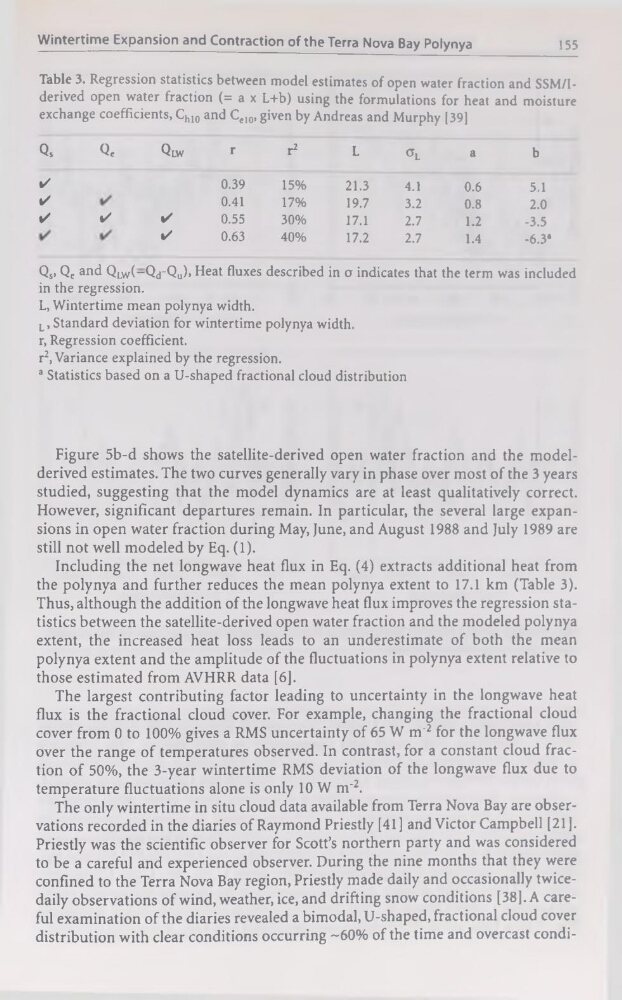
Table 3. Régression statistics between model estimâtes of open water fraction and SSM/1derived open water fraction (= a x L+b) using the formulations for heat and moisture
exchange coefficients, Chl0 and Cel0> given by Andréas and Murphy [39]
Qs
Qe
Qlw
r
r2
L
<*L
a
b
✓
0.39
15%
21.3
4.1
0.6
5.1
✓
0.41
17%
19.7
3.2
0.8
2.0
✓
✓
*z
0.55
30%
17.1
2.7
1.2
-3.5
|Z
0.63
40%
17.2
2.7
1.4
-6.3*
Qs> Qe ar>d Qlw(-Qd-Qu)> Heat fluxes described in a indicates that the term was included
in the régression.
L, Wintertime mean polynya width.
L, Standard déviation for wintertime polynya width.
r, Régression coefficient.
r2, Variance explained by the régression.
a Statistics based on a U-shaped fractional cloud distribution
Figure 5b-d shows the satellite-derived open water fraction and the modelderived estimâtes. The two curves generally vary in phase over most of the 3 years
studied, suggesting that the model dynamics are at least qualitatively correct.
However, significant departures remain. In particular, the several large expansions in open water fraction during May, June, and August 1988 and July 1989 are
still not well modeled by Eq. (1).
Including the net longwave heat flux in Eq. (4) extracts additional heat from
the polynya and further reduces the mean polynya extent to 17.1 km (Table 3).
Thus, although the addition of the longwave heat flux improves the régression statistics between the satellite-derived open water fraction and the modeled polynya
extent, the increased heat loss leads to an underestimate of both the mean
polynya extent and the amplitude of the fluctuations in polynya extent relative to
those estimated from AVHRR data [6].
The largest contributing factor leading to uncertainty in the longwave heat
flux is the fractional cloud cover. For example, changing the fractional cloud
cover from 0 to 100% gives a RMS uncertainty of 65 W m’2 for the longwave flux
over the range of températures observed. In contrast, for a constant cloud fraction of 50%, the 3-year wintertime RMS déviation of the longwave flux due to
température fluctuations alone is only 10 W m’2.
The only wintertime in situ cloud data available from Terra Nova Bay are observations recorded in the diaries of Raymond Priestly [41] and Victor Campbell [21].
Priestly was the scientific observer for Scott’s northern party and was considered
to be a careful and experienced observer. During the nine months that they were
confmed to the Terra Nova Bay région, Priestly made daily and occasionally twicedaily observations of wind, weather, ice, and drifting snow conditions [38]. A careful examination of the diaries revealed a bimodal, U-shaped, fractional cloud cover
distribution with clear conditions occurring ~60% of the time and overcast condi-
155
Table 3. Régression statistics between model estimâtes of open water fraction and SSM/1derived open water fraction (= a x L+b) using the formulations for heat and moisture
exchange coefficients, Chl0 and Cel0> given by Andréas and Murphy [39]
Qs
Qe
Qlw
r
r2
L
<*L
a
b
✓
0.39
15%
21.3
4.1
0.6
5.1
✓
0.41
17%
19.7
3.2
0.8
2.0
✓
✓
*z
0.55
30%
17.1
2.7
1.2
-3.5
|Z
0.63
40%
17.2
2.7
1.4
-6.3*
Qs> Qe ar>d Qlw(-Qd-Qu)> Heat fluxes described in a indicates that the term was included
in the régression.
L, Wintertime mean polynya width.
L, Standard déviation for wintertime polynya width.
r, Régression coefficient.
r2, Variance explained by the régression.
a Statistics based on a U-shaped fractional cloud distribution
Figure 5b-d shows the satellite-derived open water fraction and the modelderived estimâtes. The two curves generally vary in phase over most of the 3 years
studied, suggesting that the model dynamics are at least qualitatively correct.
However, significant departures remain. In particular, the several large expansions in open water fraction during May, June, and August 1988 and July 1989 are
still not well modeled by Eq. (1).
Including the net longwave heat flux in Eq. (4) extracts additional heat from
the polynya and further reduces the mean polynya extent to 17.1 km (Table 3).
Thus, although the addition of the longwave heat flux improves the régression statistics between the satellite-derived open water fraction and the modeled polynya
extent, the increased heat loss leads to an underestimate of both the mean
polynya extent and the amplitude of the fluctuations in polynya extent relative to
those estimated from AVHRR data [6].
The largest contributing factor leading to uncertainty in the longwave heat
flux is the fractional cloud cover. For example, changing the fractional cloud
cover from 0 to 100% gives a RMS uncertainty of 65 W m’2 for the longwave flux
over the range of températures observed. In contrast, for a constant cloud fraction of 50%, the 3-year wintertime RMS déviation of the longwave flux due to
température fluctuations alone is only 10 W m’2.
The only wintertime in situ cloud data available from Terra Nova Bay are observations recorded in the diaries of Raymond Priestly [41] and Victor Campbell [21].
Priestly was the scientific observer for Scott’s northern party and was considered
to be a careful and experienced observer. During the nine months that they were
confmed to the Terra Nova Bay région, Priestly made daily and occasionally twicedaily observations of wind, weather, ice, and drifting snow conditions [38]. A careful examination of the diaries revealed a bimodal, U-shaped, fractional cloud cover
distribution with clear conditions occurring ~60% of the time and overcast condi-