

M.L. Van Woert
154
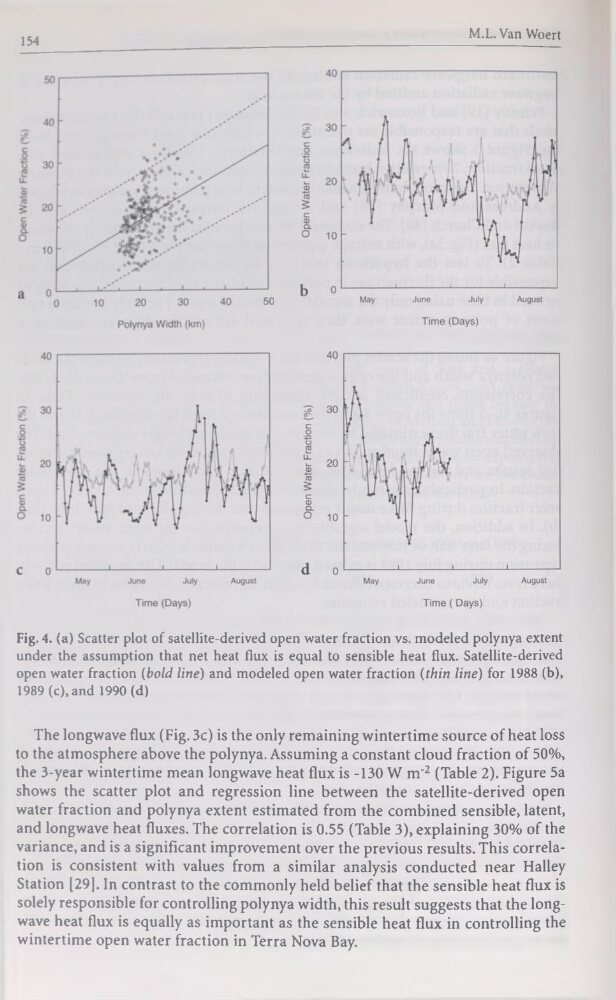
Fig. 4. (a) Scatter plot of satellite-derived open water fraction vs. modeled polynya extent
under the assumption that net heat flux is equal to sensible heat flux. Satellite-derived
open water fraction (bold line) and modeled open water fraction (thin line) for 1988 (b),
1989 (c), and 1990 (d)
The longwave flux (Fig. 3c) is the only remaining wintertime source of heat loss
to the atmosphère above the polynya. Assuming a constant cloud fraction of 50%,
the 3-year wintertime mean longwave heat flux is -130 W m'2 (Table 2). Figure 5a
shows the scatter plot and régression line between the satellite-derived open
water fraction and polynya extent estimated from the combined sensible, latent,
and longwave heat fluxes. The corrélation is 0.55 (Table 3), explaining 30% of the
variance, and is a significant improvement over the previous results. This corrélation is consistent with values from a similar analysis conducted near Halley
Station [29], In contrast to the commonly held belief that the sensible heat flux is
solely responsible for controlling polynya width, this resuit suggests that the longwave heat flux is equally as important as the sensible heat flux in controlling the
wintertime open water fraction in Terra Nova Bay.
154
Fig. 4. (a) Scatter plot of satellite-derived open water fraction vs. modeled polynya extent
under the assumption that net heat flux is equal to sensible heat flux. Satellite-derived
open water fraction (bold line) and modeled open water fraction (thin line) for 1988 (b),
1989 (c), and 1990 (d)
The longwave flux (Fig. 3c) is the only remaining wintertime source of heat loss
to the atmosphère above the polynya. Assuming a constant cloud fraction of 50%,
the 3-year wintertime mean longwave heat flux is -130 W m'2 (Table 2). Figure 5a
shows the scatter plot and régression line between the satellite-derived open
water fraction and polynya extent estimated from the combined sensible, latent,
and longwave heat fluxes. The corrélation is 0.55 (Table 3), explaining 30% of the
variance, and is a significant improvement over the previous results. This corrélation is consistent with values from a similar analysis conducted near Halley
Station [29], In contrast to the commonly held belief that the sensible heat flux is
solely responsible for controlling polynya width, this resuit suggests that the longwave heat flux is equally as important as the sensible heat flux in controlling the
wintertime open water fraction in Terra Nova Bay.