

V. Commodari, S. Pierini
138
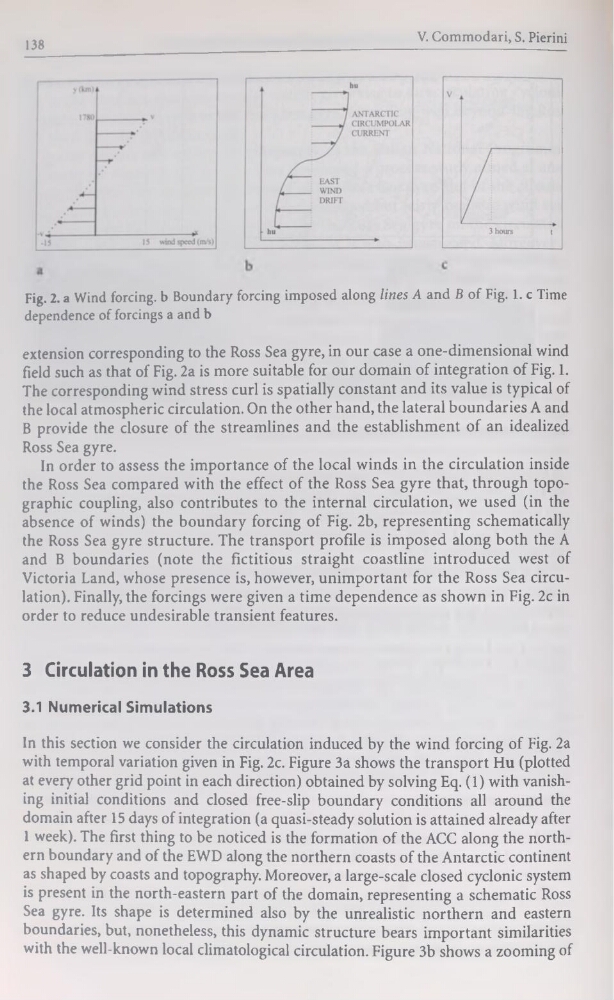
Fig. 2. a Wind forcing, b Boundary forcing imposed along Unes A and B of Fig. 1. c Time
dependence of forcings a and b
extension corresponding to the Ross Sea gyre, in our case a one-dimensional wind
field such as that of Fig. 2a is more suitable for our domain of intégration of Fig. 1.
The corresponding wind stress curl is spatially constant and its value is typical of
the local atmospheric circulation. On the other hand, the latéral boundaries A and
B provide the closure of the streamlines and the establishment of an idealized
Ross Sea gyre.
In order to assess the importance of the local winds in the circulation inside
the Ross Sea compared with the effect of the Ross Sea gyre that, through topographie coupling, also contributes to the internai circulation, we used (in the
absence of winds) the boundary forcing of Fig. 2b, representing schematically
the Ross Sea gyre structure. The transport profile is imposed along both the A
and B boundaries (note the fictitious straight coastline introduced west of
Victoria Land, whose presence is, however, unimportant for the Ross Sea circulation). Finally, the forcings were given a time dependence as shown in Fig. 2c in
order to reduce undesirable transient features.
3 Circulation in the Ross Sea Area
3.1 Numerical Simulations
In this section we consider the circulation induced by the wind forcing of Fig. 2a
with temporal variation given in Fig. 2c. Figure 3a shows the transport Hu (plotted
at every other grid point in each direction) obtained by solving Eq. (1) with vanishing initial conditions and closed free-slip boundary conditions ail around the
domain after 15 days of intégration (a quasi-steady solution is attained already after
1 week). The first thing to be noticed is the formation of the ACC along the northern boundary and of the EWD along the northern coasts of the Antarctic continent
as shaped by coasts and topography. Moreover, a large-scale closed cyclonic System
is présent in the north-eastern part of the domain, representing a schematic Ross
Sea gyre. Its shape is determined also by the unrealistic northern and eastern
boundaries, but, nonetheless, this dynamic structure bears important similarities
with the well-known local climatological circulation. Figure 3b shows a zooming of
138
Fig. 2. a Wind forcing, b Boundary forcing imposed along Unes A and B of Fig. 1. c Time
dependence of forcings a and b
extension corresponding to the Ross Sea gyre, in our case a one-dimensional wind
field such as that of Fig. 2a is more suitable for our domain of intégration of Fig. 1.
The corresponding wind stress curl is spatially constant and its value is typical of
the local atmospheric circulation. On the other hand, the latéral boundaries A and
B provide the closure of the streamlines and the establishment of an idealized
Ross Sea gyre.
In order to assess the importance of the local winds in the circulation inside
the Ross Sea compared with the effect of the Ross Sea gyre that, through topographie coupling, also contributes to the internai circulation, we used (in the
absence of winds) the boundary forcing of Fig. 2b, representing schematically
the Ross Sea gyre structure. The transport profile is imposed along both the A
and B boundaries (note the fictitious straight coastline introduced west of
Victoria Land, whose presence is, however, unimportant for the Ross Sea circulation). Finally, the forcings were given a time dependence as shown in Fig. 2c in
order to reduce undesirable transient features.
3 Circulation in the Ross Sea Area
3.1 Numerical Simulations
In this section we consider the circulation induced by the wind forcing of Fig. 2a
with temporal variation given in Fig. 2c. Figure 3a shows the transport Hu (plotted
at every other grid point in each direction) obtained by solving Eq. (1) with vanishing initial conditions and closed free-slip boundary conditions ail around the
domain after 15 days of intégration (a quasi-steady solution is attained already after
1 week). The first thing to be noticed is the formation of the ACC along the northern boundary and of the EWD along the northern coasts of the Antarctic continent
as shaped by coasts and topography. Moreover, a large-scale closed cyclonic System
is présent in the north-eastern part of the domain, representing a schematic Ross
Sea gyre. Its shape is determined also by the unrealistic northern and eastern
boundaries, but, nonetheless, this dynamic structure bears important similarities
with the well-known local climatological circulation. Figure 3b shows a zooming of