

136
V. Commodari, S. Pierini
by the local Coastal and bathymétrie morphology. At the longitudes corresponding to the Ross Sea, this two-current System gives rise to a recirculating cyclonic
dynamic structure known as the Ross Sea gyre, extending well beyond the Ross
Sea itself into the Southern Océan [1].
In this context and within the Framework of the Italian National Programme
for Antarctic Research (PNRA) we hâve developed a process study aimed at analyzing the vertically integrated transport of the Ross Sea gyre and of the circulation within the Ross Sea as induced by an idealized but fairly realistic wind System during the ice-free season. The effect of the Ross Sea gyre on the circulation
in the Ross Sea through topographie coupling is also investigated. Moreover a
high resolution model of the small région enclosing Terra Nova Bay (where the
Italian base of the PNRA is located) is nested with the large-scale circulation
model in order to obtain information on the local barotropic circulation.
In Section 2 the circulation model is presented, along with the projection used
to represent the area of interest on a plane Cartesian System. The domain of intégration and the wind forcing is described; moreover, a boundary forcing is introduced in order to investigate the direct influence of the Ross Sea gyre on the circulation inside the Ross Sea. In Section 3 the nearly steady State obtained asymptotically by resolving the initial-boundary value problem forced by the wind
shows two well-defined cyclonic Systems: a weaker one inside the Ross Sea and a
stronger one yielding a closed recirculation outside (the Ross Sea gyre). When the
System is forced only through a boundary forcing representing schematically the
Ross Sea gyre, the internai circulation is found to be very weak so that, as a conséquence, the circulation in the Ross Sea turns out to be mainly locally wind-driven. Moreover, our numerical results are found in good agreement with current
meter measurements taken in the framework of the PNRA. Finally in Section 4
the numerical results concerning the circulation in Terra Nova Bay are presented.
2 The Circulation Model and Wind and Boundary Forcings
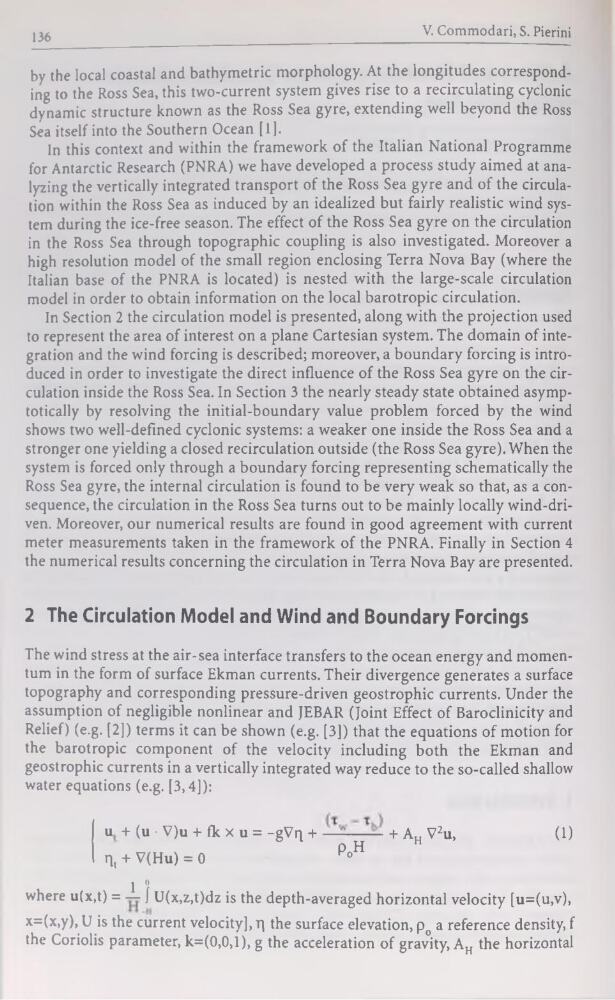
The wind stress at the air-sea interface transfers to the océan energy and momentum in the form of surface Ekman currents. Their divergence generates a surface
topography and corresponding pressure-driven geostrophic currents. Under the
assumption of negligible nonlinear and JEBAR (Joint Effect of Baroclinicity and
Relief) (e.g. [2]) terms it can be shown (e.g. [3]) that the équations of motion for
the barotropic component of the velocity including both the Ekman and
geostrophic currents in a vertically integrated way reduce to the so-called shallow
water équations (e.g. [3,4]):
u + (u • V)u + fk x u = -gVq + —---- — + A„ V2u,
(1)
p H
H
nt + v(Hu) = o
Ho
1 0
where u(x,t) = — J U(x,z,t)dz is the depth-averaged horizontal velocity [u=(u,v),
x=(x,y), U is the current velocity], r| the surface élévation, po a reference density, f
the Coriolis parameter, k=(0,0,l), g the accélération of gravity, AH the horizontal
V. Commodari, S. Pierini
by the local Coastal and bathymétrie morphology. At the longitudes corresponding to the Ross Sea, this two-current System gives rise to a recirculating cyclonic
dynamic structure known as the Ross Sea gyre, extending well beyond the Ross
Sea itself into the Southern Océan [1].
In this context and within the Framework of the Italian National Programme
for Antarctic Research (PNRA) we hâve developed a process study aimed at analyzing the vertically integrated transport of the Ross Sea gyre and of the circulation within the Ross Sea as induced by an idealized but fairly realistic wind System during the ice-free season. The effect of the Ross Sea gyre on the circulation
in the Ross Sea through topographie coupling is also investigated. Moreover a
high resolution model of the small région enclosing Terra Nova Bay (where the
Italian base of the PNRA is located) is nested with the large-scale circulation
model in order to obtain information on the local barotropic circulation.
In Section 2 the circulation model is presented, along with the projection used
to represent the area of interest on a plane Cartesian System. The domain of intégration and the wind forcing is described; moreover, a boundary forcing is introduced in order to investigate the direct influence of the Ross Sea gyre on the circulation inside the Ross Sea. In Section 3 the nearly steady State obtained asymptotically by resolving the initial-boundary value problem forced by the wind
shows two well-defined cyclonic Systems: a weaker one inside the Ross Sea and a
stronger one yielding a closed recirculation outside (the Ross Sea gyre). When the
System is forced only through a boundary forcing representing schematically the
Ross Sea gyre, the internai circulation is found to be very weak so that, as a conséquence, the circulation in the Ross Sea turns out to be mainly locally wind-driven. Moreover, our numerical results are found in good agreement with current
meter measurements taken in the framework of the PNRA. Finally in Section 4
the numerical results concerning the circulation in Terra Nova Bay are presented.
2 The Circulation Model and Wind and Boundary Forcings
The wind stress at the air-sea interface transfers to the océan energy and momentum in the form of surface Ekman currents. Their divergence generates a surface
topography and corresponding pressure-driven geostrophic currents. Under the
assumption of negligible nonlinear and JEBAR (Joint Effect of Baroclinicity and
Relief) (e.g. [2]) terms it can be shown (e.g. [3]) that the équations of motion for
the barotropic component of the velocity including both the Ekman and
geostrophic currents in a vertically integrated way reduce to the so-called shallow
water équations (e.g. [3,4]):
u + (u • V)u + fk x u = -gVq + —---- — + A„ V2u,
(1)
p H
H
nt + v(Hu) = o
Ho
1 0
where u(x,t) = — J U(x,z,t)dz is the depth-averaged horizontal velocity [u=(u,v),
x=(x,y), U is the current velocity], r| the surface élévation, po a reference density, f
the Coriolis parameter, k=(0,0,l), g the accélération of gravity, AH the horizontal