

106
P. Picco et al.
Circumpolar Antarctic Water (MCAW)_ at east. Salinity at this level is around
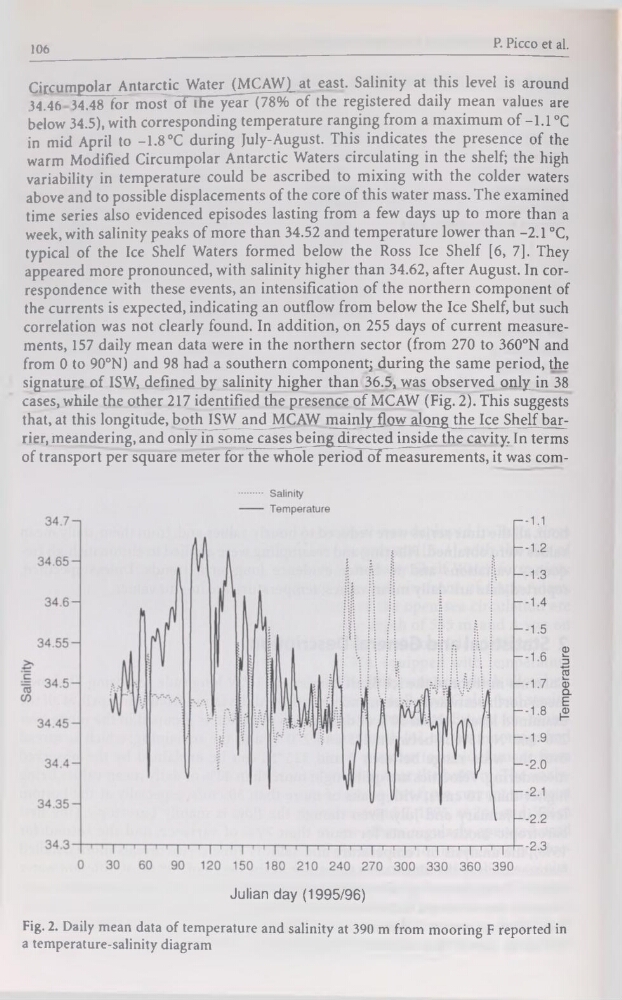
34.46 34.48 for most of the year (78% of the registered daily mean values are
below 34.5), with corresponding température ranging from a maximum of -1.1 °C
in mid April to -1.8°C during July-August. This indicates the presence of the
warm Modified Circumpolar Antarctic Waters circulating in the shelf; the high
variability in température could be ascribed to mixing with the colder waters
above and to possible displacements of the core of this water mass. The examined
time sériés also evidenced épisodes lasting from a few days up to more than a
week, with salinity peaks of more than 34.52 and température lower than -2.1 °C,
typical of the Ice Shelf Waters formed below the Ross Ice Shelf [6, 7]. They
appeared more pronounced, with salinity higher than 34.62, after August. In correspondence with these events, an intensification of the northern component of
the currents is expected, indicating an outflow from below the Ice Shelf, but such
corrélation was not clearly found. In addition, on 255 days of current measurements, 157 daily mean data were in the northern sector (from 270 to 360°N and
from 0 to 90°N) and 98 had a Southern component; during the same period, the
signature of ISW, defined by salinity higher than 36.5, was observed only in 38
cases, while the other 217 identified the presence of MCAW (Fig. 2). This suggests
that, at this longitude, both ISW and MCAW mainly flow along the Ice Shelf barrier, meandering, and only in some cases being directed inside the cavity. In terms
of transport per square meter for the whole period of measurements, it was comJulian day (1995/96)
Fig. 2. Daily mean data of température and salinity at 390 m from mooring F reported in
a temperature-saiinity diagram
P. Picco et al.
Circumpolar Antarctic Water (MCAW)_ at east. Salinity at this level is around
34.46 34.48 for most of the year (78% of the registered daily mean values are
below 34.5), with corresponding température ranging from a maximum of -1.1 °C
in mid April to -1.8°C during July-August. This indicates the presence of the
warm Modified Circumpolar Antarctic Waters circulating in the shelf; the high
variability in température could be ascribed to mixing with the colder waters
above and to possible displacements of the core of this water mass. The examined
time sériés also evidenced épisodes lasting from a few days up to more than a
week, with salinity peaks of more than 34.52 and température lower than -2.1 °C,
typical of the Ice Shelf Waters formed below the Ross Ice Shelf [6, 7]. They
appeared more pronounced, with salinity higher than 34.62, after August. In correspondence with these events, an intensification of the northern component of
the currents is expected, indicating an outflow from below the Ice Shelf, but such
corrélation was not clearly found. In addition, on 255 days of current measurements, 157 daily mean data were in the northern sector (from 270 to 360°N and
from 0 to 90°N) and 98 had a Southern component; during the same period, the
signature of ISW, defined by salinity higher than 36.5, was observed only in 38
cases, while the other 217 identified the presence of MCAW (Fig. 2). This suggests
that, at this longitude, both ISW and MCAW mainly flow along the Ice Shelf barrier, meandering, and only in some cases being directed inside the cavity. In terms
of transport per square meter for the whole period of measurements, it was comJulian day (1995/96)
Fig. 2. Daily mean data of température and salinity at 390 m from mooring F reported in
a temperature-saiinity diagram