

92
V. Gouretski
The range of parameters on this surface north of the continental slope is reduced
to only 0.2 °C for température and 0.02 for salinity, so that increased patchiness
due to observational errors makes the interprétation of some features ambiguous. However, an intrusion of LCDW with the Southern limb is évident in the
higher températures (>0.65°) and salinities (>34.715).
6 A Quasi-synoptic View of the Ross Gyre
in July 1985-February 1986
Hydrographie observations were made aboard Russian research vessels
“Professor Zubov” and “Professer Vieze” over most of the Ross Gyre during the
time period from the end of December 1985 to the end of February 1986 [7].
Vertical profiles of température, salinity, oxygen and silicate were measured at
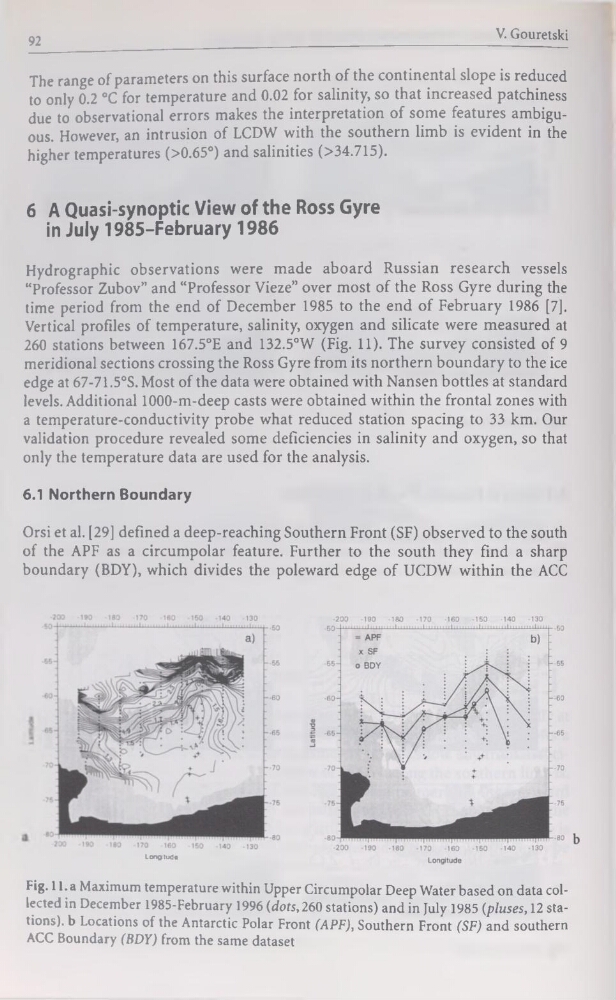
260 stations between 167.5°E and 132.5°W (Fig. 11). The survey consisted of 9
méridional sections Crossing the Ross Gyre from its northern boundary to the ice
edge at 67-71.5°S. Most of the data were obtained with Nansen bottles at standard
levels. Additional 1000-m-deep casts were obtained within the frontal zones with
a temperature-conductivity probe what reduced station spacing to 33 km. Our
validation procedure revealed some deficiencies in salinity and oxygen, so that
only the température data are used for the analysis.
6.1 Northern Boundary
Orsi et al. [29] defined a deep-reaching Southern Front (SF) observed to the south
of the APF as a circumpolar feature. Further to the south they find a sharp
boundary (BDY), which divides the poleward edge of UCDW within the ACC
Longitude
Fig. 1 l.a Maximum température within Upper Circumpolar Deep Water based on data collected in December 1985-February 1996 (dots, 260 stations) and in July 1985 (pluses, 12 stations). b Locations of the Antarctic Polar Front (APF), Southern Front (SF) and Southern
ACC Boundary (BDY) from the same dataset
V. Gouretski
The range of parameters on this surface north of the continental slope is reduced
to only 0.2 °C for température and 0.02 for salinity, so that increased patchiness
due to observational errors makes the interprétation of some features ambiguous. However, an intrusion of LCDW with the Southern limb is évident in the
higher températures (>0.65°) and salinities (>34.715).
6 A Quasi-synoptic View of the Ross Gyre
in July 1985-February 1986
Hydrographie observations were made aboard Russian research vessels
“Professor Zubov” and “Professer Vieze” over most of the Ross Gyre during the
time period from the end of December 1985 to the end of February 1986 [7].
Vertical profiles of température, salinity, oxygen and silicate were measured at
260 stations between 167.5°E and 132.5°W (Fig. 11). The survey consisted of 9
méridional sections Crossing the Ross Gyre from its northern boundary to the ice
edge at 67-71.5°S. Most of the data were obtained with Nansen bottles at standard
levels. Additional 1000-m-deep casts were obtained within the frontal zones with
a temperature-conductivity probe what reduced station spacing to 33 km. Our
validation procedure revealed some deficiencies in salinity and oxygen, so that
only the température data are used for the analysis.
6.1 Northern Boundary
Orsi et al. [29] defined a deep-reaching Southern Front (SF) observed to the south
of the APF as a circumpolar feature. Further to the south they find a sharp
boundary (BDY), which divides the poleward edge of UCDW within the ACC
Longitude
Fig. 1 l.a Maximum température within Upper Circumpolar Deep Water based on data collected in December 1985-February 1996 (dots, 260 stations) and in July 1985 (pluses, 12 stations). b Locations of the Antarctic Polar Front (APF), Southern Front (SF) and Southern
ACC Boundary (BDY) from the same dataset