

Free surface flows 83
y
q
g
c =
2
3
(5.6)
where q is the flow discharge per unit width.
5.2.1.1 Newton-Raphson method for estimation
of the normal and critical depths
Since both y n and y c are implicitly involved in Equations 5.2, 5.3 and 5.5,
solutions can be obtained very effectively using a numerical iterative algorithm such as the Newton-Raphson method. By considering a trapezoidalshaped channel (Figure 5.2), the equations that describe its geometric
characteristics are as follows:
A = (b + my)y
(5.7)
P
b
y
m
w = +
+
2 1
2
(5.8)
T = b + 2my
(5.9)
These equations can be also used for rectangular channels (m = 0) or for
triangular ones (b = 0). Combining Equations 5.2, 5.7 and 5.8 leads to the
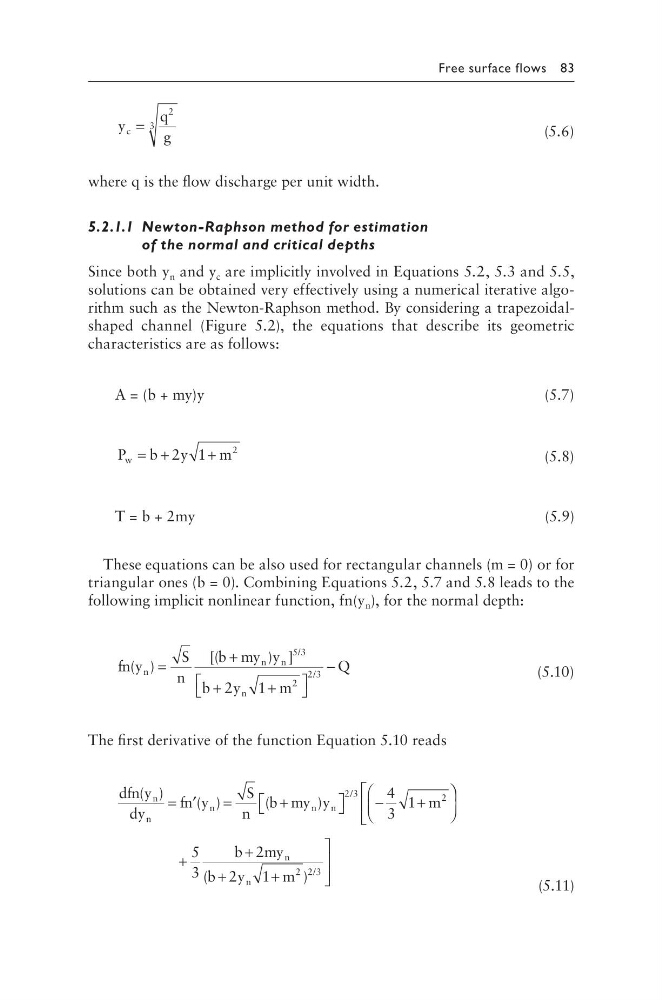
following implicit nonlinear function, fn(y n ), for the normal depth:
fn y
S
n
b my y
b
y
m
Q
n
n
n
n
( )
[(
) ]
/
/
=
+
+
+
−
5 3
2
2 3
2
1
(5.10)
The first derivative of the function Equation 5.10 reads
dfn y
dy
fn y
S
n
b my y
m
n
n
n
nn
( )
( )
(
)
/
= ′
=
+
−
+
2 3
2
4
3
1
+
+
+
+
5
3
2
2
1
2 2 3
b my
b y
m
n
n
(
)
/
(5.11)
y
q
g
c =
2
3
(5.6)
where q is the flow discharge per unit width.
5.2.1.1 Newton-Raphson method for estimation
of the normal and critical depths
Since both y n and y c are implicitly involved in Equations 5.2, 5.3 and 5.5,
solutions can be obtained very effectively using a numerical iterative algorithm such as the Newton-Raphson method. By considering a trapezoidalshaped channel (Figure 5.2), the equations that describe its geometric
characteristics are as follows:
A = (b + my)y
(5.7)
P
b
y
m
w = +
+
2 1
2
(5.8)
T = b + 2my
(5.9)
These equations can be also used for rectangular channels (m = 0) or for
triangular ones (b = 0). Combining Equations 5.2, 5.7 and 5.8 leads to the
following implicit nonlinear function, fn(y n ), for the normal depth:
fn y
S
n
b my y
b
y
m
Q
n
n
n
n
( )
[(
) ]
/
/
=
+
+
+
−
5 3
2
2 3
2
1
(5.10)
The first derivative of the function Equation 5.10 reads
dfn y
dy
fn y
S
n
b my y
m
n
n
n
nn
( )
( )
(
)
/
= ′
=
+
−
+
2 3
2
4
3
1
+
+
+
+
5
3
2
2
1
2 2 3
b my
b y
m
n
n
(
)
/
(5.11)