

Flow in pressurized conduits 59
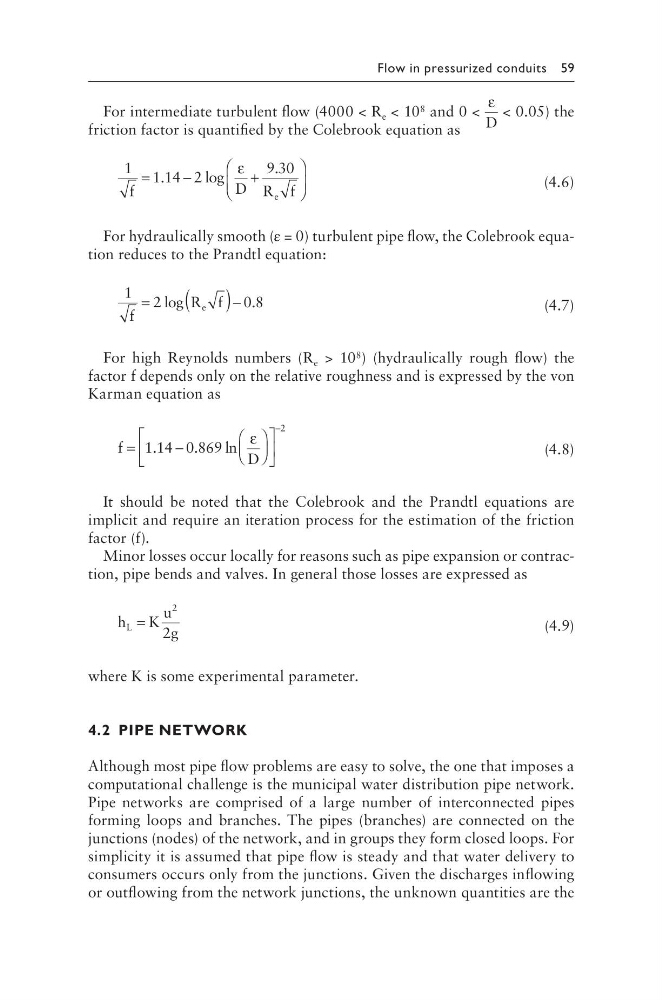
For intermediate turbulent flow (4000 < R e < 10 8 and 0 <
ε
D
< 0.05) the
friction factor is quantified by the Colebrook equation as
1 1 14 2
9 30
f
D R f
e
=
−
+
.
log
.
ε
(4.6)
For hydraulically smooth (ε = 0) turbulent pipe flow, the Colebrook equation reduces to the Prandtl equation:
1 2
0 8
f
R f
e
=
( )−
log
.
(4.7)
For high Reynolds numbers (R e > 10 8 ) (hydraulically rough flow) the
factor f depends only on the relative roughness and is expressed by the von
Karman equation as
f
D
=
−
−
1 14 0 869
2
.
.
ln
ε
(4.8)
It should be noted that the Colebrook and the Prandtl equations are
implicit and require an iteration process for the estimation of the friction
factor (f).
Minor losses occur locally for reasons such as pipe expansion or contraction, pipe bends and valves. In general those losses are expressed as
h
K
u
g
L =
2
2
(4.9)
where K is some experimental parameter.
4.2 PIPE NETWORK
Although most pipe flow problems are easy to solve, the one that imposes a
computational challenge is the municipal water distribution pipe network.
Pipe networks are comprised of a large number of interconnected pipes
forming loops and branches. The pipes (branches) are connected on the
junctions (nodes) of the network, and in groups they form closed loops. For
simplicity it is assumed that pipe flow is steady and that water delivery to
consumers occurs only from the junctions. Given the discharges inflowing
or outflowing from the network junctions, the unknown quantities are the
For intermediate turbulent flow (4000 < R e < 10 8 and 0 <
ε
D
< 0.05) the
friction factor is quantified by the Colebrook equation as
1 1 14 2
9 30
f
D R f
e
=
−
+
.
log
.
ε
(4.6)
For hydraulically smooth (ε = 0) turbulent pipe flow, the Colebrook equation reduces to the Prandtl equation:
1 2
0 8
f
R f
e
=
( )−
log
.
(4.7)
For high Reynolds numbers (R e > 10 8 ) (hydraulically rough flow) the
factor f depends only on the relative roughness and is expressed by the von
Karman equation as
f
D
=
−
−
1 14 0 869
2
.
.
ln
ε
(4.8)
It should be noted that the Colebrook and the Prandtl equations are
implicit and require an iteration process for the estimation of the friction
factor (f).
Minor losses occur locally for reasons such as pipe expansion or contraction, pipe bends and valves. In general those losses are expressed as
h
K
u
g
L =
2
2
(4.9)
where K is some experimental parameter.
4.2 PIPE NETWORK
Although most pipe flow problems are easy to solve, the one that imposes a
computational challenge is the municipal water distribution pipe network.
Pipe networks are comprised of a large number of interconnected pipes
forming loops and branches. The pipes (branches) are connected on the
junctions (nodes) of the network, and in groups they form closed loops. For
simplicity it is assumed that pipe flow is steady and that water delivery to
consumers occurs only from the junctions. Given the discharges inflowing
or outflowing from the network junctions, the unknown quantities are the