

58 Computational Modelling in Hydraulic and Coastal Engineering
The term h e includes both the frictional (h f ) and the local (minor; h L )
energy losses. The frictional losses are quantified by the well-known DarcyWeisbach equation:
h f
L
D
u
g
f g
LQ
D
RQ
f =
=
=
2
2
2
5
2
2
8
π
(4.4)
where f is the friction coefficient and R is the resistance coefficient. The friction coefficient depends on the Reynolds number R
uD uD
e =
=
ρ
µ
ν
and the
relative roughness
ε
D
, where ρ is the fluid density, μ is the dynamic (or absolute viscosity), ν is the kinematic viscosity, and ε is the roughness of the pipe’s
interior surface (available from the manufacturer’s specifications). The DarcyWeisbach formula is valid for both turbulent and laminar flows. For laminar
flow (R e < 4000) the friction factor is independent of the relative roughness:
f R e
=
64
(4.5)
2
1
z 1
z 2
y 1
y 2
u 1
2 /2g
u 2
2 /2g
Reference datum
Energy grade line
Hydraulic grade line
h f
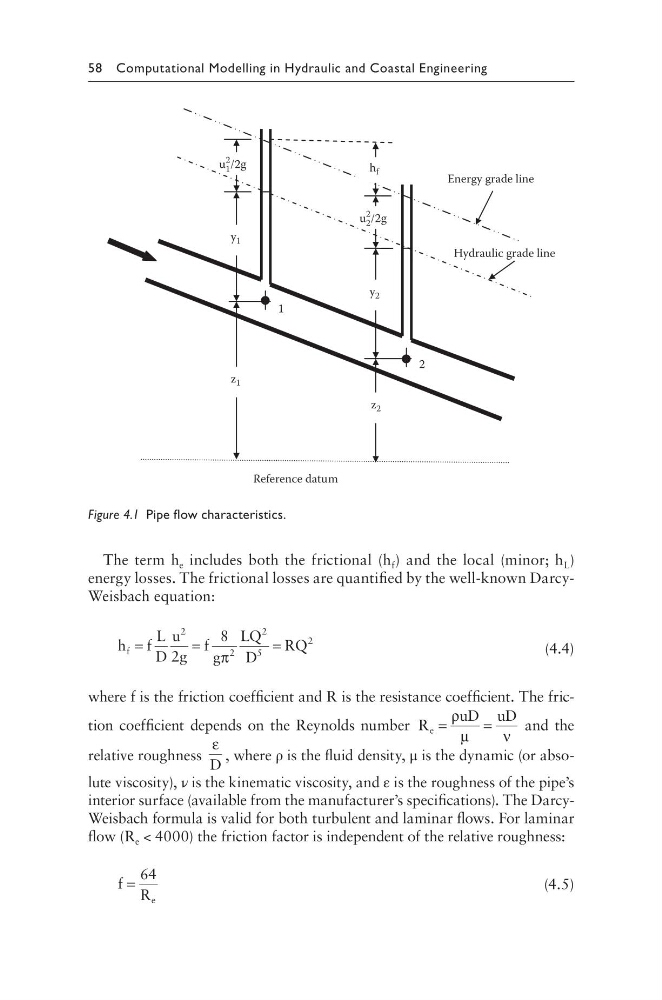
Figure 4.1 Pipe flow characteristics.
The term h e includes both the frictional (h f ) and the local (minor; h L )
energy losses. The frictional losses are quantified by the well-known DarcyWeisbach equation:
h f
L
D
u
g
f g
LQ
D
RQ
f =
=
=
2
2
2
5
2
2
8
π
(4.4)
where f is the friction coefficient and R is the resistance coefficient. The friction coefficient depends on the Reynolds number R
uD uD
e =
=
ρ
µ
ν
and the
relative roughness
ε
D
, where ρ is the fluid density, μ is the dynamic (or absolute viscosity), ν is the kinematic viscosity, and ε is the roughness of the pipe’s
interior surface (available from the manufacturer’s specifications). The DarcyWeisbach formula is valid for both turbulent and laminar flows. For laminar
flow (R e < 4000) the friction factor is independent of the relative roughness:
f R e
=
64
(4.5)
2
1
z 1
z 2
y 1
y 2
u 1
2 /2g
u 2
2 /2g
Reference datum
Energy grade line
Hydraulic grade line
h f
Figure 4.1 Pipe flow characteristics.