

30 Computational Modelling in Hydraulic and Coastal Engineering
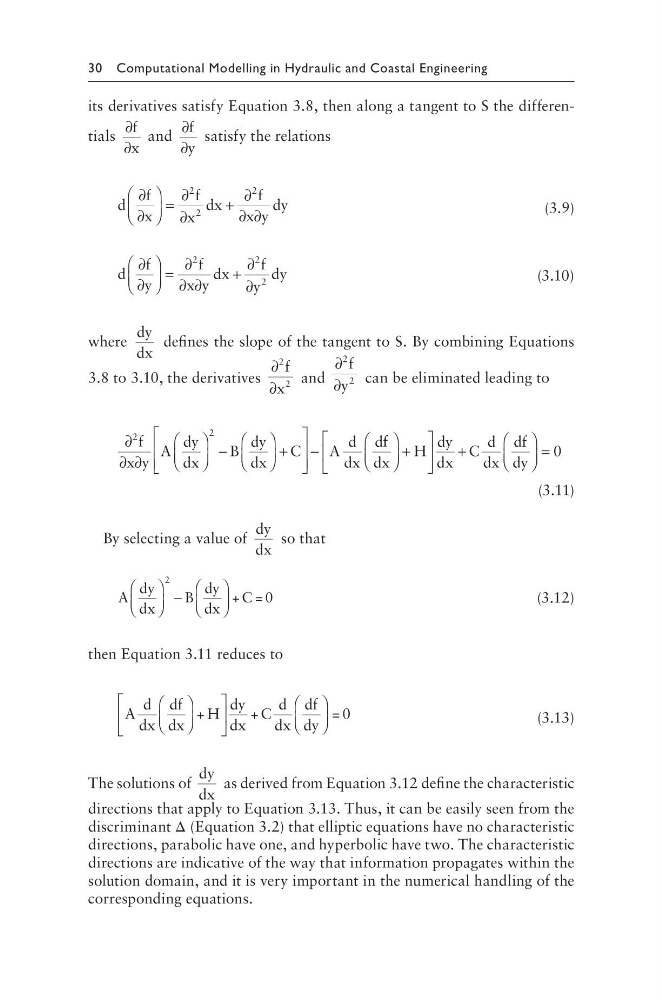
its derivatives satisfy Equation 3.8, then along a tangent to S the differentials
∂
∂
f
x
and
∂
∂
f
y
satisfy the relations
d
f
x
f
x
dx
f
x y
dy
∂
∂
=
∂
∂
+
∂
∂ ∂
2
2
2
(3.9)
d
f
y
f
x y
dx
f
y
dy
∂
∂
=
∂
∂ ∂
+
∂
∂
2
2
2
(3.10)
where
dy
dx
defines the slope of the tangent to S. By combining Equations
3.8 to 3.10, the derivatives
∂
∂
2
2
f
x
and
∂
∂
2
2
f
y
can be eliminated leading to
∂
∂ ∂
−
+
−
2
2
f
x y
A
dy
dx
B
dy
dx
C
A
d
dx
df f
dx
H
dy
dx
C
d
dx
df
dy
+
+
= 0
(3.11)
By selecting a value of
dy
dx
so that
A
dy
dx
B
dy
dx
+ C = 0
2
−
(3.12)
then Equation 3.11 reduces to
A
d
dx
df
dx
+ H
dy
dx
+ C
d
dx
df
dy
= 0
(3.13)
The solutions of
dy
dx
as derived from Equation 3.12 define the characteristic
directions that apply to Equation 3.13. Thus, it can be easily seen from the
discriminant Δ (Equation 3.2) that elliptic equations have no characteristic
directions, parabolic have one, and hyperbolic have two. The characteristic
directions are indicative of the way that information propagates within the
solution domain, and it is very important in the numerical handling of the
corresponding equations.
its derivatives satisfy Equation 3.8, then along a tangent to S the differentials
∂
∂
f
x
and
∂
∂
f
y
satisfy the relations
d
f
x
f
x
dx
f
x y
dy
∂
∂
=
∂
∂
+
∂
∂ ∂
2
2
2
(3.9)
d
f
y
f
x y
dx
f
y
dy
∂
∂
=
∂
∂ ∂
+
∂
∂
2
2
2
(3.10)
where
dy
dx
defines the slope of the tangent to S. By combining Equations
3.8 to 3.10, the derivatives
∂
∂
2
2
f
x
and
∂
∂
2
2
f
y
can be eliminated leading to
∂
∂ ∂
−
+
−
2
2
f
x y
A
dy
dx
B
dy
dx
C
A
d
dx
df f
dx
H
dy
dx
C
d
dx
df
dy
+
+
= 0
(3.11)
By selecting a value of
dy
dx
so that
A
dy
dx
B
dy
dx
+ C = 0
2
−
(3.12)
then Equation 3.11 reduces to
A
d
dx
df
dx
+ H
dy
dx
+ C
d
dx
df
dy
= 0
(3.13)
The solutions of
dy
dx
as derived from Equation 3.12 define the characteristic
directions that apply to Equation 3.13. Thus, it can be easily seen from the
discriminant Δ (Equation 3.2) that elliptic equations have no characteristic
directions, parabolic have one, and hyperbolic have two. The characteristic
directions are indicative of the way that information propagates within the
solution domain, and it is very important in the numerical handling of the
corresponding equations.