

27
Chapter 3
Common partial
differential equations of
computational hydraulics
3.1 CLASSIFICATION OF PARTIAL
DIFFERENTIAL EQUATIONS
Many phenomena in hydrodynamics are described by partial differential
equations (PDEs) that cannot be solved analytically. As a result, solutions
for those equations are feasible only by means of numerical algorithms. The
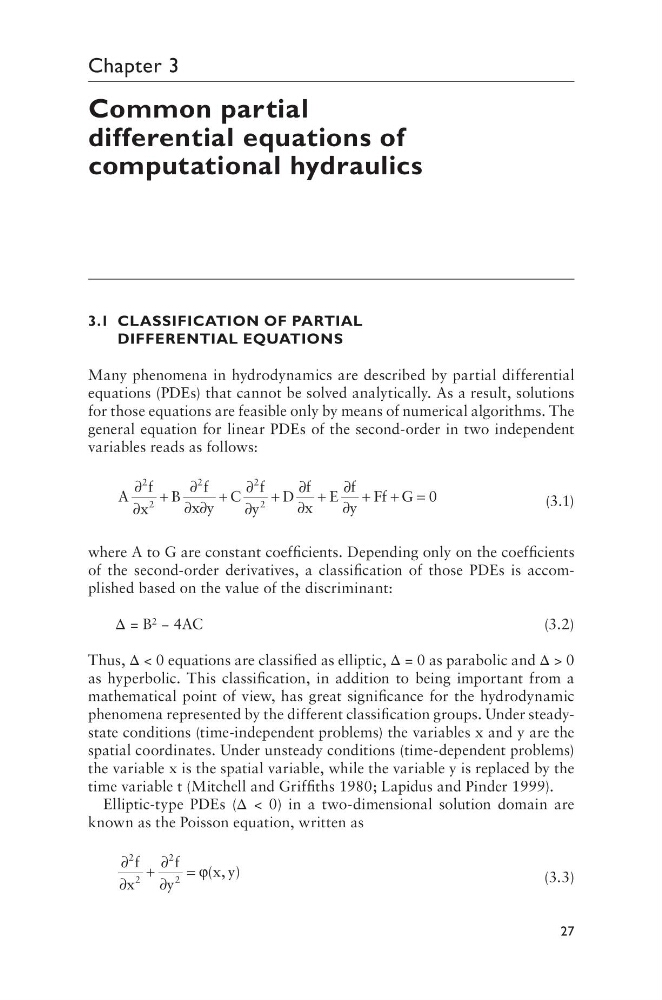
general equation for linear PDEs of the second-order in two independent
variables reads as follows:
A
f
x
B
f
x y
C
f
y
D
f
x
E
f
y
Ff G
∂
∂
+
∂
∂ ∂
+
∂
∂
+
∂
∂
+
∂
∂
+ + =
2
2
2
2
2
0
(3.1)
where A to G are constant coefficients. Depending only on the coefficients
of the second-order derivatives, a classification of those PDEs is accomplished based on the value of the discriminant:
Δ = B 2 − 4AC
(3.2)
Thus, Δ < 0 equations are classified as elliptic, Δ = 0 as parabolic and Δ > 0
as hyperbolic. This classification, in addition to being important from a
mathematical point of view, has great significance for the hydrodynamic
phenomena represented by the different classification groups. Under steadystate conditions (time-independent problems) the variables x and y are the
spatial coordinates. Under unsteady conditions (time-dependent problems)
the variable x is the spatial variable, while the variable y is replaced by the
time variable t (Mitchell and Griffiths 1980; Lapidus and Pinder 1999).
Elliptic-type PDEs (Δ < 0) in a two-dimensional solution domain are
known as the Poisson equation, written as
∂
∂
+
∂
∂
=
2
2
2
2
f
x
f
y
x y
ϕ( , )
(3.3)
Chapter 3
Common partial
differential equations of
computational hydraulics
3.1 CLASSIFICATION OF PARTIAL
DIFFERENTIAL EQUATIONS
Many phenomena in hydrodynamics are described by partial differential
equations (PDEs) that cannot be solved analytically. As a result, solutions
for those equations are feasible only by means of numerical algorithms. The
general equation for linear PDEs of the second-order in two independent
variables reads as follows:
A
f
x
B
f
x y
C
f
y
D
f
x
E
f
y
Ff G
∂
∂
+
∂
∂ ∂
+
∂
∂
+
∂
∂
+
∂
∂
+ + =
2
2
2
2
2
0
(3.1)
where A to G are constant coefficients. Depending only on the coefficients
of the second-order derivatives, a classification of those PDEs is accomplished based on the value of the discriminant:
Δ = B 2 − 4AC
(3.2)
Thus, Δ < 0 equations are classified as elliptic, Δ = 0 as parabolic and Δ > 0
as hyperbolic. This classification, in addition to being important from a
mathematical point of view, has great significance for the hydrodynamic
phenomena represented by the different classification groups. Under steadystate conditions (time-independent problems) the variables x and y are the
spatial coordinates. Under unsteady conditions (time-dependent problems)
the variable x is the spatial variable, while the variable y is replaced by the
time variable t (Mitchell and Griffiths 1980; Lapidus and Pinder 1999).
Elliptic-type PDEs (Δ < 0) in a two-dimensional solution domain are
known as the Poisson equation, written as
∂
∂
+
∂
∂
=
2
2
2
2
f
x
f
y
x y
ϕ( , )
(3.3)