

Contaminant and sediment transport by advection and diffusion 237
using some well-established quantitative relations in combination with the
principle of mass conservation for the sediment in the cross-shore direction.
The result will be a partial differential equation (PDE) in terms of the water
depth h(x,t) across the beach.
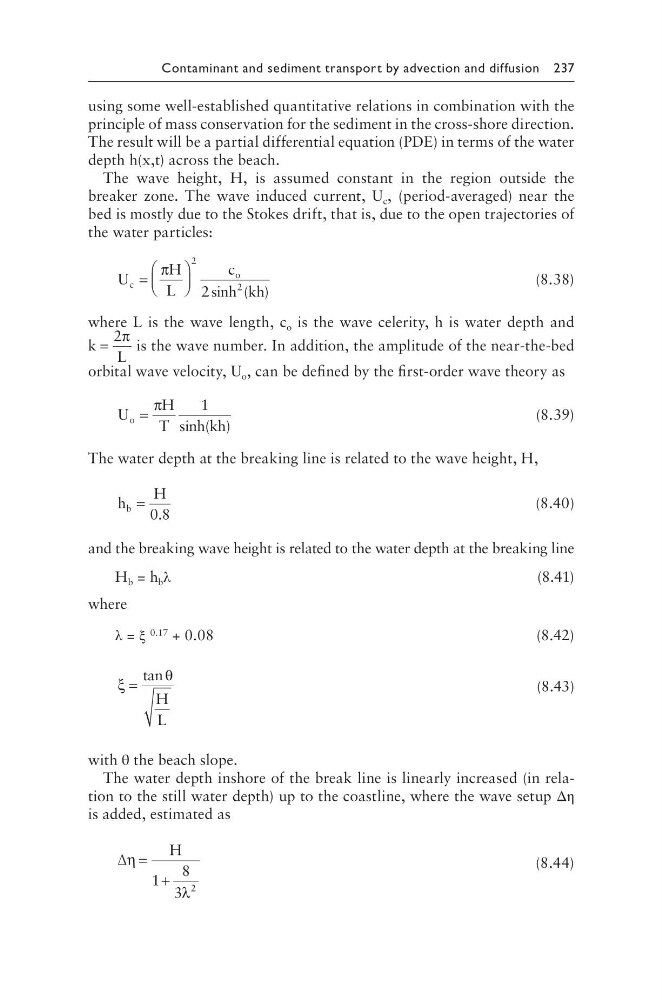
The wave height, H, is assumed constant in the region outside the
breaker zone. The wave induced current, U c , (period-averaged) near the
bed is mostly due to the Stokes drift, that is, due to the open trajectories of
the water particles:
U
H
L
c
kh
c
o
=
π
2
2
2sinh ( )
(8.38)
where L is the wave length, c o is the wave celerity, h is water depth and
k L
=
2π is the wave number. In addition, the amplitude of the near-the-bed
orbital wave velocity, U o , can be defined by the first-order wave theory as
U
H
T
kh
o =
π
1
sinh( )
(8.39)
The water depth at the breaking line is related to the wave height, H,
h
H
b = 0 8
.
(8.40)
and the breaking wave height is related to the water depth at the breaking line
H b = h b λ
(8.41)
where
λ = ξ 0.17 + 0.08
(8.42)
ξ
θ
=
tan
H
L
(8.43)
with θ the beach slope.
The water depth inshore of the break line is linearly increased (in relation to the still water depth) up to the coastline, where the wave setup Δη
is added, estimated as
∆η
λ
=
+
H
1
8
3
2
(8.44)
using some well-established quantitative relations in combination with the
principle of mass conservation for the sediment in the cross-shore direction.
The result will be a partial differential equation (PDE) in terms of the water
depth h(x,t) across the beach.
The wave height, H, is assumed constant in the region outside the
breaker zone. The wave induced current, U c , (period-averaged) near the
bed is mostly due to the Stokes drift, that is, due to the open trajectories of
the water particles:
U
H
L
c
kh
c
o
=
π
2
2
2sinh ( )
(8.38)
where L is the wave length, c o is the wave celerity, h is water depth and
k L
=
2π is the wave number. In addition, the amplitude of the near-the-bed
orbital wave velocity, U o , can be defined by the first-order wave theory as
U
H
T
kh
o =
π
1
sinh( )
(8.39)
The water depth at the breaking line is related to the wave height, H,
h
H
b = 0 8
.
(8.40)
and the breaking wave height is related to the water depth at the breaking line
H b = h b λ
(8.41)
where
λ = ξ 0.17 + 0.08
(8.42)
ξ
θ
=
tan
H
L
(8.43)
with θ the beach slope.
The water depth inshore of the break line is linearly increased (in relation to the still water depth) up to the coastline, where the wave setup Δη
is added, estimated as
∆η
λ
=
+
H
1
8
3
2
(8.44)