

236 Computational Modelling in Hydraulic and Coastal Engineering
4. The two near-bed sediment fluxes, one moving onshore outside the
breaking line and one moving offshore inside the breaking line, converge on the breaking line, where the sediment is accumulated, creating in time a sand bar.
5. This bar increases to a shape that is stabilized due to the sediment
transport threshold and to the maximum possible natural bed slope
(angle of repose).
6. This bar locally reduces the water depth and consequently the breaking wave height from this position to the coastline, and thus reduces
the erosive capacity of the waves.
In summary, sand masses are transported through erosion, mainly from the
inshore region towards the wave breaking line, thus forming a defence from
further beach erosion.
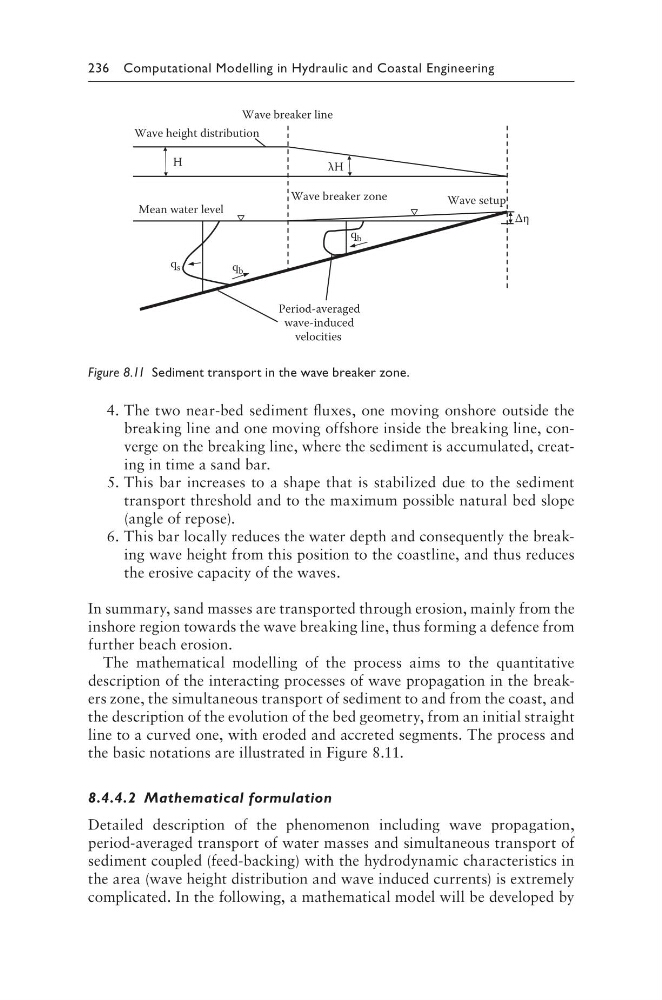
The mathematical modelling of the process aims to the quantitative
description of the interacting processes of wave propagation in the breakers zone, the simultaneous transport of sediment to and from the coast, and
the description of the evolution of the bed geometry, from an initial straight
line to a curved one, with eroded and accreted segments. The process and
the basic notations are illustrated in Figure 8.11.
8.4.4.2 Mathematical formulation
Detailed description of the phenomenon including wave propagation,
period-averaged transport of water masses and simultaneous transport of
sediment coupled (feed-backing) with the hydrodynamic characteristics in
the area (wave height distribution and wave induced currents) is extremely
complicated. In the following, a mathematical model will be developed by
Wave breaker line
H
λH
Wave height distribution
Period-averaged
wave-induced
velocities
q b
q b
q s
Mean water level
Wave setup
Wave breaker zone
Δη
Figure 8.11 Sediment transport in the wave breaker zone.
4. The two near-bed sediment fluxes, one moving onshore outside the
breaking line and one moving offshore inside the breaking line, converge on the breaking line, where the sediment is accumulated, creating in time a sand bar.
5. This bar increases to a shape that is stabilized due to the sediment
transport threshold and to the maximum possible natural bed slope
(angle of repose).
6. This bar locally reduces the water depth and consequently the breaking wave height from this position to the coastline, and thus reduces
the erosive capacity of the waves.
In summary, sand masses are transported through erosion, mainly from the
inshore region towards the wave breaking line, thus forming a defence from
further beach erosion.
The mathematical modelling of the process aims to the quantitative
description of the interacting processes of wave propagation in the breakers zone, the simultaneous transport of sediment to and from the coast, and
the description of the evolution of the bed geometry, from an initial straight
line to a curved one, with eroded and accreted segments. The process and
the basic notations are illustrated in Figure 8.11.
8.4.4.2 Mathematical formulation
Detailed description of the phenomenon including wave propagation,
period-averaged transport of water masses and simultaneous transport of
sediment coupled (feed-backing) with the hydrodynamic characteristics in
the area (wave height distribution and wave induced currents) is extremely
complicated. In the following, a mathematical model will be developed by
Wave breaker line
H
λH
Wave height distribution
Period-averaged
wave-induced
velocities
q b
q b
q s
Mean water level
Wave setup
Wave breaker zone
Δη
Figure 8.11 Sediment transport in the wave breaker zone.