

212 Computational Modelling in Hydraulic and Coastal Engineering
In order to estimate the random velocity, for a certain particle during a
certain time step, a random number ranging from –1 to +1 is selected and
then multiplied by U B .
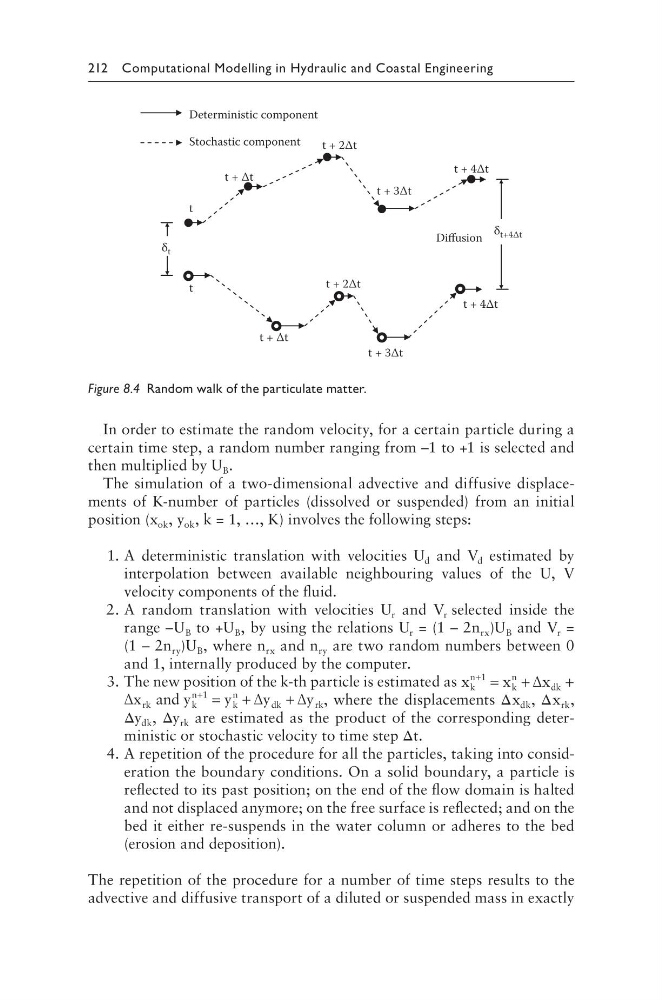
The simulation of a two-dimensional advective and diffusive displacements of K-number of particles (dissolved or suspended) from an initial
position (x ok , y ok , k = 1, …, K) involves the following steps:
1. A deterministic translation with velocities U d and V d estimated by
interpolation between available neighbouring values of the U, V
velocity components of the fluid.
2. A random translation with velocities U r and V r selected inside the
range –U B to +U B , by using the relations U r = (1 – 2n rx )U B and V r =
(1 – 2n ry )U B , where n rx and n ry are two random numbers between 0
and 1, internally produced by the computer.
3. The new position of the k-th particle is estimated as x
x
x
k
n
k
n
dk
+
=
+
+
1
∆
∆
∆
∆
x and y
y
y
y
rk
k
n
k
n
dk
rk
+
= +
+
1
, where the displacements Δx dk , Δx rk ,
Δy dk , Δy rk are estimated as the product of the corresponding deterministic or stochastic velocity to time step Δt.
4. A repetition of the procedure for all the particles, taking into consideration the boundary conditions. On a solid boundary, a particle is
reflected to its past position; on the end of the flow domain is halted
and not displaced anymore; on the free surface is reflected; and on the
bed it either re-suspends in the water column or adheres to the bed
(erosion and deposition).
The repetition of the procedure for a number of time steps results to the
advective and diffusive transport of a diluted or suspended mass in exactly
t
t + 4Δt
t + 4Δt
t + 3Δt
t + 3Δt
Stochastic component
t + 2Δt
t + 2Δt
t + Δt
t + Δt
Deterministic component
t
δ t
δ t+4Δt
Diffusion
Figure 8.4 Random walk of the particulate matter.
In order to estimate the random velocity, for a certain particle during a
certain time step, a random number ranging from –1 to +1 is selected and
then multiplied by U B .
The simulation of a two-dimensional advective and diffusive displacements of K-number of particles (dissolved or suspended) from an initial
position (x ok , y ok , k = 1, …, K) involves the following steps:
1. A deterministic translation with velocities U d and V d estimated by
interpolation between available neighbouring values of the U, V
velocity components of the fluid.
2. A random translation with velocities U r and V r selected inside the
range –U B to +U B , by using the relations U r = (1 – 2n rx )U B and V r =
(1 – 2n ry )U B , where n rx and n ry are two random numbers between 0
and 1, internally produced by the computer.
3. The new position of the k-th particle is estimated as x
x
x
k
n
k
n
dk
+
=
+
+
1
∆
∆
∆
∆
x and y
y
y
y
rk
k
n
k
n
dk
rk
+
= +
+
1
, where the displacements Δx dk , Δx rk ,
Δy dk , Δy rk are estimated as the product of the corresponding deterministic or stochastic velocity to time step Δt.
4. A repetition of the procedure for all the particles, taking into consideration the boundary conditions. On a solid boundary, a particle is
reflected to its past position; on the end of the flow domain is halted
and not displaced anymore; on the free surface is reflected; and on the
bed it either re-suspends in the water column or adheres to the bed
(erosion and deposition).
The repetition of the procedure for a number of time steps results to the
advective and diffusive transport of a diluted or suspended mass in exactly
t
t + 4Δt
t + 4Δt
t + 3Δt
t + 3Δt
Stochastic component
t + 2Δt
t + 2Δt
t + Δt
t + Δt
Deterministic component
t
δ t
δ t+4Δt
Diffusion
Figure 8.4 Random walk of the particulate matter.