

Contaminant and sediment transport by advection and diffusion 211
space, and it monitors the fluid behaviour within the control volume by balancing the fluxes through the surface boundaries with the changes occurring within the control volume.
The dynamics of a continuous medium can be effectively approximated
by a sufficiently large number of particles that would at least statistically
simulate the behaviour of the continuum.
The description of the properties of the continuum (density, velocity, pressure) is done through the tracking of the position and the properties of the
numerous particles that simulate it. Applications of that methodology in fluid
mechanics, is known as smoothed particle hydrodynamics (SPH) (Scarlatos
and Mehta 1993; Kourafalou et al. 2004; Zafirakou-Koulouris et al. 2012).
The correspondence between the real mass and the mass of the particles
is linear. For instance, if 1000 kg of water mass is simulated by 100,000
particles, then each particle represents 0.01 kg of water mass. It is obvious
that the bigger the number of particles, the more exact is the description,
but also the computational requirements increase substantially.
Simulation of a continuum by particles tracked in Lagrangian coordinates eliminates the problem of the numerical diffusion introduced during
the solution of the transport equation. It also offers the ability to track the
shape of the pollutant plume at the sub-grid scale (in space smaller than the
cell (ΔxΔy) used for the description of the hydrodynamics). This methodology applies to a wide range of simulation techniques of discrete particle
models and the Monte Carlo probabilistic method.
The movement of dissolved or suspended particles within the fluid
involves advective and diffusive processes. The advective motion requires
the knowledge of the ambient fluid velocity on the exact location or near
the tracked particle. Due to the domain discretization, this information is
available either on the nodes or the sides of the grid cells. However, interpolation between the nearest velocity values provides sufficient accuracy.
8.3.1 Application of the random-walk method
The diffusive particle transport process is accomplished by using Einstein’s
theory for the diffusion phenomena. According to that theory, diffusion is the
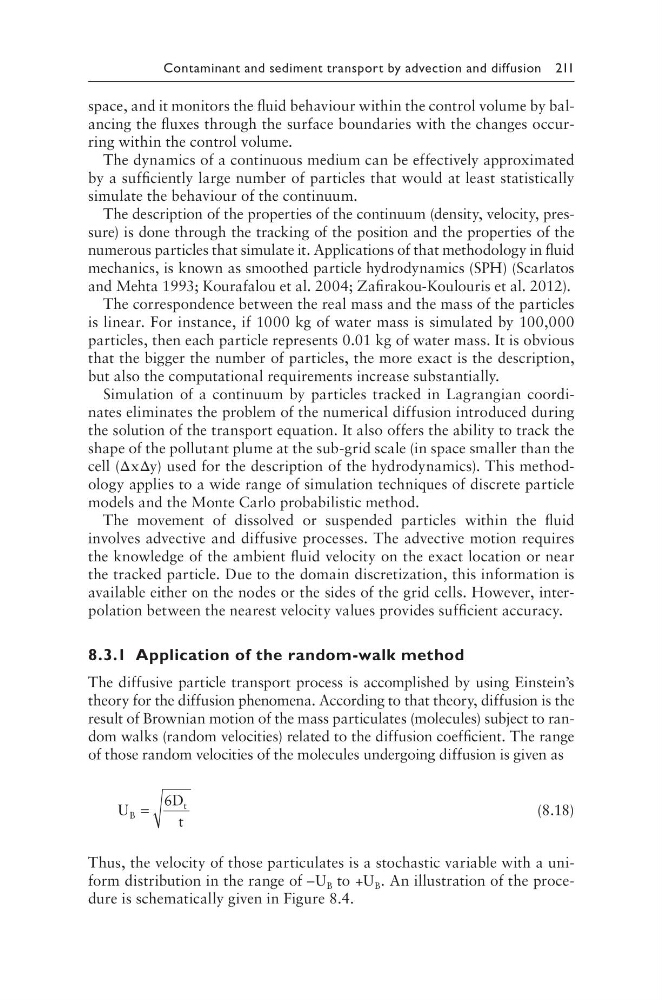
result of Brownian motion of the mass particulates (molecules) subject to random walks (random velocities) related to the diffusion coefficient. The range
of those random velocities of the molecules undergoing diffusion is given as
U
D
t
B
t
=
6
(8.18)
Thus, the velocity of those particulates is a stochastic variable with a uniform distribution in the range of –U B to +U B . An illustration of the procedure is schematically given in Figure 8.4.
space, and it monitors the fluid behaviour within the control volume by balancing the fluxes through the surface boundaries with the changes occurring within the control volume.
The dynamics of a continuous medium can be effectively approximated
by a sufficiently large number of particles that would at least statistically
simulate the behaviour of the continuum.
The description of the properties of the continuum (density, velocity, pressure) is done through the tracking of the position and the properties of the
numerous particles that simulate it. Applications of that methodology in fluid
mechanics, is known as smoothed particle hydrodynamics (SPH) (Scarlatos
and Mehta 1993; Kourafalou et al. 2004; Zafirakou-Koulouris et al. 2012).
The correspondence between the real mass and the mass of the particles
is linear. For instance, if 1000 kg of water mass is simulated by 100,000
particles, then each particle represents 0.01 kg of water mass. It is obvious
that the bigger the number of particles, the more exact is the description,
but also the computational requirements increase substantially.
Simulation of a continuum by particles tracked in Lagrangian coordinates eliminates the problem of the numerical diffusion introduced during
the solution of the transport equation. It also offers the ability to track the
shape of the pollutant plume at the sub-grid scale (in space smaller than the
cell (ΔxΔy) used for the description of the hydrodynamics). This methodology applies to a wide range of simulation techniques of discrete particle
models and the Monte Carlo probabilistic method.
The movement of dissolved or suspended particles within the fluid
involves advective and diffusive processes. The advective motion requires
the knowledge of the ambient fluid velocity on the exact location or near
the tracked particle. Due to the domain discretization, this information is
available either on the nodes or the sides of the grid cells. However, interpolation between the nearest velocity values provides sufficient accuracy.
8.3.1 Application of the random-walk method
The diffusive particle transport process is accomplished by using Einstein’s
theory for the diffusion phenomena. According to that theory, diffusion is the
result of Brownian motion of the mass particulates (molecules) subject to random walks (random velocities) related to the diffusion coefficient. The range
of those random velocities of the molecules undergoing diffusion is given as
U
D
t
B
t
=
6
(8.18)
Thus, the velocity of those particulates is a stochastic variable with a uniform distribution in the range of –U B to +U B . An illustration of the procedure is schematically given in Figure 8.4.