

Introduction 5
1.1.2 Development and application
of numerical models
The correct development and application of numerical models is a lengthy
process that requires competence and understanding of different scientific
areas. Those areas as well as the requirements involved are described as
follows:
• In-depth understanding of the physical phenomenon under consideration, through analysis and observations of field, laboratory and
theoretical data.
• Mathematical representation of the physical phenomena involved by
adopting a set of appropriate governing equations along with the necessary boundary and initial conditions.
• Making simplifying assumptions and conducting parameterization of
the various variables involved.
• Selection of an appropriate numerical scheme for solution of the governing equations. Special attention should be given to the computational consistency, convergence and stability.
• Model calibration, verification and validation using the necessary
data sets.
• Compilation, analysis and interpretation of the modelling results, followed by final reporting and presentation.
Lack of understanding or misinterpretation of a model’s abilities and limitations can lead to inaccurate or even totally erroneous solutions.
1.2 FINITE DIFFERENCES METHOD
The method of finite differences is a classical method of numerical analysis,
referring to the approximation of total or partial derivatives of functions,
with respect to one or more free variables like x, y, z and t (the space and
time variables), by divided differences of values of the functions.
The method is based on the expansion of a function in terms of Taylor
series and is very useful for the numerical solution of PDEs and ordinary
differential equations (ODEs) (Press et al. 1992; Cheney and Kincaid 2013).
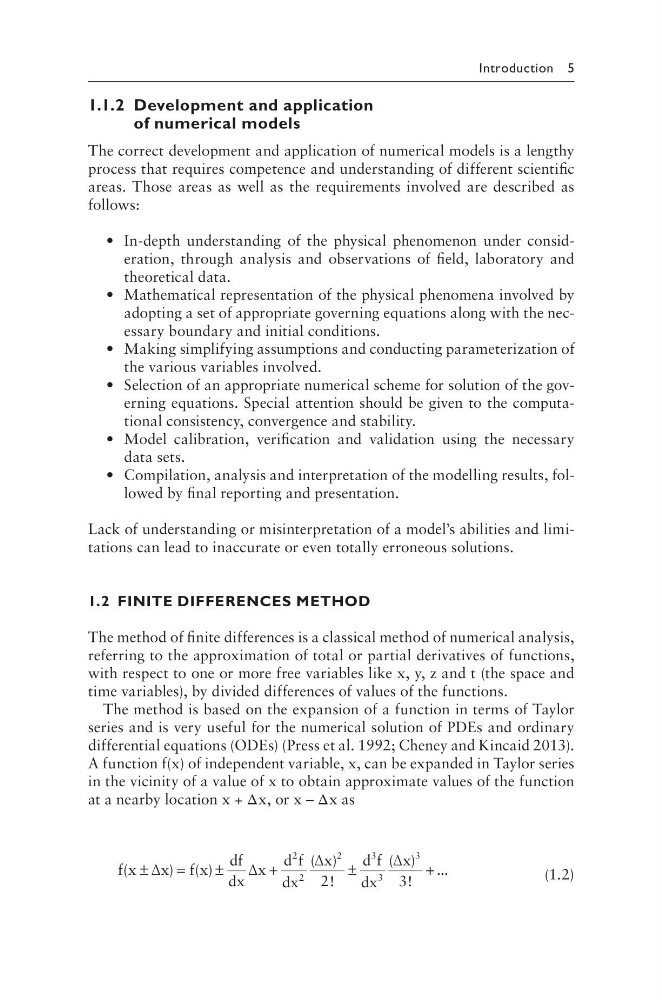
A function f(x) of independent variable, x, can be expanded in Taylor series
in the vicinity of a value of x to obtain approximate values of the function
at a nearby location x + Δx, or x – Δx as
f x
x f x
df
dx
x
d f
dx
x
d f
dx
x
(
) ( )
( )
!
( )
!
±
=
±
+
±
∆
∆
∆
∆
2
2
2
3
3
3
2
3
+ + ...
(1.2)
1.1.2 Development and application
of numerical models
The correct development and application of numerical models is a lengthy
process that requires competence and understanding of different scientific
areas. Those areas as well as the requirements involved are described as
follows:
• In-depth understanding of the physical phenomenon under consideration, through analysis and observations of field, laboratory and
theoretical data.
• Mathematical representation of the physical phenomena involved by
adopting a set of appropriate governing equations along with the necessary boundary and initial conditions.
• Making simplifying assumptions and conducting parameterization of
the various variables involved.
• Selection of an appropriate numerical scheme for solution of the governing equations. Special attention should be given to the computational consistency, convergence and stability.
• Model calibration, verification and validation using the necessary
data sets.
• Compilation, analysis and interpretation of the modelling results, followed by final reporting and presentation.
Lack of understanding or misinterpretation of a model’s abilities and limitations can lead to inaccurate or even totally erroneous solutions.
1.2 FINITE DIFFERENCES METHOD
The method of finite differences is a classical method of numerical analysis,
referring to the approximation of total or partial derivatives of functions,
with respect to one or more free variables like x, y, z and t (the space and
time variables), by divided differences of values of the functions.
The method is based on the expansion of a function in terms of Taylor
series and is very useful for the numerical solution of PDEs and ordinary
differential equations (ODEs) (Press et al. 1992; Cheney and Kincaid 2013).
A function f(x) of independent variable, x, can be expanded in Taylor series
in the vicinity of a value of x to obtain approximate values of the function
at a nearby location x + Δx, or x – Δx as
f x
x f x
df
dx
x
d f
dx
x
d f
dx
x
(
) ( )
( )
!
( )
!
±
=
±
+
±
∆
∆
∆
∆
2
2
2
3
3
3
2
3
+ + ...
(1.2)