

Surface gravity water waves 141
Therefore the total value of the free surface elevation at the incoming wave
boundary is
ζ total = ζ inc + ζ rad
(6.22)
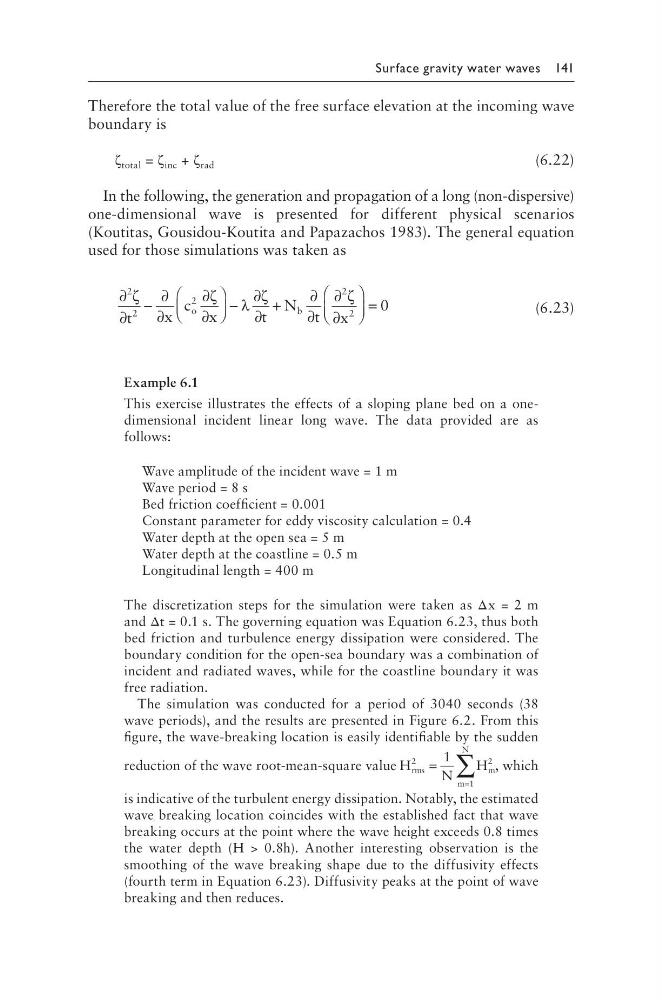
In the following, the generation and propagation of a long (non-dispersive)
one-dimensional wave is presented for different physical scenarios
(Koutitas, Gousidou-Koutita and Papazachos 1983). The general equation
used for those simulations was taken as
∂
∂
−
∂
∂
∂
∂
−
∂
∂
+
∂
∂
∂
∂
2
2
2
2
2
ζ
ζ
λ
ζ
ζ
t
x
c x
t
N t x
o
b
= = 0
(6.23)
Example 6.1
This exercise illustrates the effects of a sloping plane bed on a onedimensional incident linear long wave. The data provided are as
follows:
Wave amplitude of the incident wave = 1 m
Wave period = 8 s
Bed friction coefficient = 0.001
Constant parameter for eddy viscosity calculation = 0.4
Water depth at the open sea = 5 m
Water depth at the coastline = 0.5 m
Longitudinal length = 400 m
The discretization steps for the simulation were taken as Δx = 2 m
and Δt = 0.1 s. The governing equation was Equation 6.23, thus both
bed friction and turbulence energy dissipation were considered. The
boundary condition for the open-sea boundary was a combination of
incident and radiated waves, while for the coastline boundary it was
free radiation.
The simulation was conducted for a period of 3040 seconds (38
wave periods), and the results are presented in Figure 6.2. From this
figure, the wave-breaking location is easily identifiable by the sudden
reduction of the wave root-mean-square value H
N
H
rms
m
m
N
2
2
1
1
=
=
∑ , which
is indicative of the turbulent energy dissipation. Notably, the estimated
wave breaking location coincides with the established fact that wave
breaking occurs at the point where the wave height exceeds 0.8 times
the water depth (H > 0.8h). Another interesting observation is the
smoothing of the wave breaking shape due to the diffusivity effects
(fourth term in Equation 6.23). Diffusivity peaks at the point of wave
breaking and then reduces.
Therefore the total value of the free surface elevation at the incoming wave
boundary is
ζ total = ζ inc + ζ rad
(6.22)
In the following, the generation and propagation of a long (non-dispersive)
one-dimensional wave is presented for different physical scenarios
(Koutitas, Gousidou-Koutita and Papazachos 1983). The general equation
used for those simulations was taken as
∂
∂
−
∂
∂
∂
∂
−
∂
∂
+
∂
∂
∂
∂
2
2
2
2
2
ζ
ζ
λ
ζ
ζ
t
x
c x
t
N t x
o
b
= = 0
(6.23)
Example 6.1
This exercise illustrates the effects of a sloping plane bed on a onedimensional incident linear long wave. The data provided are as
follows:
Wave amplitude of the incident wave = 1 m
Wave period = 8 s
Bed friction coefficient = 0.001
Constant parameter for eddy viscosity calculation = 0.4
Water depth at the open sea = 5 m
Water depth at the coastline = 0.5 m
Longitudinal length = 400 m
The discretization steps for the simulation were taken as Δx = 2 m
and Δt = 0.1 s. The governing equation was Equation 6.23, thus both
bed friction and turbulence energy dissipation were considered. The
boundary condition for the open-sea boundary was a combination of
incident and radiated waves, while for the coastline boundary it was
free radiation.
The simulation was conducted for a period of 3040 seconds (38
wave periods), and the results are presented in Figure 6.2. From this
figure, the wave-breaking location is easily identifiable by the sudden
reduction of the wave root-mean-square value H
N
H
rms
m
m
N
2
2
1
1
=
=
∑ , which
is indicative of the turbulent energy dissipation. Notably, the estimated
wave breaking location coincides with the established fact that wave
breaking occurs at the point where the wave height exceeds 0.8 times
the water depth (H > 0.8h). Another interesting observation is the
smoothing of the wave breaking shape due to the diffusivity effects
(fourth term in Equation 6.23). Diffusivity peaks at the point of wave
breaking and then reduces.