

138 Computational Modelling in Hydraulic and Coastal Engineering
∂
∂
+
∂
∂
= −
∂
∂
u
t
u
x
g x
1
2
2
ζ
(6.12)
Due to the quadratic quantities, ζu in Equation 6.11 and u 2 in Equation
6.12, the system is known as the non-linear long-wave model. It should be
noted that for long-wave (or shallow-wave, L > 10h) the vertical pressure
is assumed to be distributed hydrostatically, since both the vertical water
velocities and accelerations are small.
The non-linearity of the wave model, even after neglecting the non-linear
effects of frictional energy losses, or the dispersion of the wave components
in the case of a composite wave, results in the formation of a ‘bore’, that
is, a vertical wall of water propagating with the speed of the wave celerity
c
gh
o =
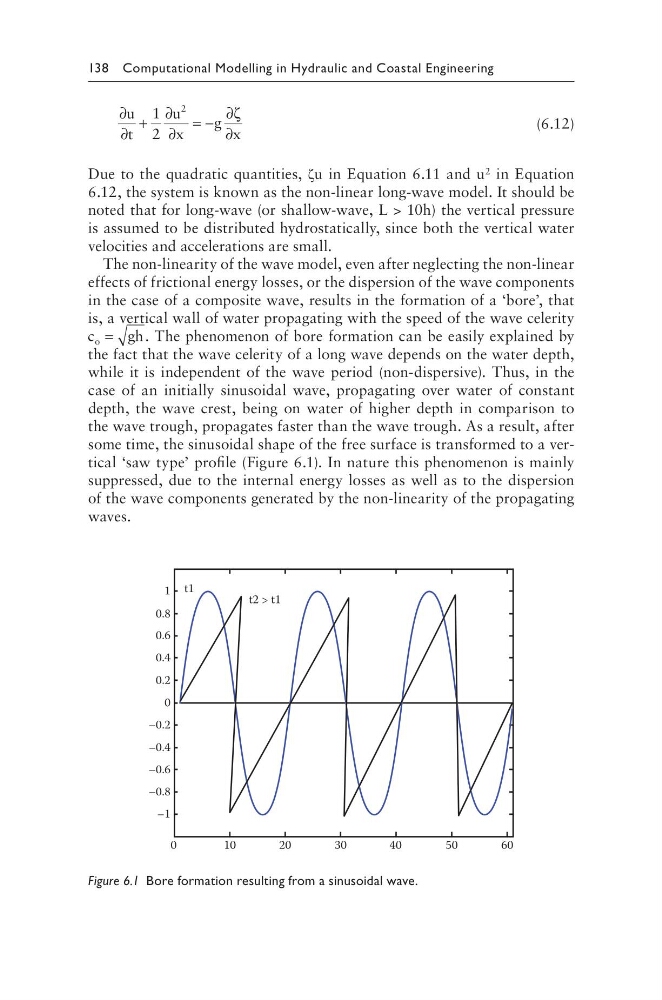
. The phenomenon of bore formation can be easily explained by
the fact that the wave celerity of a long wave depends on the water depth,
while it is independent of the wave period (non-dispersive). Thus, in the
case of an initially sinusoidal wave, propagating over water of constant
depth, the wave crest, being on water of higher depth in comparison to
the wave trough, propagates faster than the wave trough. As a result, after
some time, the sinusoidal shape of the free surface is transformed to a vertical ‘saw type’ profile (Figure 6.1). In nature this phenomenon is mainly
suppressed, due to the internal energy losses as well as to the dispersion
of the wave components generated by the non-linearity of the propagating
waves.
1
0.8
0.6
0.4
0.2
–0.2
–0.4
–0.6
–0.8
–1
0
0
1 0
2 0
3 0
4 0
5 0
6 0
t1
t2 > t1
Figure 6.1 Bore formation resulting from a sinusoidal wave.
∂
∂
+
∂
∂
= −
∂
∂
u
t
u
x
g x
1
2
2
ζ
(6.12)
Due to the quadratic quantities, ζu in Equation 6.11 and u 2 in Equation
6.12, the system is known as the non-linear long-wave model. It should be
noted that for long-wave (or shallow-wave, L > 10h) the vertical pressure
is assumed to be distributed hydrostatically, since both the vertical water
velocities and accelerations are small.
The non-linearity of the wave model, even after neglecting the non-linear
effects of frictional energy losses, or the dispersion of the wave components
in the case of a composite wave, results in the formation of a ‘bore’, that
is, a vertical wall of water propagating with the speed of the wave celerity
c
gh
o =
. The phenomenon of bore formation can be easily explained by
the fact that the wave celerity of a long wave depends on the water depth,
while it is independent of the wave period (non-dispersive). Thus, in the
case of an initially sinusoidal wave, propagating over water of constant
depth, the wave crest, being on water of higher depth in comparison to
the wave trough, propagates faster than the wave trough. As a result, after
some time, the sinusoidal shape of the free surface is transformed to a vertical ‘saw type’ profile (Figure 6.1). In nature this phenomenon is mainly
suppressed, due to the internal energy losses as well as to the dispersion
of the wave components generated by the non-linearity of the propagating
waves.
1
0.8
0.6
0.4
0.2
–0.2
–0.4
–0.6
–0.8
–1
0
0
1 0
2 0
3 0
4 0
5 0
6 0
t1
t2 > t1
Figure 6.1 Bore formation resulting from a sinusoidal wave.