

Free surface flows 129
∂
∂
+
∂
∂
= −
∂
+ +
−
∂
+
∂
∂
u
t
u
u
x
g
h h z
h
x
u
x
u
u
u
o
u
b
o
h
u
(
) ∆ρ
ε
2
2 2
+
−
τ
ρ
τ
ρ
ix
o o
bx
u u
h
h
(5.80)
When subject to wind-induced stress on the open surface, the system
is mobilized. The unknown quantities describing the phenomenon are the
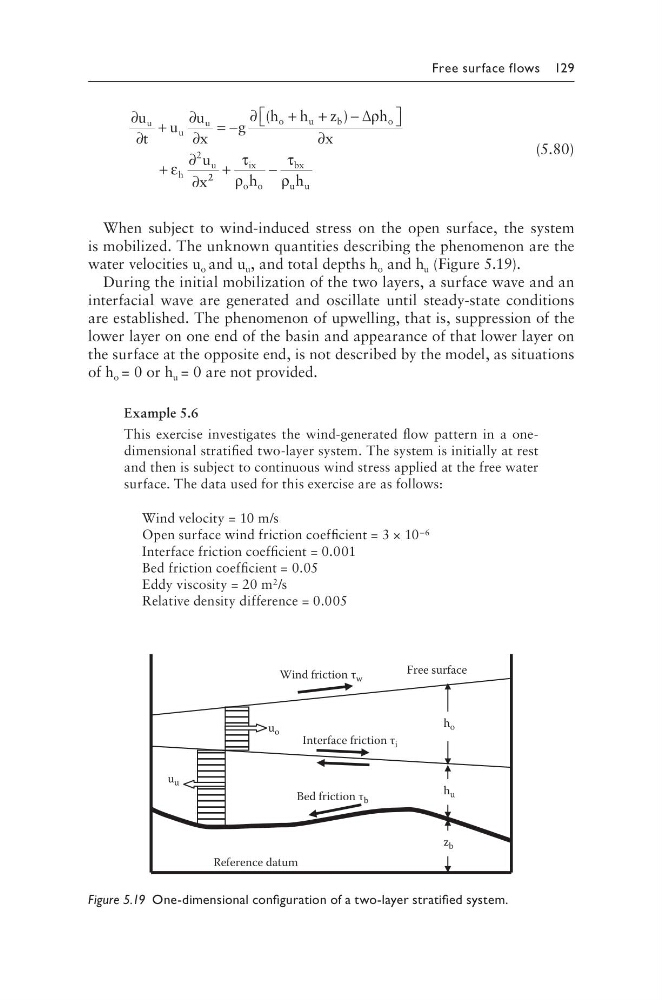
water velocities u o and u u , and total depths h o and h u (Figure 5.19).
During the initial mobilization of the two layers, a surface wave and an
interfacial wave are generated and oscillate until steady-state conditions
are established. The phenomenon of upwelling, that is, suppression of the
lower layer on one end of the basin and appearance of that lower layer on
the surface at the opposite end, is not described by the model, as situations
of h o = 0 or h u = 0 are not provided.
Example 5.6
This exercise investigates the wind-generated flow pattern in a onedimensional stratified two-layer system. The system is initially at rest
and then is subject to continuous wind stress applied at the free water
surface. The data used for this exercise are as follows:
Wind velocity = 10 m/s
Open surface wind friction coefficient = 3 × 10 –6
Interface friction coefficient = 0.001
Bed friction coefficient = 0.05
Eddy viscosity = 20 m 2 /s
Relative density difference = 0.005
u u
u o
Free surface
Reference datum
Bed friction τ b
Interface friction τ i
Wind friction τ w
h o
h u
z b
Figure 5.19 One-dimensional configuration of a two-layer stratified system.
∂
∂
+
∂
∂
= −
∂
+ +
−
∂
+
∂
∂
u
t
u
u
x
g
h h z
h
x
u
x
u
u
u
o
u
b
o
h
u
(
) ∆ρ
ε
2
2 2
+
−
τ
ρ
τ
ρ
ix
o o
bx
u u
h
h
(5.80)
When subject to wind-induced stress on the open surface, the system
is mobilized. The unknown quantities describing the phenomenon are the
water velocities u o and u u , and total depths h o and h u (Figure 5.19).
During the initial mobilization of the two layers, a surface wave and an
interfacial wave are generated and oscillate until steady-state conditions
are established. The phenomenon of upwelling, that is, suppression of the
lower layer on one end of the basin and appearance of that lower layer on
the surface at the opposite end, is not described by the model, as situations
of h o = 0 or h u = 0 are not provided.
Example 5.6
This exercise investigates the wind-generated flow pattern in a onedimensional stratified two-layer system. The system is initially at rest
and then is subject to continuous wind stress applied at the free water
surface. The data used for this exercise are as follows:
Wind velocity = 10 m/s
Open surface wind friction coefficient = 3 × 10 –6
Interface friction coefficient = 0.001
Bed friction coefficient = 0.05
Eddy viscosity = 20 m 2 /s
Relative density difference = 0.005
u u
u o
Free surface
Reference datum
Bed friction τ b
Interface friction τ i
Wind friction τ w
h o
h u
z b
Figure 5.19 One-dimensional configuration of a two-layer stratified system.