

126 Computational Modelling in Hydraulic and Coastal Engineering
5.4 STRATIFIED FLOWS IN GEOPHYSICAL DOMAINS
A very important class of free surface flows in geophysical flow domains
such as coastal and ocean waters are characterized by thermal, saline or
fluid-mud stratification. The first results mainly from the heating of surface
water masses during the hot period of the year; the second results from the
fresh water outflows from rivers and creeks to the coast; the third results
from underwater mudslides or even re-suspension of deposited sediments.
Although stratification is a complicated three-dimensional phenomenon,
it is common to assume that the two layers of different density are separated by a sharp interface. That interface is known as thermocline for
thermal stratification, halocline for saline stratification and lutocline for
mud-induced stratification. This thin-interface simplification negates the
interfacial mixing. This is a valid assumption for time scales smaller than
the time required for considerable mixing of the two layers. This mixing is
locally reduced, due to the turbulence suppression in the interfacial region,
as described by the Richardson number. If the density of the upper layer is
ρ ο and the density of the lower layer is ρ u , the system is hydrodynamically
stable if ρ o < ρ u (Scarlatos 1996b).
The distinction of the two layers permits the assumption of nearly horizontal flow in each layer, and the description of the layer hydrodynamics
via hydrostatic pressure distribution and layer-mean flow velocities u o and
u u , respectively.
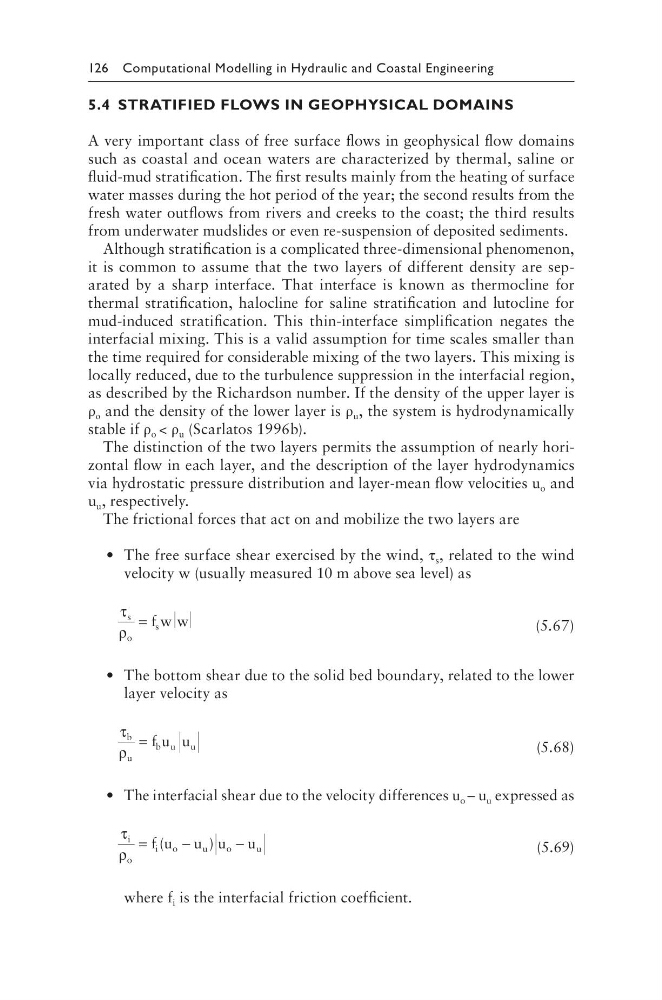
The frictional forces that act on and mobilize the two layers are
• The free surface shear exercised by the wind, τ s , related to the wind
velocity w (usually measured 10 m above sea level) as
τ
ρ
s
o
s
f w w
=
(5.67)
• The bottom shear due to the solid bed boundary, related to the lower
layer velocity as
τ
ρ
b
u
b u
u
f u u
=
(5.68)
• The interfacial shear due to the velocity differences u o – u u expressed as
τ
ρ
i
o
i
o
u
o
u
f u u u u
=
−
−
(
)
(5.69)
where f i is the interfacial friction coefficient.
5.4 STRATIFIED FLOWS IN GEOPHYSICAL DOMAINS
A very important class of free surface flows in geophysical flow domains
such as coastal and ocean waters are characterized by thermal, saline or
fluid-mud stratification. The first results mainly from the heating of surface
water masses during the hot period of the year; the second results from the
fresh water outflows from rivers and creeks to the coast; the third results
from underwater mudslides or even re-suspension of deposited sediments.
Although stratification is a complicated three-dimensional phenomenon,
it is common to assume that the two layers of different density are separated by a sharp interface. That interface is known as thermocline for
thermal stratification, halocline for saline stratification and lutocline for
mud-induced stratification. This thin-interface simplification negates the
interfacial mixing. This is a valid assumption for time scales smaller than
the time required for considerable mixing of the two layers. This mixing is
locally reduced, due to the turbulence suppression in the interfacial region,
as described by the Richardson number. If the density of the upper layer is
ρ ο and the density of the lower layer is ρ u , the system is hydrodynamically
stable if ρ o < ρ u (Scarlatos 1996b).
The distinction of the two layers permits the assumption of nearly horizontal flow in each layer, and the description of the layer hydrodynamics
via hydrostatic pressure distribution and layer-mean flow velocities u o and
u u , respectively.
The frictional forces that act on and mobilize the two layers are
• The free surface shear exercised by the wind, τ s , related to the wind
velocity w (usually measured 10 m above sea level) as
τ
ρ
s
o
s
f w w
=
(5.67)
• The bottom shear due to the solid bed boundary, related to the lower
layer velocity as
τ
ρ
b
u
b u
u
f u u
=
(5.68)
• The interfacial shear due to the velocity differences u o – u u expressed as
τ
ρ
i
o
i
o
u
o
u
f u u u u
=
−
−
(
)
(5.69)
where f i is the interfacial friction coefficient.