

108 Computational Modelling in Hydraulic and Coastal Engineering
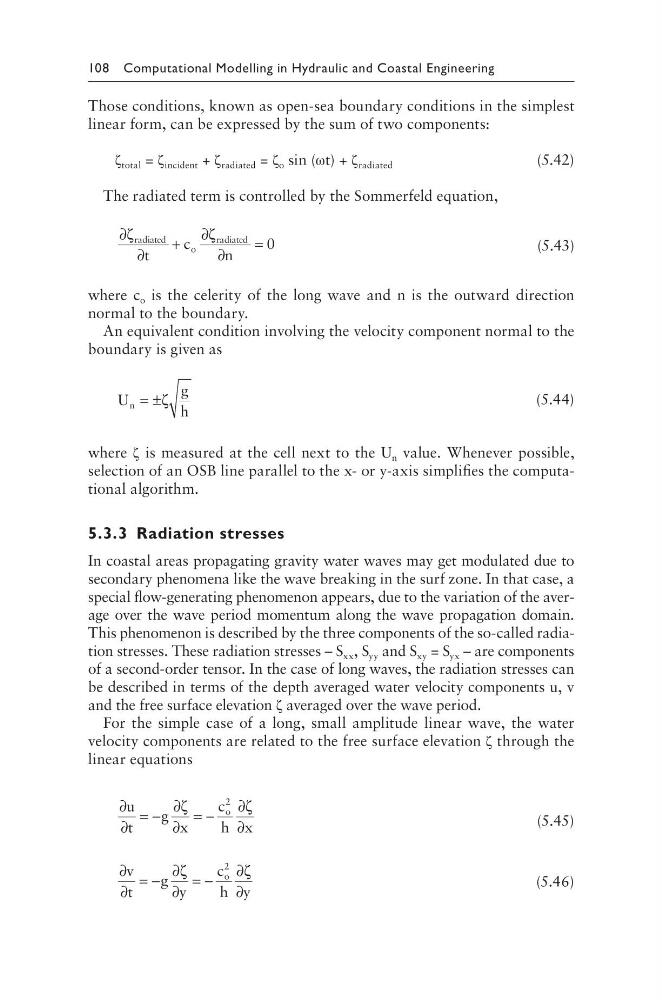
Those conditions, known as open-sea boundary conditions in the simplest
linear form, can be expressed by the sum of two components:
ζ total = ζ incident + ζ radiated = ζ o sin (ωt) + ζ radiated
(5.42)
The radiated term is controlled by the Sommerfeld equation,
∂
∂
+
∂
∂
=
ζ
ζ
radiated
o
radiated
t
c
n
0
(5.43)
where c o is the celerity of the long wave and n is the outward direction
normal to the boundary.
An equivalent condition involving the velocity component normal to the
boundary is given as
U
g
h
n = ±ζ
(5.44)
where ζ is measured at the cell next to the U n value. Whenever possible,
selection of an OSB line parallel to the x- or y-axis simplifies the computational algorithm.
5.3.3 Radiation stresses
In coastal areas propagating gravity water waves may get modulated due to
secondary phenomena like the wave breaking in the surf zone. In that case, a
special flow-generating phenomenon appears, due to the variation of the average over the wave period momentum along the wave propagation domain.
This phenomenon is described by the three components of the so-called radiation stresses. These radiation stresses – S xx , S yy and S xy = S yx – are components
of a second-order tensor. In the case of long waves, the radiation stresses can
be described in terms of the depth averaged water velocity components u, v
and the free surface elevation ζ averaged over the wave period.
For the simple case of a long, small amplitude linear wave, the water
velocity components are related to the free surface elevation ζ through the
linear equations
∂
∂
= −
∂
∂
= −
∂
∂
u
t
g x
c
h x
o
ζ
ζ
2
(5.45)
∂
∂
= −
∂
∂
= −
∂
∂
v
t
g y
c
h y
o
ζ
ζ
2
(5.46)
Those conditions, known as open-sea boundary conditions in the simplest
linear form, can be expressed by the sum of two components:
ζ total = ζ incident + ζ radiated = ζ o sin (ωt) + ζ radiated
(5.42)
The radiated term is controlled by the Sommerfeld equation,
∂
∂
+
∂
∂
=
ζ
ζ
radiated
o
radiated
t
c
n
0
(5.43)
where c o is the celerity of the long wave and n is the outward direction
normal to the boundary.
An equivalent condition involving the velocity component normal to the
boundary is given as
U
g
h
n = ±ζ
(5.44)
where ζ is measured at the cell next to the U n value. Whenever possible,
selection of an OSB line parallel to the x- or y-axis simplifies the computational algorithm.
5.3.3 Radiation stresses
In coastal areas propagating gravity water waves may get modulated due to
secondary phenomena like the wave breaking in the surf zone. In that case, a
special flow-generating phenomenon appears, due to the variation of the average over the wave period momentum along the wave propagation domain.
This phenomenon is described by the three components of the so-called radiation stresses. These radiation stresses – S xx , S yy and S xy = S yx – are components
of a second-order tensor. In the case of long waves, the radiation stresses can
be described in terms of the depth averaged water velocity components u, v
and the free surface elevation ζ averaged over the wave period.
For the simple case of a long, small amplitude linear wave, the water
velocity components are related to the free surface elevation ζ through the
linear equations
∂
∂
= −
∂
∂
= −
∂
∂
u
t
g x
c
h x
o
ζ
ζ
2
(5.45)
∂
∂
= −
∂
∂
= −
∂
∂
v
t
g y
c
h y
o
ζ
ζ
2
(5.46)