

Free surface flows 93
For the initial conditions, the values of u(x, t = 0) and y(x, t = 0) should
be provided for the entire solution domain. In case of an initially ‘dry bed’,
the initial conditions are written as u(x, t = 0) = 0 and y(x, t = 0) = 0.
For subcritical flows boundary conditions should be provided for both
the upstream and downstream ends of the channel. For the upstream end,
the incoming flood discharge hydrograph Q(x = 0, t) is provided. In general, the discharge hydrograph is described as a discrete-value time series of
Q values with an observation time interval δt. For the time interval, hourly
values may suffice for a flood event lasting more than a day. In most cases,
the observation interval δt is different from the computational time step Δt
(see Chapter 3, Figure 3.3).
For the downstream end boundary, either a constant water depth can be
maintained (e.g. outflow to a very large water body) or the flow can be led to
a critical flow regime (e.g. free outflow) so that no reflected signs can return
toward the upstream direction. The first condition is as simple as y(x = L, t) =
Y = constant, and the second has the form of a (critical) relation between the
flow depth in the last reach and the outflow (Equation 5.6).
5.2.2.2 Numerical solution algorithm
After the discretization of the solution domain, the numerical solution of
the system of the governing equations (Equations 5.26, 5.27 and 5.29) is
done by means of a staggered grid, similar to that one used for the water
hammer phenomenon in closed conduits (Chapter 4, Section 4.3.4.3).
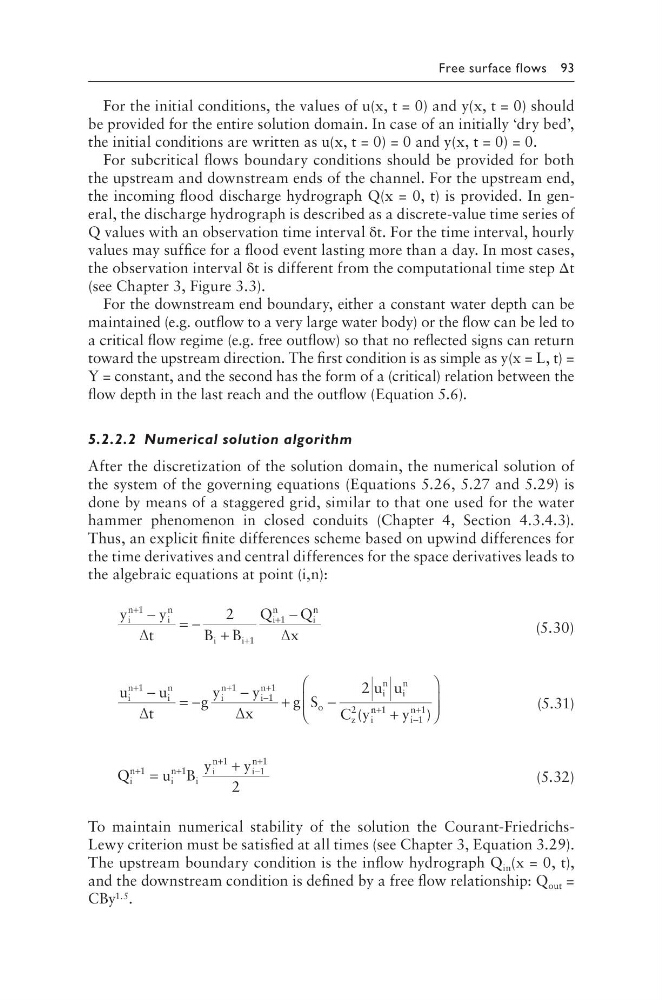
Thus, an explicit finite differences scheme based on upwind differences for
the time derivatives and central differences for the space derivatives leads to
the algebraic equations at point (i,n):
y
y
t
B B
Q
Q
x
i
n
i
n
i
i
i
n
i
n
+
+
+
−
= − +
−
1
1
1
2
∆
∆
(5.30)
u
u
t
g
y
y
x
g S
u u
C y
i
n
i
n
i
n
i
n
o
i
n
i
n
z
i
+
+
−
+
−
= −
−
+
−
1
1
1
1
2
2
∆
∆
(
n n
i
n
y
+
−
+
+
1
1
1
)
(5.31)
Q
u B
y
y
i
n
i
n
i
i
n
i
n
+
+
+
−
+
=
+
1
1
1
1
1
2
(5.32)
To maintain numerical stability of the solution the Courant-FriedrichsLewy criterion must be satisfied at all times (see Chapter 3, Equation 3.29).
The upstream boundary condition is the inflow hydrograph Q in (x = 0, t),
and the downstream condition is defined by a free flow relationship: Q out =
CBy 1.5 .
For the initial conditions, the values of u(x, t = 0) and y(x, t = 0) should
be provided for the entire solution domain. In case of an initially ‘dry bed’,
the initial conditions are written as u(x, t = 0) = 0 and y(x, t = 0) = 0.
For subcritical flows boundary conditions should be provided for both
the upstream and downstream ends of the channel. For the upstream end,
the incoming flood discharge hydrograph Q(x = 0, t) is provided. In general, the discharge hydrograph is described as a discrete-value time series of
Q values with an observation time interval δt. For the time interval, hourly
values may suffice for a flood event lasting more than a day. In most cases,
the observation interval δt is different from the computational time step Δt
(see Chapter 3, Figure 3.3).
For the downstream end boundary, either a constant water depth can be
maintained (e.g. outflow to a very large water body) or the flow can be led to
a critical flow regime (e.g. free outflow) so that no reflected signs can return
toward the upstream direction. The first condition is as simple as y(x = L, t) =
Y = constant, and the second has the form of a (critical) relation between the
flow depth in the last reach and the outflow (Equation 5.6).
5.2.2.2 Numerical solution algorithm
After the discretization of the solution domain, the numerical solution of
the system of the governing equations (Equations 5.26, 5.27 and 5.29) is
done by means of a staggered grid, similar to that one used for the water
hammer phenomenon in closed conduits (Chapter 4, Section 4.3.4.3).
Thus, an explicit finite differences scheme based on upwind differences for
the time derivatives and central differences for the space derivatives leads to
the algebraic equations at point (i,n):
y
y
t
B B
Q
Q
x
i
n
i
n
i
i
i
n
i
n
+
+
+
−
= − +
−
1
1
1
2
∆
∆
(5.30)
u
u
t
g
y
y
x
g S
u u
C y
i
n
i
n
i
n
i
n
o
i
n
i
n
z
i
+
+
−
+
−
= −
−
+
−
1
1
1
1
2
2
∆
∆
(
n n
i
n
y
+
−
+
+
1
1
1
)
(5.31)
Q
u B
y
y
i
n
i
n
i
i
n
i
n
+
+
+
−
+
=
+
1
1
1
1
1
2
(5.32)
To maintain numerical stability of the solution the Courant-FriedrichsLewy criterion must be satisfied at all times (see Chapter 3, Equation 3.29).
The upstream boundary condition is the inflow hydrograph Q in (x = 0, t),
and the downstream condition is defined by a free flow relationship: Q out =
CBy 1.5 .