

70
DETERMINISTIC DESCRIPTIONS OF OFFSHORE WAVES
du
du
si+uâi'
du
Wdz =
1 dp
p dx
(3.20)
dw
dw
+ U—----F W
dw
1 —
— -
1 dp
-- x---- 9
(3-21)
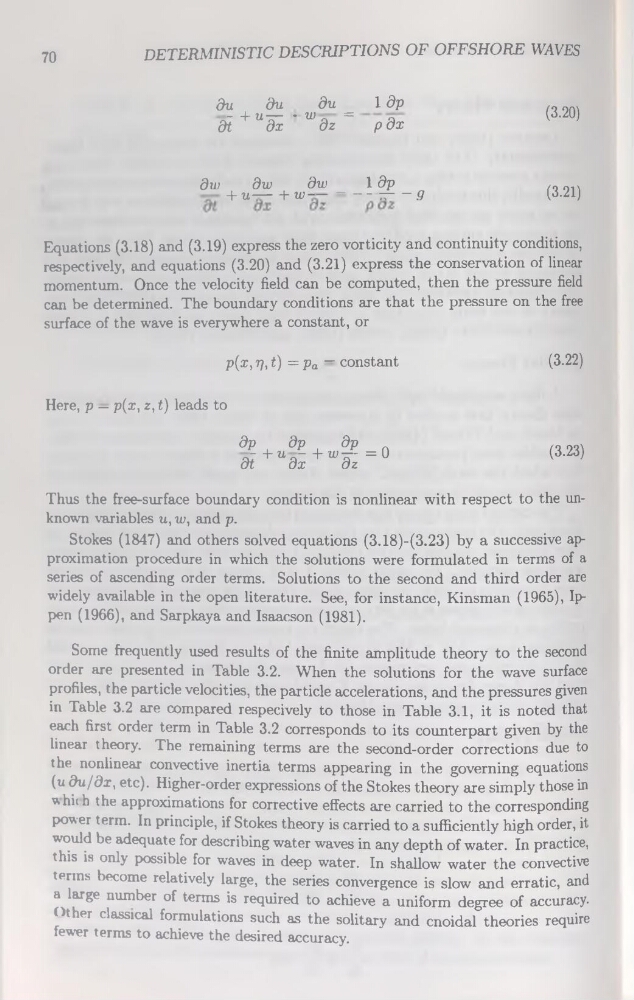
Equations (3.18) and (3.19) express the zéro vorticity and continuity conditions,
respectively, and équations (3.20) and (3.21) express the conservation of linear
momentum. Once the velocity field can be computed, then the pressure field
can be determined. The boundary conditions are that the pressure on the free
surface of the wave is everywhere a constant, or
p(z,p,t) = pa — constant
(3.22)
Here, p — p(x, z,t) leads to
dp
dp
dp
di + udi + wSi=a
(3.23)
Thus the free-surface boundary condition is nonlinear with respect to the unknown variables u, w, and p.
Stokes (1847) and others solved équations (3.18)-(3.23) by a successive approximation procedure in which the solutions were formulated in terms of a
sériés of ascending order terms. Solutions to the second and third order are
widely available in the open literature. See, for instance, Kinsman (1965), Ippen (1966), and Sarpkaya and Isaacson (1981).
Some frequently used results of the finite amplitude theory to the second
order are presented in Table 3.2. When the solutions for the wave surface
profiles, the particle velocities, the particle accélérations, and the pressures given
in Table 3.2 are compared respecively to those in Table 3.1, it is noted that
each first order term in Table 3.2 corresponds to its counterpart given by the
linear theory. The remaining terms are the second-order corrections due to
the nonlinear convective inertia terms appearing in the governing équations
(u du/dx, etc). Higher-order expressions of the Stokes theory are simply those in
v. hic h the approximations for corrective effects are carried to the corresponding
power term. In principle, if Stokes theory is carried to a sufficiently high order, it
would be adéquate for describing water waves in any depth of water. In practice,
this is only possible for waves in deep water. In shallow water the convective
terms become relatively large, the sériés convergence is slow and erratic, and
a large number of terms is required to achieve a uniform degree of accuracy.
Other classical formulations such as the solitary and cnoidal théories require
fewer terms to achieve the desired accuracy.
DETERMINISTIC DESCRIPTIONS OF OFFSHORE WAVES
du
du
si+uâi'
du
Wdz =
1 dp
p dx
(3.20)
dw
dw
+ U—----F W
dw
1 —
— -
1 dp
-- x---- 9
(3-21)
Equations (3.18) and (3.19) express the zéro vorticity and continuity conditions,
respectively, and équations (3.20) and (3.21) express the conservation of linear
momentum. Once the velocity field can be computed, then the pressure field
can be determined. The boundary conditions are that the pressure on the free
surface of the wave is everywhere a constant, or
p(z,p,t) = pa — constant
(3.22)
Here, p — p(x, z,t) leads to
dp
dp
dp
di + udi + wSi=a
(3.23)
Thus the free-surface boundary condition is nonlinear with respect to the unknown variables u, w, and p.
Stokes (1847) and others solved équations (3.18)-(3.23) by a successive approximation procedure in which the solutions were formulated in terms of a
sériés of ascending order terms. Solutions to the second and third order are
widely available in the open literature. See, for instance, Kinsman (1965), Ippen (1966), and Sarpkaya and Isaacson (1981).
Some frequently used results of the finite amplitude theory to the second
order are presented in Table 3.2. When the solutions for the wave surface
profiles, the particle velocities, the particle accélérations, and the pressures given
in Table 3.2 are compared respecively to those in Table 3.1, it is noted that
each first order term in Table 3.2 corresponds to its counterpart given by the
linear theory. The remaining terms are the second-order corrections due to
the nonlinear convective inertia terms appearing in the governing équations
(u du/dx, etc). Higher-order expressions of the Stokes theory are simply those in
v. hic h the approximations for corrective effects are carried to the corresponding
power term. In principle, if Stokes theory is carried to a sufficiently high order, it
would be adéquate for describing water waves in any depth of water. In practice,
this is only possible for waves in deep water. In shallow water the convective
terms become relatively large, the sériés convergence is slow and erratic, and
a large number of terms is required to achieve a uniform degree of accuracy.
Other classical formulations such as the solitary and cnoidal théories require
fewer terms to achieve the desired accuracy.