

NONLINEAR WAVES
69
Trochoidal Theory
Gerstner (1802) and Rankine (1863) developed the trochoidal wave theory
independently. The three distinguishing features of the trochoidal theory are:
circulât particle orbits; a rotational fluid; and a trochoidal wave surface profile.
Historically, this nonlinear theory found favor with naval architects, who focused
not so much on the fluid kinematics with its rotational characteristic, but on
the trochoidal surface profile of these finite amplitude waves. With the advent
of offshore structures, more realistic wave kinematics were needed, and thus
trochoidal theory is not usually used by engineers in offshore structural design.
The importance of trochoidal wave theory is that it serves as a link from linear
theory to the finite amplitude oscillatory wave theory as developed by Stokes
(1845), Levi-Civita (1925), Struik (1926), and Havelock (1914).
Cnoidal Theory
A finite amplitude wave theory appropriate for shallow water is the cnoidal
wave theory, first studied by Korteweg and de Vries (1895) and more recently
by Masch and Wiegel (1961). As suggested by Sarpkaya and Isaacson (1981),
the cnoidal wave parameters are formulated in terms of elliptic cosine functions,
from which the term "cnoidal” arises. Tables and charts published in the latter
two citations aid in application of this theory.
The cnoidal wave theory was developed from the governing équations for long
waves using the assumption that the square of the slope of the water surface, or
wave steepness, is small relative to unity. One important feature is that cnoidal
waves are periodic. For small values of H/d, where H is the crest to trough
wave dimension and d is the water depth, the cnoidal wave profile is sinusoidal.
Another limiting case is for very long wave lengths, which yields a solitary wave
profile, as discussed below. The use of the cnoidal wave theory is limited to the
following range: 0.01 < H/d < 0.78 and X/d < 8. Within this range, cnoidal
theory describes the progression of the periodic waves more accurately than
does the theory for Stokes waves. Cnoidal theory bridges the gap between the
periodic and the solitary wave théories.
Stokes Theory
The basic assumption in the development of the finite amplitude wave theory
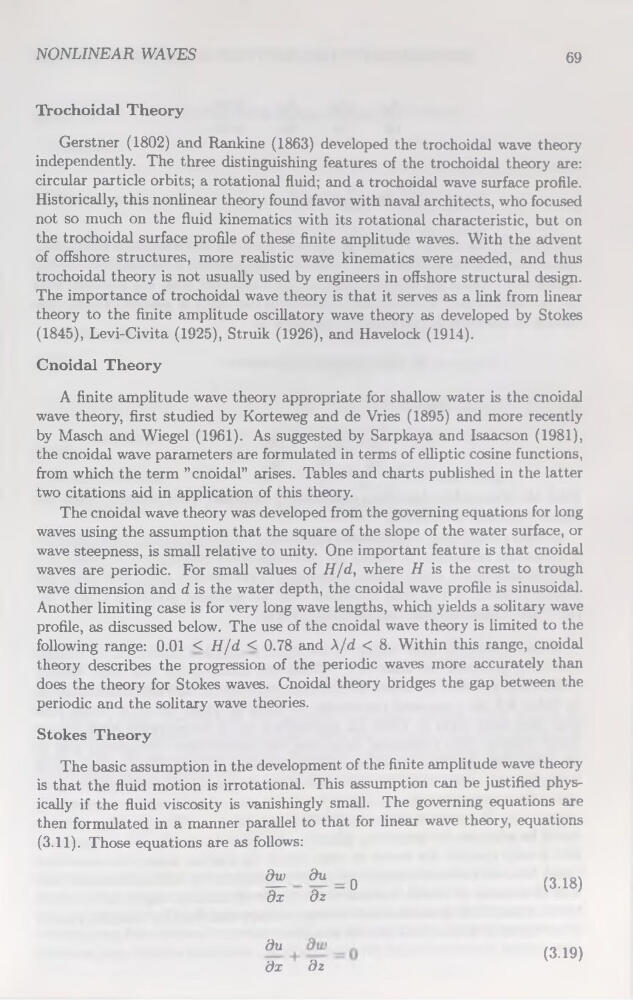
is that the fluid motion is irrotational. This assumption can be justified physically if the fluid viscosity is vanishingly small. The governing équations are
then formulated in a manner parallel to that for linear wave theory, équations
(3.11). Those équations are as follows:
dw
du
dx
dz
0
(3.18)
du
dx
dz
(3.19)
69
Trochoidal Theory
Gerstner (1802) and Rankine (1863) developed the trochoidal wave theory
independently. The three distinguishing features of the trochoidal theory are:
circulât particle orbits; a rotational fluid; and a trochoidal wave surface profile.
Historically, this nonlinear theory found favor with naval architects, who focused
not so much on the fluid kinematics with its rotational characteristic, but on
the trochoidal surface profile of these finite amplitude waves. With the advent
of offshore structures, more realistic wave kinematics were needed, and thus
trochoidal theory is not usually used by engineers in offshore structural design.
The importance of trochoidal wave theory is that it serves as a link from linear
theory to the finite amplitude oscillatory wave theory as developed by Stokes
(1845), Levi-Civita (1925), Struik (1926), and Havelock (1914).
Cnoidal Theory
A finite amplitude wave theory appropriate for shallow water is the cnoidal
wave theory, first studied by Korteweg and de Vries (1895) and more recently
by Masch and Wiegel (1961). As suggested by Sarpkaya and Isaacson (1981),
the cnoidal wave parameters are formulated in terms of elliptic cosine functions,
from which the term "cnoidal” arises. Tables and charts published in the latter
two citations aid in application of this theory.
The cnoidal wave theory was developed from the governing équations for long
waves using the assumption that the square of the slope of the water surface, or
wave steepness, is small relative to unity. One important feature is that cnoidal
waves are periodic. For small values of H/d, where H is the crest to trough
wave dimension and d is the water depth, the cnoidal wave profile is sinusoidal.
Another limiting case is for very long wave lengths, which yields a solitary wave
profile, as discussed below. The use of the cnoidal wave theory is limited to the
following range: 0.01 < H/d < 0.78 and X/d < 8. Within this range, cnoidal
theory describes the progression of the periodic waves more accurately than
does the theory for Stokes waves. Cnoidal theory bridges the gap between the
periodic and the solitary wave théories.
Stokes Theory
The basic assumption in the development of the finite amplitude wave theory
is that the fluid motion is irrotational. This assumption can be justified physically if the fluid viscosity is vanishingly small. The governing équations are
then formulated in a manner parallel to that for linear wave theory, équations
(3.11). Those équations are as follows:
dw
du
dx
dz
0
(3.18)
du
dx
dz
(3.19)