

PROBLEMS
55
Deck mass = 1.5 x 10⁷ kg
Caisson mass (filled) = 2 x 10⁸ kg
Concrète density = 2500 kg/m3
Sea water density = 1025 kg/m3
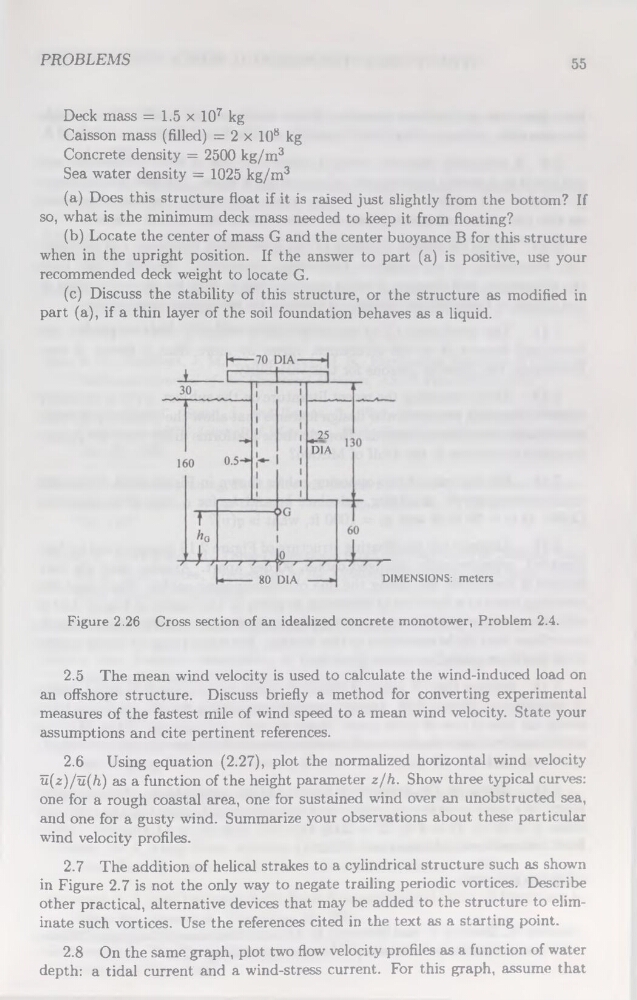
(a) Does this structure float if it is raised just slightly from the bottom? If
so, what is the minimum deck mass needed to keep it from floating?
(b) Locate the center of mass G and the center buoyance B for this structure
when in the upright position. If the answer to part (a) is positive, use your
recommended deck weight to locate G.
(c) Discuss the stability of this structure, or the structure as modified in
part (a), if a thin layer of the soil foundation behaves as a liquid.
DIMENSIONS: metcrs
80 DIA
_25
DIA
Figure 2.26 Cross section of an idealized concrète monotower, Problem 2.4.
2.5 The mean wind velocity is used to calculate the wind-induced load on
an offshore structure. Discuss briefly a method for converting experimental
measures of the fastest mile of wind speed to a mean wind velocity. State your
assumptions and cite pertinent references.
2.6 Using équation (2.27), plot the normalized horizontal wind velocity
ü(z)/ü(/z) as a function of the height parameter z/h. Show three typical curves:
one for a rough Coastal area, one for sustained wind over an unobstructed sea,
and one for a gusty wind. Summarize your observations about these particular
wind velocity profiles.
2.7 The addition of helical strakes to a cylindrical structure such as shown
in Figure 2.7 is not the only way to negate trailing periodic vortices. Describe
other practical, alternative devices that may be added to the structure to eliminate such vortices. Use the references cited in the text as a starting point.
2.8 On the same graph, plot two flow velocity profiles as a function of water
depth: a tidal current and a wind-stress current. For this graph, assume that
55
Deck mass = 1.5 x 10⁷ kg
Caisson mass (filled) = 2 x 10⁸ kg
Concrète density = 2500 kg/m3
Sea water density = 1025 kg/m3
(a) Does this structure float if it is raised just slightly from the bottom? If
so, what is the minimum deck mass needed to keep it from floating?
(b) Locate the center of mass G and the center buoyance B for this structure
when in the upright position. If the answer to part (a) is positive, use your
recommended deck weight to locate G.
(c) Discuss the stability of this structure, or the structure as modified in
part (a), if a thin layer of the soil foundation behaves as a liquid.
DIMENSIONS: metcrs
80 DIA
_25
DIA
Figure 2.26 Cross section of an idealized concrète monotower, Problem 2.4.
2.5 The mean wind velocity is used to calculate the wind-induced load on
an offshore structure. Discuss briefly a method for converting experimental
measures of the fastest mile of wind speed to a mean wind velocity. State your
assumptions and cite pertinent references.
2.6 Using équation (2.27), plot the normalized horizontal wind velocity
ü(z)/ü(/z) as a function of the height parameter z/h. Show three typical curves:
one for a rough Coastal area, one for sustained wind over an unobstructed sea,
and one for a gusty wind. Summarize your observations about these particular
wind velocity profiles.
2.7 The addition of helical strakes to a cylindrical structure such as shown
in Figure 2.7 is not the only way to negate trailing periodic vortices. Describe
other practical, alternative devices that may be added to the structure to eliminate such vortices. Use the references cited in the text as a starting point.
2.8 On the same graph, plot two flow velocity profiles as a function of water
depth: a tidal current and a wind-stress current. For this graph, assume that