

54
STRUCTURE-ENVIRONMENTAL FORCE INTERACTIONS
PROBLEMS
2.1 The nondimensional parameter cylinder roughness affects the values of
the coefficients Cd and Cm as indicated by équations (2.18) and (2.20). Define
precisely this measure of cylinder roughness by Consulting a standard reference
book in fluid mechanics. Then based on reported experimental results, discuss
briefly the effect of this parameter on the coefficients Cd and Cm f°r both the
steady flow and the periodic flow of water which flows normal to a submerged
stationary, circular cylinder.
2.2 To linearize équation (2.21), Berge and Penzien (1974) made certain
statistical assumptions concerning the nature of the constant Cd of équation
(2.22). Review this paper, especially their équations (10)-(15), and describe the
method and assumptions leading to this linearized équation of motion.
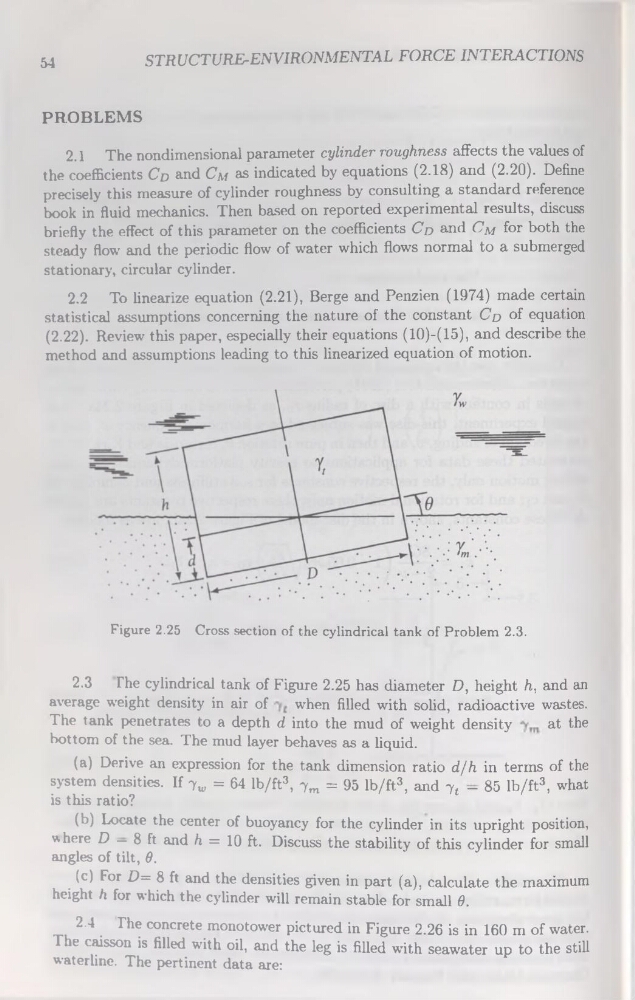
Figure 2.25 Cross section of the cylindrical tank of Problem 2.3.
2.3 The cylindrical tank of Figure 2.25 has diameter D, height h, and an
average weight density in air of
when filled with solid, radioactive wastes.
The tank pénétrâtes to a depth d into the mud of weight density
at the
bottom of the sea. The mud layer behaves as a liquid.
(a) Dérivé an expression for the tank dimension ratio d/h in terms of the
System densities. If 7w = 64 lb/ft3, 7rn = 95 lb/ft3, and 7( - 85 lb/ft3, what
is this ratio?
(b) Locate the center of buoyancy for the cylinder in its upright position,
where D — 8 ft and h = 10 ft. Discuss the stability of this cylinder for small
angles of tilt, 6.
(c) For D= 8 ft and the densities given in part (a), calculate the maximum
height h for which the cylinder will remain stable for small 9.
2.4 The concrète monotower pictured in Figure 2.26 is in 160 m of water.
The caisson is filled with oil, and the leg is filled with seawater up to the still
waterline. The pertinent data are:
STRUCTURE-ENVIRONMENTAL FORCE INTERACTIONS
PROBLEMS
2.1 The nondimensional parameter cylinder roughness affects the values of
the coefficients Cd and Cm as indicated by équations (2.18) and (2.20). Define
precisely this measure of cylinder roughness by Consulting a standard reference
book in fluid mechanics. Then based on reported experimental results, discuss
briefly the effect of this parameter on the coefficients Cd and Cm f°r both the
steady flow and the periodic flow of water which flows normal to a submerged
stationary, circular cylinder.
2.2 To linearize équation (2.21), Berge and Penzien (1974) made certain
statistical assumptions concerning the nature of the constant Cd of équation
(2.22). Review this paper, especially their équations (10)-(15), and describe the
method and assumptions leading to this linearized équation of motion.
Figure 2.25 Cross section of the cylindrical tank of Problem 2.3.
2.3 The cylindrical tank of Figure 2.25 has diameter D, height h, and an
average weight density in air of
when filled with solid, radioactive wastes.
The tank pénétrâtes to a depth d into the mud of weight density
at the
bottom of the sea. The mud layer behaves as a liquid.
(a) Dérivé an expression for the tank dimension ratio d/h in terms of the
System densities. If 7w = 64 lb/ft3, 7rn = 95 lb/ft3, and 7( - 85 lb/ft3, what
is this ratio?
(b) Locate the center of buoyancy for the cylinder in its upright position,
where D — 8 ft and h = 10 ft. Discuss the stability of this cylinder for small
angles of tilt, 6.
(c) For D= 8 ft and the densities given in part (a), calculate the maximum
height h for which the cylinder will remain stable for small 9.
2.4 The concrète monotower pictured in Figure 2.26 is in 160 m of water.
The caisson is filled with oil, and the leg is filled with seawater up to the still
waterline. The pertinent data are: