

36
STRUCTURE-ENVIRONMENTAL FORCE INTERACTIONS
2.3 EARTHQUAKES, ICE IMPACT, AND WAVE SLAMMING
Earthquake Forces
The engineer who is designing jacket-template or gravity platforms which
will resist marine seismic disturbances finds that records of strong ground earthquake motion on the sea floor are generally nonexistent in locations where such
structures are contemplated (Page, 1975). The needed data are the time historiés of velocity or accélération of the sea floor, in both the vertical and horizontal
directions. With such data, the engineer can calculate the structural dynamic
responses, estimate seismic damage, and evaluate the possibilities of structural
survival (Bea et al., 1979).
Lacking the needed data and faced with the need to design offshore platforms
in the earthquake-prone Gulf of Alaska, Wiggins et al. (1976) rationalized the
use of California seismic records as a first approximation to the phenomena
expected in the Alaskan Gulf. Wiggins et al. compared varions measured values
for focal depths, which are locations below the earth’s surface where strong
earthquakes hâve originated. This average depth below ground level is 16 km for
California earthquakes and 26.5 km for the severe 1964 shocks in Alaska. Since
ground motion atténuâtes rapidly with the distance from the focus, ground level
motion should be less in Alaska than in California, given earthquakes of equal
intensity and assuming identical soil characteristics. Based on this argument,
the engineer can employ California earthquake data in the design of Alaskan
offshore structures.
□
z
Z)
O
□
0.4g
0.2g
0
0.2g
0.4g
TIME, t seconds
K1
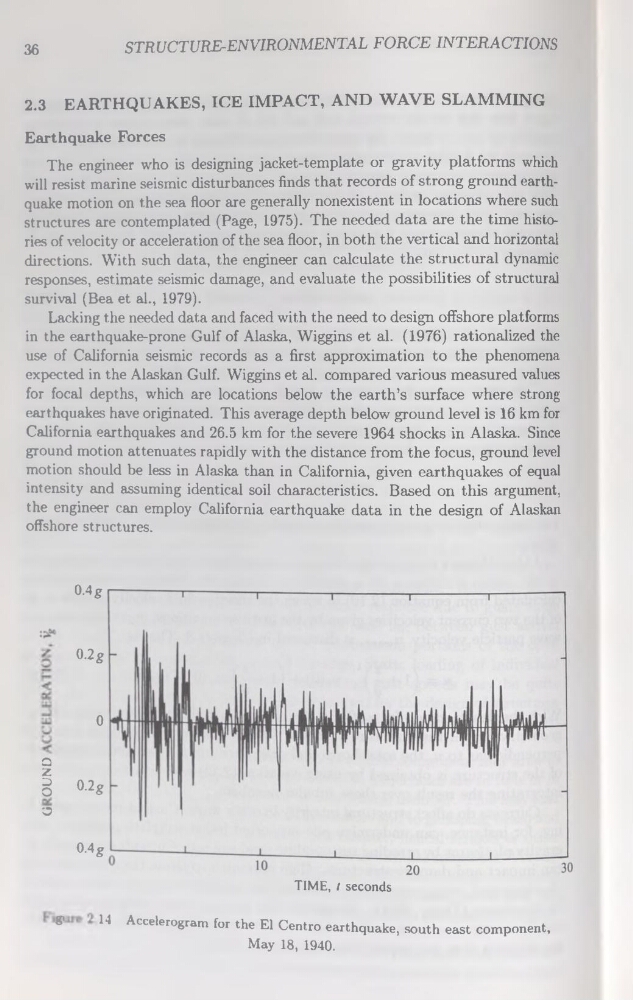
14 Accelerogram for the El Centro earthquake, south east component,
May 18, 1940.
STRUCTURE-ENVIRONMENTAL FORCE INTERACTIONS
2.3 EARTHQUAKES, ICE IMPACT, AND WAVE SLAMMING
Earthquake Forces
The engineer who is designing jacket-template or gravity platforms which
will resist marine seismic disturbances finds that records of strong ground earthquake motion on the sea floor are generally nonexistent in locations where such
structures are contemplated (Page, 1975). The needed data are the time historiés of velocity or accélération of the sea floor, in both the vertical and horizontal
directions. With such data, the engineer can calculate the structural dynamic
responses, estimate seismic damage, and evaluate the possibilities of structural
survival (Bea et al., 1979).
Lacking the needed data and faced with the need to design offshore platforms
in the earthquake-prone Gulf of Alaska, Wiggins et al. (1976) rationalized the
use of California seismic records as a first approximation to the phenomena
expected in the Alaskan Gulf. Wiggins et al. compared varions measured values
for focal depths, which are locations below the earth’s surface where strong
earthquakes hâve originated. This average depth below ground level is 16 km for
California earthquakes and 26.5 km for the severe 1964 shocks in Alaska. Since
ground motion atténuâtes rapidly with the distance from the focus, ground level
motion should be less in Alaska than in California, given earthquakes of equal
intensity and assuming identical soil characteristics. Based on this argument,
the engineer can employ California earthquake data in the design of Alaskan
offshore structures.
□
z
Z)
O
□
0.4g
0.2g
0
0.2g
0.4g
TIME, t seconds
K1
14 Accelerogram for the El Centro earthquake, south east component,
May 18, 1940.