

FLUID-INDUCED STRUCTURAL FORCES
23
Real Viscous Fluid Flow
Measurements show that Cm and Ca are time-dependent, which is due to
fluid viscosity. There is flow séparation behind the cylinder, accompanied by
differential pressure forces opposing cylinder motion. Such forces are referred
to as form drag. In applications, a root-mean-square (rms) measured average of
each coefficient Cm and Ca is used. If such data are lacking, it is appropriate
to choose Ca = 1 for design purposes, provided that the géométrie ratio f./D is
much greater than one.
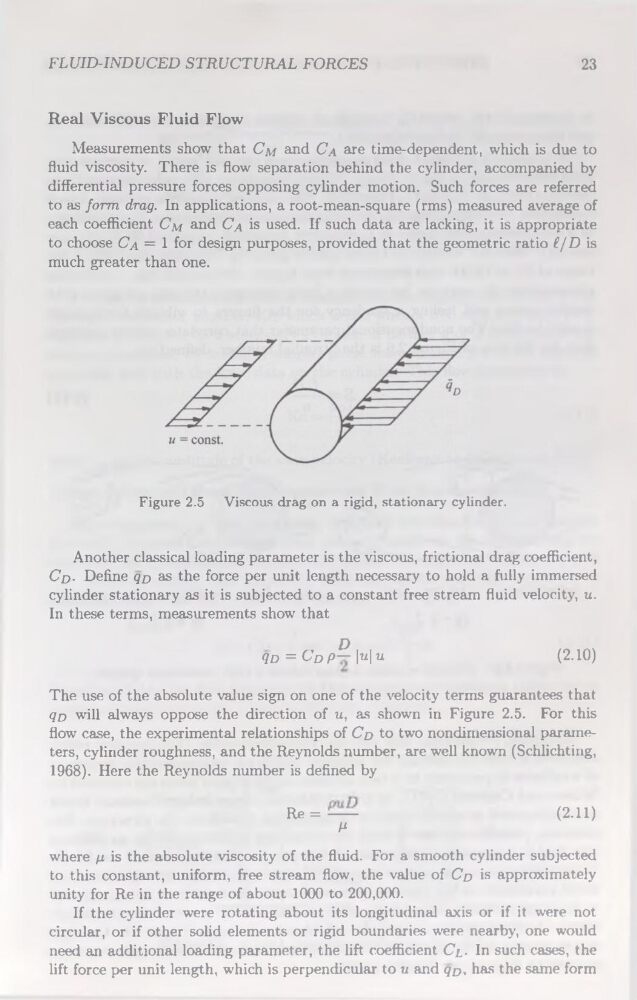
Figure 2.5 Viscous drag on a rigid, stationary cylinder.
Another classical loading parameter is the viscous, frictional drag coefficient,
Cd- Define qo as the force per unit length necessary to hold a fully immersed
cylinder stationary as it is subjected to a constant free stream fluid velocity, u.
In these terms, measurements show that
D
Qd = CDP~ |a|u
(2.10)
The use of the absolute value sign on one of the velocity terms guarantees that
qo will always oppose the direction of u, as shown in Figure 2.5. For this
flow case, the experimental relationships of Cd to two nondimensional parameters, cylinder roughness, and the Reynolds number, are well known (Schlichting,
1968). Here the Reynolds number is defined by
d Re =-----(2-11)
P
where y, is the absolute viscosity of the fluid. For a smooth cylinder subjected
to this constant, uniform, free stream flow, the value of Cd is approximately
unity for Re in the range of about 1000 to 200,000.
If the cylinder were rotating about its longitudinal axis or if it were not
circular, or if other solid éléments or rigid boundaries were nearby, one would
need an additional loading parameter, the lift coefficient Cl. In such cases, the
lift force per unit length, which is perpendicular to u and qp, has the same form
23
Real Viscous Fluid Flow
Measurements show that Cm and Ca are time-dependent, which is due to
fluid viscosity. There is flow séparation behind the cylinder, accompanied by
differential pressure forces opposing cylinder motion. Such forces are referred
to as form drag. In applications, a root-mean-square (rms) measured average of
each coefficient Cm and Ca is used. If such data are lacking, it is appropriate
to choose Ca = 1 for design purposes, provided that the géométrie ratio f./D is
much greater than one.
Figure 2.5 Viscous drag on a rigid, stationary cylinder.
Another classical loading parameter is the viscous, frictional drag coefficient,
Cd- Define qo as the force per unit length necessary to hold a fully immersed
cylinder stationary as it is subjected to a constant free stream fluid velocity, u.
In these terms, measurements show that
D
Qd = CDP~ |a|u
(2.10)
The use of the absolute value sign on one of the velocity terms guarantees that
qo will always oppose the direction of u, as shown in Figure 2.5. For this
flow case, the experimental relationships of Cd to two nondimensional parameters, cylinder roughness, and the Reynolds number, are well known (Schlichting,
1968). Here the Reynolds number is defined by
d Re =-----(2-11)
P
where y, is the absolute viscosity of the fluid. For a smooth cylinder subjected
to this constant, uniform, free stream flow, the value of Cd is approximately
unity for Re in the range of about 1000 to 200,000.
If the cylinder were rotating about its longitudinal axis or if it were not
circular, or if other solid éléments or rigid boundaries were nearby, one would
need an additional loading parameter, the lift coefficient Cl. In such cases, the
lift force per unit length, which is perpendicular to u and qp, has the same form