

22
STRUCTURE-ENVIRONMENTAL FORCE INTERACTIONS
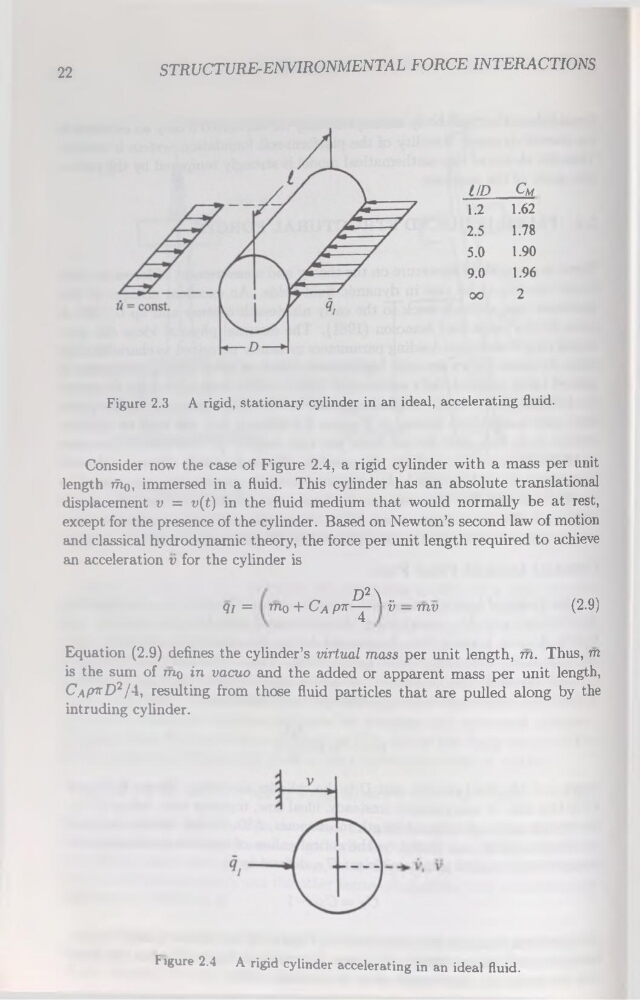
Figure 2.3 A rigid, stationary cylinder in an idéal, accelerating fluid.
Consider now the case of Figure 2.4, a rigid cylinder with a mass per unit
length rfiQ, immersed in a fluid. This cylinder has an absolute translational
displacement v = u(t) in the fluid medium that would normally be at rest,
except for the presence of the cylinder. Based on Newton’s second law of motion
and classical hydrodynamic theory, the force per unit length required to achieve
an accélération v for the cylinder is
qi =
D2\ ..
v — mv
(2-9)
mo + Ca P^—— 4
Equation (2.9) defines the cylinder’s Virtual mass per unit length, m. Thus, m
is the sum of mo in vacuo and the added or apparent mass per unit length,
CaP*D2/A, resulting from those fluid particles that are pulled along by the
intruding cylinder.
Figure 2.4 A rigid cylinder accelerating in an idéal fluid.
STRUCTURE-ENVIRONMENTAL FORCE INTERACTIONS
Figure 2.3 A rigid, stationary cylinder in an idéal, accelerating fluid.
Consider now the case of Figure 2.4, a rigid cylinder with a mass per unit
length rfiQ, immersed in a fluid. This cylinder has an absolute translational
displacement v = u(t) in the fluid medium that would normally be at rest,
except for the presence of the cylinder. Based on Newton’s second law of motion
and classical hydrodynamic theory, the force per unit length required to achieve
an accélération v for the cylinder is
qi =
D2\ ..
v — mv
(2-9)
mo + Ca P^—— 4
Equation (2.9) defines the cylinder’s Virtual mass per unit length, m. Thus, m
is the sum of mo in vacuo and the added or apparent mass per unit length,
CaP*D2/A, resulting from those fluid particles that are pulled along by the
intruding cylinder.
Figure 2.4 A rigid cylinder accelerating in an idéal fluid.