

276
CONTINUOUS SYSTEMS
S(f), Sway
H(f), Heave
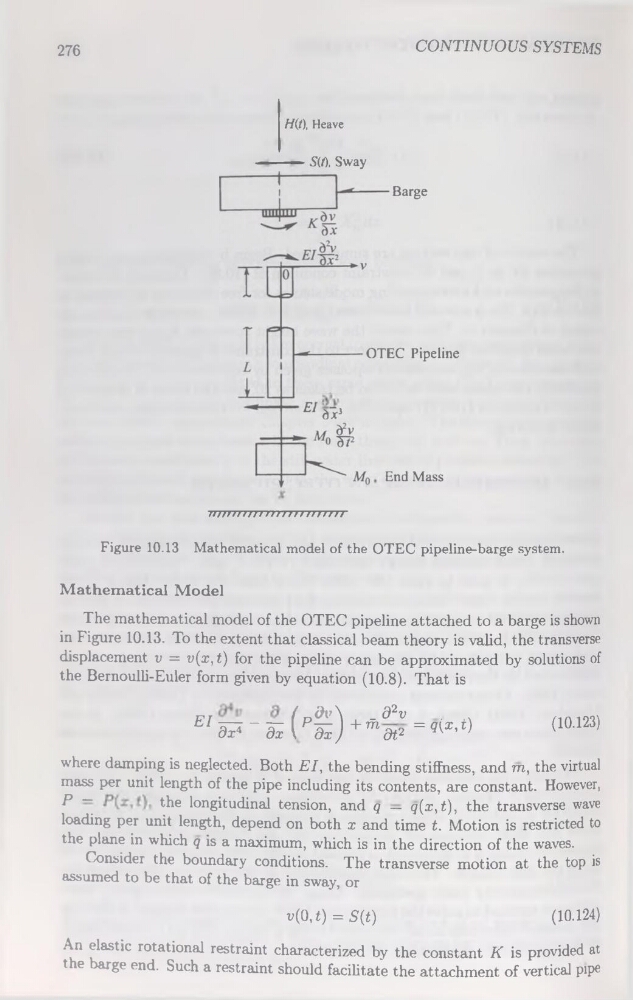
irrrrrrrrrrrrrrrrrrnTTnFigure 10.13 Mathematical model of the OTEC pipeline-barge System.
Mathematical Model
The mathematical model of the OTEC pipeline attached to a barge is shown
in Figure 10.13. To the extent that classical beam theory is valid, the transverse
displacement v = v(x,t) for the pipeline can be approximated by solutions of
the Bernoulli-Euler form given by équation (10.8). That is
EI—- — (p^\
dx4
dx \ dx J
_ d2v
.
+ mQ{2 =9^,0
(10.123)
where damping is neglected. Both El, the bending stiffness, and m, the virtual
mass per unit length of the pipe including its contents, are constant. However,
? ~
the longitudinal tension, and q — q(x,t), the transverse wave
loading per unit length, dépend on both x and time t. Motion is restricted to
the plane in which g is a maximum, which is in the direction of the waves.
Consider the boundary conditions. The transverse motion at the top is
assumed to be that of the barge in sway, or
v(0,t) =S(t)
(10.124)
An elastic rotational restraint characterized by the constant K is provided at
the barge end. Such a restraint should facilitate the attachment of vertical pipe
CONTINUOUS SYSTEMS
S(f), Sway
H(f), Heave
irrrrrrrrrrrrrrrrrrnTTnFigure 10.13 Mathematical model of the OTEC pipeline-barge System.
Mathematical Model
The mathematical model of the OTEC pipeline attached to a barge is shown
in Figure 10.13. To the extent that classical beam theory is valid, the transverse
displacement v = v(x,t) for the pipeline can be approximated by solutions of
the Bernoulli-Euler form given by équation (10.8). That is
EI—- — (p^\
dx4
dx \ dx J
_ d2v
.
+ mQ{2 =9^,0
(10.123)
where damping is neglected. Both El, the bending stiffness, and m, the virtual
mass per unit length of the pipe including its contents, are constant. However,
? ~
the longitudinal tension, and q — q(x,t), the transverse wave
loading per unit length, dépend on both x and time t. Motion is restricted to
the plane in which g is a maximum, which is in the direction of the waves.
Consider the boundary conditions. The transverse motion at the top is
assumed to be that of the barge in sway, or
v(0,t) =S(t)
(10.124)
An elastic rotational restraint characterized by the constant K is provided at
the barge end. Such a restraint should facilitate the attachment of vertical pipe