

270
CONTINUOUS SYSTEMS
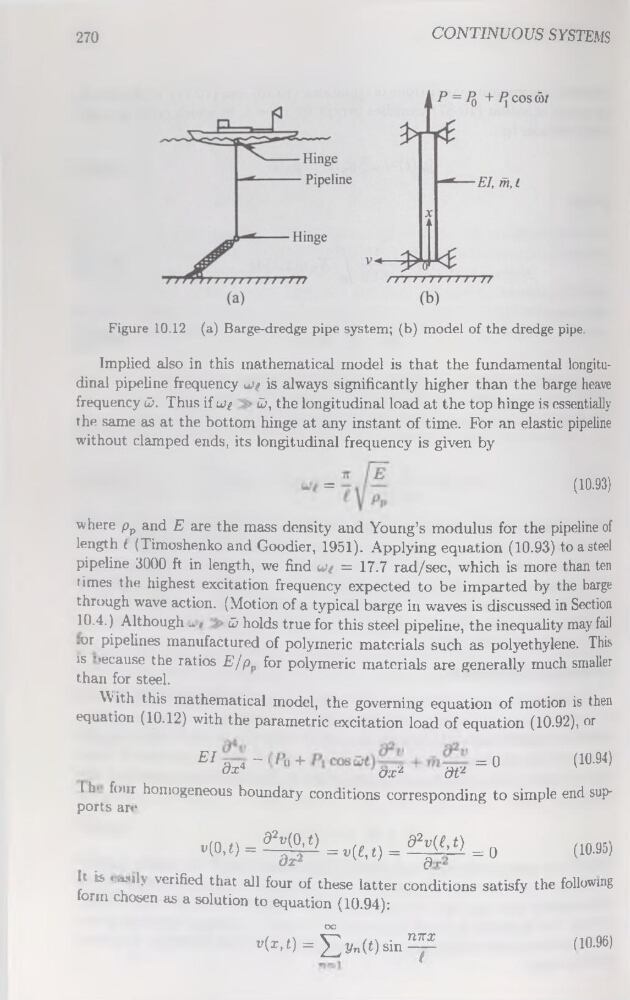
Figure 10.12 (a) Barge-dredge pipe System; (b) model of the dredge pipe.
Implied also in this mathematical model is that the fundamental longitudinal pipeline frequency m/ is always significantly higher than the barge heave
frequency ü>. Thus if ivg
à;, the longitudinal load at the top hinge is essentially
the same as at the bottom hinge at any instant of time. For an elastic pipeline
without clamped ends, its longitudinal frequency is given by
=
(10-93)
where pp and E are the mass density and Young’s modulus for the pipeline of
length t (Timoshenko and Goodier, 1951). Applying équation (10.93) to a Steel
pipeline 3000 ft in length, we find u>f = 17.7 rad/sec, which is more than ten
times the highest excitation frequency expected to be imparted by the barge
through wrave action. (Motion of a typical barge in waves is discussed in Section
10.4.) Although .. /
ü holds true for this Steel pipeline, the inequality may fail
.or pipelines manufactured of polymeric materials such as polyethylene. This
is ’>ecause the ratios E/pp for polymeric materials are generally much smaller
than for Steel.
With this mathematical model, the governing équation of motion is then
équation (10.12) with the parametric excitation load of équation (10.92), or
EI dx4 ~ '/>n +
= 0
(10-94)
ox
ox4
dtz
I L* four homogeneous boundary conditions corresponding to simple end supports are
„(0,t) = É^=^,f) = ^O=0
(«>•»)
It is «-.vsily verified that ail four of these latter conditions satisfy the following
fonn chosen as a solution to équation (10.94):
v(z>t) = f MO sin 2^
;1M6!
CONTINUOUS SYSTEMS
Figure 10.12 (a) Barge-dredge pipe System; (b) model of the dredge pipe.
Implied also in this mathematical model is that the fundamental longitudinal pipeline frequency m/ is always significantly higher than the barge heave
frequency ü>. Thus if ivg
à;, the longitudinal load at the top hinge is essentially
the same as at the bottom hinge at any instant of time. For an elastic pipeline
without clamped ends, its longitudinal frequency is given by
=
(10-93)
where pp and E are the mass density and Young’s modulus for the pipeline of
length t (Timoshenko and Goodier, 1951). Applying équation (10.93) to a Steel
pipeline 3000 ft in length, we find u>f = 17.7 rad/sec, which is more than ten
times the highest excitation frequency expected to be imparted by the barge
through wrave action. (Motion of a typical barge in waves is discussed in Section
10.4.) Although .. /
ü holds true for this Steel pipeline, the inequality may fail
.or pipelines manufactured of polymeric materials such as polyethylene. This
is ’>ecause the ratios E/pp for polymeric materials are generally much smaller
than for Steel.
With this mathematical model, the governing équation of motion is then
équation (10.12) with the parametric excitation load of équation (10.92), or
EI dx4 ~ '/>n +
= 0
(10-94)
ox
ox4
dtz
I L* four homogeneous boundary conditions corresponding to simple end supports are
„(0,t) = É^=^,f) = ^O=0
(«>•»)
It is «-.vsily verified that ail four of these latter conditions satisfy the following
fonn chosen as a solution to équation (10.94):
v(z>t) = f MO sin 2^
;1M6!