

CONTINUOUS SYSTEMS
249
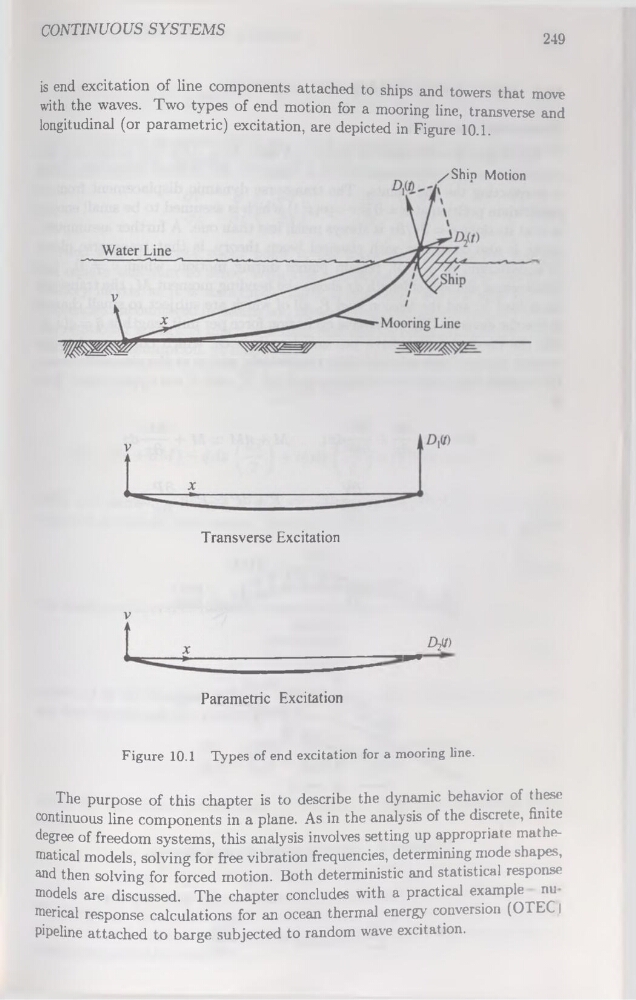
is end excitation of line components attached to ships and towers that move
with the waves. Two types of end motion for a mooring line, transverse and
longitudinal (or parametric) excitation, are depicted in Figure 10.1.
/Shin Motion
Transverse Excitation
Parametric Excitation
Figure 10.1 Types of end excitation for a mooring line.
The purpose of this chapter is to describe the dynamic behavior of these
continuons line components in a plane. As in the analysis of the discrète, finite
degree of freedom Systems, this analysis involves setting up appropriate mathematical models, solving for free vibration frequencies, determining mode shapes,
and then solving for forced motion. Both deterministic and statistical response
models are discussed. The chapter concludes with a practical example nu
merical response calculations for an océan thermal energy conversion (OTEC I
pipeline attached to barge subjected to random wave excitation.
249
is end excitation of line components attached to ships and towers that move
with the waves. Two types of end motion for a mooring line, transverse and
longitudinal (or parametric) excitation, are depicted in Figure 10.1.
/Shin Motion
Transverse Excitation
Parametric Excitation
Figure 10.1 Types of end excitation for a mooring line.
The purpose of this chapter is to describe the dynamic behavior of these
continuons line components in a plane. As in the analysis of the discrète, finite
degree of freedom Systems, this analysis involves setting up appropriate mathematical models, solving for free vibration frequencies, determining mode shapes,
and then solving for forced motion. Both deterministic and statistical response
models are discussed. The chapter concludes with a practical example nu
merical response calculations for an océan thermal energy conversion (OTEC I
pipeline attached to barge subjected to random wave excitation.